Municipal rescue officers retrieve the body of a massive six-meter python from a water source in Banglamung after the animal fled into the area and was later found dead.
PATTAYA, Thailand — A giant python measuring around six meters in length was found dead after fleeing rescue officers and submerging itself in a body of water near a residential area in east Pattaya.
The Banglamung Municipality Disaster Prevention and Mitigation Radio Center received a report from residents that a large python had slithered into a house adjacent to an industrial cleaning machinery factory in Soi Banglamung 1. Rescue personnel were immediately dispatched to investigate.
Upon arrival, residents told officers that the python had escaped into a nearby water source next to the factory. After searching for more than 10 minutes, officers located the snake, described as extremely thick-bodied — about the size of a human thigh — and approximately six meters long. The python was found entangled around a tree, with its head submerged in the water.
As officers prepared to capture the animal, they discovered it was motionless and had already died. The rescue team then recovered the carcass from the water.
Jeerasak Nuchlek, an officer from the Banglamung Municipality Disaster Prevention and Mitigation Department, said the team responded quickly after receiving the report from residents. However, by the time they arrived, the python had already fled into the water, become trapped around the tree, and drowned.
"It is unfortunate that we were unable to safely capture and release the snake back into its natural habitat," he said, noting the unusually large size of the python. Authorities said the carcass would be buried in accordance with standard procedures.
Large pythons are occasionally spotted in residential areas of Banglamung, particularly near water sources and undeveloped land, as urban expansion continues to encroach on natural habitats.
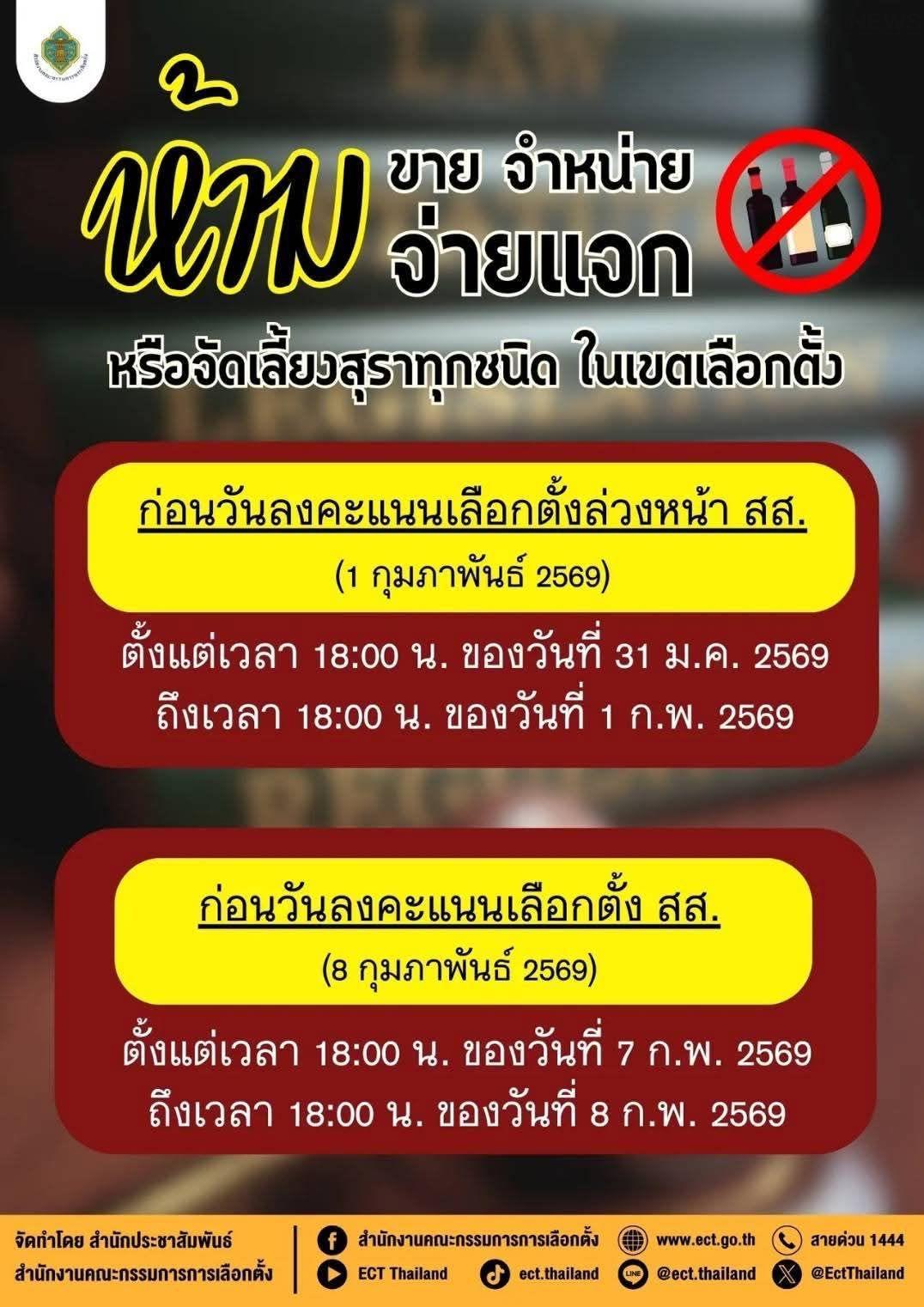
Thailand's Election Commission (EC) has reminded the public of strict alcohol sale and service prohibitions during the upcoming 2026 general election periods, in accordance with national election laws designed to maintain order and fairness at polling stations nationwide.
The bans apply across the entire country, covering all election districts, and does not allow any exceptions even to entertainment or tourism zones unlike a recent test for religious holidays. It is prohibited to sell, distribute, provide, or serve any type of alcoholic beverages during the specified times. Violations are punishable under the law, with potential penalties including imprisonment, fines, or both. It applies to both Thai nationals and foreigners, including tourists.
The restrictions are in place for two key voting periods:
Advance Voting Day – Sunday, February 1st, 2026 (advance polling for eligible registered voters) – The alcohol ban runs from 6:00 p.m. on Saturday, January 31, 2026, until 6:00 p.m. on Sunday, February 1, 2026.
Election Day – Sunday, February 8th, 2026 (main general election day for House of Representatives members, held concurrently with a constitutional referendum) – The alcohol ban runs from 6:00 p.m. on Saturday, February 7, 2026, until 6:00 p.m. on Sunday, February 8, 2026.
These measures align with longstanding Thai electoral regulations aimed at preventing any influence or disruption during voting. The EC has discussed compliance for all businesses, including bars, restaurants, convenience stores, and retail outlets. This essentially means that especially for many bars and entertainment venues they will be shut doing this period. Restaurants and venues like sports bars can open but cannot serve alcohol.
The upcoming snap election follows the dissolution of the House of Representatives in December 2025, with polling stations set to open from 8:00 a.m. to 5:00 p.m. on the respective days. Authorities urge voters and operators to plan accordingly and adhere to the rules to avoid legal consequences.
The alcohol prohibition on election days has drawn criticism from some quarters, particularly within the tourism and hospitality sectors. Critics argue that the blanket ban unfairly impacts foreign visitors, who are not eligible to vote, and disrupts nightlife and leisure activities in popular tourist destinations during what could otherwise be busy weekend periods.
This has fueled debates about balancing democratic integrity with the economic importance of tourism, especially amid recent government efforts to relax other alcohol restrictions to attract more international visitors on religious holidays.
However, the Election Commission has stressed that while it understands the potential effects on tourism and businesses, the laws must be followed strictly and without exception to ensure a fair and orderly electoral process. Authorities urge voters and operators to plan accordingly and adhere to the rules to avoid legal consequences.
CCTV footage shows a motorcycle rider approaching a woman in the Jomtien Second Road area before fleeing moments later, as residents urge police to step up patrols and track down the suspect amid growing safety concerns.
PATTAYA, Thailand – Concerns over public safety are growing among residents and tourists in Pattaya following a series of reported incidents in which a man on a motorcycle allegedly targeted women in public areas, Jan 27.
In the latest case, CCTV footage captured a suspect riding a motorcycle alongside a woman in Jomtien Second Road area before committing a brief sexual assault and fleeing the scene. The incident occurred in a busy area with regular pedestrian and vehicle traffic.
The victim, a 35-year-old woman who requested anonymity, told reporters that the incident happened on the morning of Jan. 23 as she was on her way to work near Pattaya Beach. She said she had lived in Pattaya for more than two years and had never previously experienced anything similar.
According to CCTV footage reviewed by authorities, the suspect was riding a grey scooter believed to be a Honda PCX, wearing dark clothing and a full-face helmet. The motorcycle's registration number was not visible. After approaching the victim, the suspect quickly fled the area.
The woman said she was shocked by the incident and sought immediate help at a nearby business. She later decided to release the CCTV footage publicly to warn other women, particularly those who travel alone, stressing that such incidents can happen regardless of clothing or location. She also expressed fear that the suspect remains at large and said she plans to formally file a police complaint.
Residents and visitors express growing fear over public safety in Pattaya, as reports of repeated motorcycle assaults on women prompt calls for stronger police action and increased patrols.
The victim and other residents have noted similarities between this case and earlier reports involving a motorcyclist who allegedly harassed women in other parts of Pattaya, including Pratumnak Hill. Some women in the area have also reported increasingly aggressive behavior, including suspects allegedly following victims after the initial encounter.
Residents are now urging police to review surveillance footage along possible escape routes and increase patrols in quieter streets and alleys to prevent further incidents and restore public confidence in safety.
Following the incident, Pattaya Mayor Poramet Ngampichet has instructed police to urgently track down and arrest the suspect as quickly as possible. City officials have been directed to increase vigilance and coordinate closely with law enforcement to protect residents and visitors.
Residents welcomed the mayor's response, expressing hope that firm and serious enforcement will help deter future crimes and restore confidence in public safety. Many said decisive action would not only reassure tourists but also give local families greater peace of mind, while sending a clear warning to offenders that such behavior will not be tolerated in Pattaya.
The Ministry of Public Health on Sunday began screening air passengers arriving from India for possible Nipah virus (NiV) infection, following reports of cases in West Bengal.
.
Screening is being carried out at Suvarnabhumi and Don Mueang airports, focusing on travellers arriving from West Bengal. Authorities said passengers and relevant agencies have been cooperative.
📍 Thailand's Department of Disease Control continues to closely monitor the Nipah virus situation.
👉 Thailand currently has no reported cases of Nipah virus infection.
🛡️ Simple preventive measures—such as regular handwashing and avoiding fruit with bite marks—remain essential.
👩🏻⚕️ Stay informed, stay safe, and follow official public health guidance.
The Department of Disaster Prevention and Mitigation (DDPM) said on Monday that it will test Thailand's nationwide cell broadcast alert system on Tuesday afternoon via three mobile operators.
.
DDPM said the test alert will be sent at 2pm on Tuesday, January 20, 2026, to mobile phones nationwide through the cell broadcast systems of National Telecom (NT), True Corporation (TrueMove H and DTAC) and Advanced Info Service (AIS).
.
Full story link is in the first comment.
.
#ThailandNews #General #CellBroadcast
Rescue workers assist a man after he was injured by a venomous fish spine on Jomtien Beach late Friday nightbefore being taken to Pattaya City Hospital.
PATTAYA, Thailand – A man was injured after being pierced by a venomous fish spine on Jomtien Beach, prompting an emergency response late Saturday night, Jan 17.
Jomtien municipal officers said they received a report from concerned citizens who found a man lying on the sand near Jomtien Beach Soi 1. Officials rushed to the scene and found the man conscious but suffering severe pain after a fish spine became lodged in his left hand, causing numbness that spread to part of his body.
Rescue workers from the Sawang Boriboon were called in and transported the injured man to Pattaya City Hospital for further treatment. His condition was not immediately disclosed.
The incident sparked widespread discussion online, with many beachgoers and fishermen sharing personal experiences and warning of the intense pain caused by venomous marine animals, particularly during nighttime beach activities. Authorities have not confirmed the species involved but urged the public to exercise caution when walking or handling marine life along the shoreline.
A venomous fish spine is believed to have caused severe pain and numbness after piercing a man's hand on Jomtien Beach late Friday night.
The incident triggered widespread online discussion, with fishermen and beachgoers sharing warnings and first-hand experiences about venomous fish encounters along Pattaya's shoreline.
Med jämna mellanrum påstår någon i sociala medier att passpolisen "inte frågade efter mitt TDAC", som om det skulle betyda att man kan strunta i att göra en reseanmälan.
Gå inte på det.
Immigration behöver inte se din papperskopia för att veta om du har gjort en inreseanmälan eller inte. Uppgifterna finns redan i deras system.
Immigration är i dag fullt digitaliserade. De har en informationsfil om dig.
De vet exakt hur du rest in och ut ur landet, hur länge du stannat, vilka visum du haft, om du tidigare haft overstay och var du bor.
Om de anser att något ser misstänkt ut i en resenärs resehistorik blir denne förd åt sidan, förhörd och blir i värsta fall nekad inresa och deporterad. Det sker betydligt oftare idag sedan myndigheterna skärpte tillämpningen av regelverket förra året.
Den som överstannar kan bli upplockad av en immigrationspolis redan dag tre. Den som saknar utreseresebiljett inom 60 dagar kan bli nekad inresa.
Och skulle du inte ha fyllt i TDAC får du gå åt sidan och göra det. Att så många inte fyllt i reseanmälan är en anledning till att köerna på flygplatserna ofta är mycket långa.
Thailand's real estate market faces its toughest slowdown in nearly 30 years, with over 400,000 unsold condos. Rising interest rates and high debt are major factors holding back recovery.
While the mass market struggles, some high-end properties and regions like Phuket, Pattaya, and Sriracha are showing signs of life, driven by foreign investment and strong demand. The market is expected to remain challenging in the near term, with developers taking a cautious approach to new projects.
A devastating scene unfolds after a construction crane collapsed and crushed a passing passenger train in Nakhon Ratchasima, killing at least 32 people. The tragedy, one of two crane-related accidents in Thailand within 48 hours, has renewed concerns over construction safety and oversight.
BANGKOK, Thailand – Between 14 and 15 January 2026, Thailand experienced major losses from two serious crane-related accidents occurring within less than 48 hours. The first incident took place in Nakhon Ratchasima province, when a crane from a high-speed rail construction project collapsed onto a special passenger train that was passing through the area. The incident resulted in at least 32 fatalities and more than 60 injuries. Many of the victims were ordinary passengers with no connection to the construction site, yet they were exposed to life-threatening risks from activities that should have been subject to the highest levels of safety control.
Just one day later, a similar incident occurred on Rama 2 Road, where a crane and concrete beams from an elevated roadway construction project collapsed onto an active traffic lane. The collapse caused additional deaths and injuries. Images of concrete debris and steel structures crushing vehicles on one of the country's main highways became a stark reminder that construction-related risks in Thailand are not confined to workers within project sites, but extend directly to members of the public going about their daily lives.
These two incidents were not isolated events. Rather, they form part of a recurring pattern of accidents associated with large-scale construction projects in Thailand, particularly infrastructure projects involving public roads and transport systems. Rama 2 Road, in particular, has long been cited as a problem area, with repeated construction-related accidents over several years. These have included crane collapses, snapped slings, falling concrete beams, and structural components dropping onto vehicles and road users, resulting in multiple deaths and injuries throughout the prolonged construction period.
A closer examination of the two recent cases shows that Italian-Thai Development (ITD) was reported as the main contractor for both the Nakhon Ratchasima rail project and the Rama 2 elevated road works. This has raised concerns about how contractor accountability is addressed in Thailand, especially when large companies involved in national-level projects experience multiple serious accidents without clear consequences for their long-term business standing or future access to public contracts.
Under the current regulatory framework, contracting authorities are legally permitted to propose the blacklisting of contractors who fail to comply with contractual obligations. However, in practice, no contractor has yet been blacklisted specifically as a result of a serious construction accident causing loss of life. This gap has meant that enforcement remains largely reactive, focusing on responses after incidents occur rather than preventing risks at a systemic level.
Following the most recent tragedies, the Thai government has accelerated efforts to introduce a "Contractor Rating Book" system. This system is intended to track and score construction companies, particularly in relation to safety performance. Companies would face point deductions for negligence leading to accidents, and poor safety ratings could result in restrictions on their ability to bid for future government projects. The initiative reflects an attempt to shift procurement practices away from a primary focus on price and technical capacity toward a broader assessment that includes long-term risk management and safety responsibility.
Comparable systems have been in place in other countries for many years. In the United States, the Occupational Safety and Health Administration (OSHA) has the authority to investigate crane accidents and impose penalties on contractors. In one example from New York City, OSHA fined a contractor more than USD 155,000 for violations of safety regulations following a crane collapse. Beyond financial penalties, safety violations are recorded as part of a company's safety profile, which can directly affect its eligibility for future projects and its reputation within the procurement system.
In the United Kingdom and across much of Europe, the Health and Safety Executive (HSE) enforces strict safety standards for the installation and operation of cranes. Companies that fail to comply may face severe civil and criminal penalties, as well as mandatory compliance with standards such as BS EN 14439. Requirements typically include pre-work inspections, site-specific risk management plans, and continuous reporting and monitoring throughout the construction process.
International experience demonstrates that construction safety is treated not as an optional cost, but as a core component of corporate capability and credibility. Rating systems and strong legal enforcement ensure that a single accident does not end with compensation alone, but has lasting implications for a company's future operations.
The crane collapses in Nakhon Ratchasima and on Rama 2 Road therefore serve not only as individual tragedies, but as a warning that Thailand's construction safety framework still contains significant gaps in oversight, risk assessment, and contractor accountability. Strengthening legal enforcement and implementing an effective Contractor Rating system may represent an important first step toward reducing accumulated risks and preventing similar losses from recurring in the future.
A Pattaya robbery targeting a Chinese property agent exposes the risks of Thailand's largely informal, unregulated real estate brokerage sector, especially within expatriate networks.
Risks in Thailand's unregulated real estate market PATTAYA, Thailand – For years, Thailand's real estate market has been described often half-jokingly as the Wild West. Deals are discussed in cafés, commissions are agreed verbally, and trust frequently substitutes for formal structure. Most of the time, the system works. Sometimes it fails quietly. And occasionally, it fails violently.
The recent Pattaya incident in which a Chinese real estate agent was lured to view a property, restrained, and robbed by suspects posing as same-nationality clients is one such moment. It is tempting to see this as an isolated crime. That would be a mistake. What the case exposes is not merely a security lapse, but a deeper structural vulnerability in Thailand's largely unregulated property brokerage sector particularly where expatriate agents operate within informal, nationality-based networks
A market built on informality Unlike many developed jurisdictions, Thailand has no mandatory nationwide licensing regime for real estate agents. There is no compulsory examination, no central register of licensed brokers, and no enforceable professional code comparable to those in the US, Europe, or Australia. In practice, anyone with listings, language skills, and connections can call themselves an agent.
This informality has long been tolerated arguably enabled by a tourism-driven economy and strong foreign demand. In cities such as Pattaya, Phuket, Chiang Mai, and Koh Samui, parallel ecosystems of independent agents, introducers, and nationality-specific brokers have emerged, operating in legal grey zones. Most transactions pass without incident. But the absence of structure comes at a cost.
The same nationality trust trap A defining feature of Thailand's foreign-driven property market is that agents often sell to buyers from their own country: Chinese to Chinese, Russians to Russians, Europeans to Europeans. On the surface, this makes sense. Shared language, culture, and expectations streamline transactions and create instant trust. Formalities are reduced. Questions go unasked. Yet this familiarity creates what might be called the same-nationality trust trap. When both parties assume safety based on shared nationality, due diligence weakens.
Meetings are arranged via messaging apps, property viewings are conducted alone, and basic verification steps are skipped sometimes out of convenience, sometimes out of perceived politeness. The Pattaya case illustrates the danger of this assumption. The agent was targeted not despite her profession, but because of it. Her role, access to properties, and perceived financial standing made her vulnerable.
Agents without a safety net In regulated markets, agents typically work under licensed firms, with insurance coverage, standard protocols, and clear accountability. In Thailand's informal ecosystem, many agents operate alone without institutional backing, professional insurance, or even legal clarity regarding their work status. For expatriates, the situation is more complex. Under Thai law, foreigners are generally prohibited from working as property agents unless operating through compliant legal structures with valid work permits.
This creates a quiet contradiction: expatriate agents are widespread in practice, yet their role is only partially acknowledged in law. The result is a class of intermediaries exposed to commercial and personal risk, but largely unprotected when problems arise. When disputes or crimes occur, there is often no professional body to intervene, no regulator to complain to, and no employer to absorb the impact.
Crime as a symptom, not the cause It is easy to frame such incidents as criminality, nationality issues, or law-enforcement failures. But that explanation is incomplete. The deeper issue is systemic risk exposure. Informality lowers barriers to entry, but it also removes safety nets. The lack of regulation reduces friction for legitimate operators and equally for those seeking to exploit the system. In unregulated markets, everyone manages risk individually. Some do so effectively. Others miscalculate.
An inevitable reckoning Thailand is not alone in facing these challenges, but it is increasingly out of step with global norms. As other countries tighten licensing, consumer protection, and professional accountability, Thailand's laissez-faire approach appears less sustainable. As the country moves toward stricter immigration enforcement, digital monitoring, and tax transparency, it is only a matter of time before scrutiny extends to real estate brokerage particularly where foreign nationals, large sums of money, and social sensitivity intersect. When that moment arrives, the informal era will not end gently.
A quiet warning The Pattaya incident should not be seen as a warning only to buyers, nor as an indictment of expatriate agents as a group. It is a reminder that in systems built on trust without structure, risk does not discriminate. Sometimes, the intermediaries themselves become the targets. And when that happens, it is no longer just a crime story it is a signal that Thailand's property market may be approaching the limits of informality.
As Thailand enters 2026, expat tax worries persist, but despite greater transparency under CRS, the fundamentals of Thai personal income tax remain largely unchanged.
Why greater transparency does not mean greater taxation PATTAYA, Thailand – As Thailand moves further into 2026, few topics have generated more discussion among the expatriate community than taxation particularly the interaction between the Common Reporting Standard (CRS) and the revised treatment of foreign funds brought into the country. Much of this discussion, however, has been driven more by anxiety than by law. A closer look suggests that while the visibility of financial information has undeniably increased, the core principles of Thai personal income tax have not fundamentally changed.
Transparency has increased not the tax base Thailand's participation in CRS places it firmly within a global framework of automatic financial information exchange. In practical terms, this means that Thai tax authorities can now receive information relating to offshore bank accounts, interest income and certain investment returns held by Thai tax residents. What CRS does not do is redefine what constitutes taxable income. Under Thai law, tax is imposed on income, not on capital. The mere act of transferring money into Thailand does not, by itself, create a tax liability. The determining factor remains the nature of the funds, not their movement. Savings accumulated in prior years, capital that has already been taxed abroad, inheritances and other non-income receipts do not automatically become taxable simply because they are remitted to Thailand.
The remittance rule in context Recent changes to the treatment of foreign-sourced income have led to widespread misunderstanding. For Thai tax residents generally those spending more than 180 days in the country foreign income brought into Thailand may be subject to tax regardless of when that income was earned. This rule, however, applies only to income, as defined under the Revenue Code. It does not convert every inbound transfer into taxable income. The practical consequence is not an expanded tax net, but an increased expectation that taxpayers are able to identify and explain the character of the funds they remit.
CRS as a compliance tool, not a collection mechanism CRS is often described as a "tax collection system". This is inaccurate. It is more accurately described as a compliance and verification framework. The existence of offshore accounts or foreign investment income does not, in itself, trigger tax. What CRS changes is the assumption that such information is beyond the reach of tax authorities. In this environment, documentation and consistency matter. Tax positions that are supportable, documented and aligned with existing law remain defensible.
Foreign tax paid and double tax agreements Thailand continues to honour its extensive network of Double Taxation Agreements (DTAs). Income that has been taxed abroad may, depending on the treaty and the circumstances, be exempt in Thailand or eligible for foreign tax credits. The challenge for many expatriates is not the absence of legal protection, but the practical management of proof ensuring that foreign tax payments, income classifications and timing are clearly evidenced. This is an administrative issue, not a substantive change in tax rights.
LTR visas and policy alignment It is also worth noting that Thailand has chosen not to apply these principles uniformly across all visa categories. Holders of Long-Term Resident (LTR) visas continue to benefit from exemptions for foreign-sourced income remitted into Thailand, reflecting a deliberate policy choice rather than a loophole.
What has actually changed in 2026 Stripped of speculation, the changes facing expatriates can be summarised simply, financial information is more visible, The burden of explanation rests more squarely with the taxpayer, Informal or poorly documented arrangements are less comfortable than before. None of these amounts to a departure from established tax law. They reflect, instead, a shift towards administrative clarity and international alignment.
A year for order, not alarm 2026 is not the year in which Thailand decided to tax expatriates more aggressively. It is the year in which uncertainty and ambiguity became less sustainable. For those whose finances are properly structured and documented, little has changed in substance. For others, the message is not one of panic, but of preparation.
Transparency, after all, does not create tax it merely reveals whether it was ever due in the first place.
As the country's shift toward Digital ID and paperless immigration reshapes border procedures and fuels growing unease among long-term expatriates about how the rules of living in Thailand may be changing permanently.
PATTAYA, Thailand – At the start of 2026, the tone of conversation within Thailand's expatriate community has changed. This is no longer about exchange rates, visa renewals, or seasonal political noise. What is emerging instead is a deeper, structural unease a sense that the rules of living in Thailand may be changing permanently. On paper, Thailand's shift toward Digital ID and paperless immigration makes perfect sense. Faster processing, fewer queues, greater efficiency. Yet for many long term foreign residents, especially those with international income or multi-country obligations, the move raises questions that convenience alone does not answer.
A European expatriate recently wrote to me after reading about the disappearance of physical passport stamps. His observation was blunt but telling: "Electricity failure and everything comes to a halt. But a paper passport and a simple stamp will still do the job." It is an unfashionable point, perhaps, but a legally significant one. Thailand, after all, is not the whole world. Expatriates remain accountable to tax authorities, pension agencies, healthcare systems, and residency regulators in their home countries. These institutions often ask a very traditional question: can you prove where you were and when?
For decades, the answer was clear. A passport stamp was tangible, visual, and universally understood. Digital records, by contrast, are not always portable across borders. A Thai immigration database may be authoritative domestically, but will a foreign tax office accept it as proof? Will it be accessible, certified, or independently verifiable? These are not abstract concerns. They affect real people trying to remain compliant.
Running alongside this issue is a quieter anxiety about tax visibility. Among expatriates, particularly those who work remotely or receive income from abroad, the familiar 180-day residency rule now feels different. When entry and exit records become seamless, automated, and potentially linked across government agencies, time itself becomes a data point rather than a personal calculation. The concern is not about avoiding tax obligations.
It is about predictability. Transparency is welcome, but only when it comes with clarity about how that transparency is used. There is also the uncomfortable reality that digital systems fail. Power outages happen. Networks go down. Cloud services stall. In legal terms, this is a question of resilience. Paper continues to function when technology does not. Removing physical proof without offering an equally robust alternative introduces a new layer of fragility into everyday life.
Beyond the digital debate lies a more human pressure: affordability. Thailand has long attracted not only the wealthy, but the comfortable retirees on fixed pensions, professionals living between contracts, families drawn by lifestyle rather than accumulation. Increasingly, that middle ground feels squeezed. As global capital displaced by conflict and instability flows into Thai property markets, rents rise faster than incomes. Familiar expatriate neighbourhoods quietly price out the very communities that helped sustain them. This is not resentment toward newcomers. It is anxiety about displacement.
When financial thresholds, residency criteria, and housing costs all move upward together, the message received by many long-term expatriates is subtle but clear: the country they chose may no longer be designed with them in mind. The most important question raised by these discussions is also the simplest. If passport stamps disappear, what replaces them? Can expatriates still request physical confirmation of entry and exit? If not, will there be a certified, printable, internationally recognised record that functions across borders and systems? This is not resistance to progress. It is a request for legal certainty.
Digitalisation is not the problem. Transparency is not the enemy. But when efficiency removes proof, and visibility removes flexibility, trust begins to erode. For many expatriates, the humble passport stamp was never about nostalgia. It was about certainty something law, tax, and life planning still depend on.
And until digital systems can offer that same certainty, one question remains open: is progress truly progress if it leaves people legally exposed?
In 2026, Thailand will go fully digital on immigration, ending passport stamps and reshaping how foreign residents are monitored—an upgrade that brings both reassurance and unease for expats.
PATTAYA, Thailand – In 2026, Thailand is expected to complete one of the most significant transformations in its immigration system, the abolition of passport stamping and the full adoption of a 100% digital immigration platform. This change is not merely an administrative upgrade. It represents a fundamental shift in how the Thai state monitors, manages, and regulates foreign residents, and it will inevitably become part of Thailand's new normal. For the expat community, the implications are both reassuring and unsettling.
The end of "counting the days yourself" For decades, expats have relied on a simple habit, opening their passport and checking the inked stamp to confirm how long they were allowed to remain in the Kingdom. That small rectangle of ink offered both clarity and, occasionally, plausible deniability. Under a fully digital system, that era ends. From 2026 onward, permitted stay will be calculated automatically through a centralized immigration database. Every entry, extension, and departure will be time stamped digitally. Even a brief overstay measured in minutes rather than days will be recorded instantly and flagged to the relevant authorities. Excuses such as "I misread the stamp" or "the handwriting was unclear" will no longer exist. The cloud, not the passport, will be the final arbiter.
Proving legal status without a stamp While immigration officers may adapt quickly, a more immediate challenge lies elsewhere. Expats in Thailand routinely present passport pages with entry stamps to banks, condominium offices, car leasing companies, and driving licence authorities. In a stamp-free environment, these institutions will need to rely on digital residence certificates or QR-based verification issued by Immigration. The concern is not technological capability, but institutional readiness. If banks or local offices continue to insist on physical stamps that no longer exist, expats may find themselves trapped in a bureaucratic grey zone during the transition period legally present, yet unable to prove it to third parties.
Border runs under algorithmic scrutiny Digital immigration also brings something far more consequential, behavioral analysis powered by artificial intelligence. Entry and exit records will no longer be viewed in isolation. Instead, AI systems will analyze travel patterns to identify individuals who repeatedly use visa exemptions or tourist visas to remain in Thailand long term. Those who rely on frequent border runs may find that the decision to deny entry is made before the aircraft even departs, through advanced passenger screening systems. The informal, grey-area lifestyles that once existed between regulatory cracks will become increasingly difficult to sustain. In practical terms, the system nudges expats toward appropriate long-term visas such as LTR or DTV, and away from improvisation.
Data, privacy, and unease A fully digital system requires more than travel dates. It depends on biometric identifiers facial recognition, fingerprints, and possibly iris scans. For expats from jurisdictions with strong privacy protections, this raises understandable concerns. Questions about data storage, cybersecurity, surveillance, and potential data breaches will not disappear simply because the system is efficient. Convenience and speed come at the price of expanded state visibility.
The invisible stamp The disappearance of the physical stamp is more than symbolic. It marks the end of a loosely regulated era and the beginning of one defined by precision, automation, and accountability. For law abiding expats with properly structured visas, the benefits are clear, shorter queues, fewer extensions, and no more passports filled with ink. For those who have relied on ambiguity and legal loopholes, however, the message is unmistakable.
The invisible stamp remembers everything Thailand's digital immigration system does not merely modernize border control it reshapes what it means to live in the Kingdom as a foreigner. The question for expats in 2026 is no longer whether the system is ready.
Global uncertainty in 2026 is forcing expatriates in Thailand to rethink finances, visas and long-term plans as world events increasingly shape daily life.
PATTAYA, Thailand – The opening months of 2026 have brought a level of global uncertainty rarely seen in recent years. Escalating geopolitical tensions, volatile currency movements and tightening immigration enforcement are reshaping the international landscape. For expatriates living in Thailand, these developments are no longer distant headlines. They are increasingly shaping everyday decisions from household budgets to visa planning and long-term residency choices. A review of recent discussions across expat communities, online forums and international news coverage points to a clear conclusion, 2026 is not a year for passive living abroad. It is a year that demands foresight and planning. Four key issues now dominate the concerns of expatriates in Thailand.
The strong baht squeeze For many expats, particularly retirees and remote professionals earning in US dollars or euros, currency movements have become the most immediate pressure point. The Thai baht has strengthened significantly, trading in the range of 31.20–31.80 baht to the US dollar, its strongest level in several years. In practical terms, this has reduced foreign-currency purchasing power by an estimated 10–15% compared with last year, without any change in lifestyle or spending habits. At the same time, Thailand's cost structure has shifted quietly but steadily. Rental prices in Bangkok, Phuket and other popular expat centres continue to rise, while food, healthcare and everyday services are no longer perceived as inexpensive merely cheaper than in Western countries, and in some cases not by a wide margin. It is now increasingly common to hear a phrase once rare in expat circles: "Thailand isn't cheap anymore." This reality is prompting many long-term residents to reassess how income, savings and overseas transfers are structured, particularly among those relying on fixed pensions or stable foreign income streams.
Immigration tightening the end of the grey zone Early 2026 has also marked a noticeable shift in immigration enforcement. Reports from expat communities suggest increased scrutiny at airports and land borders, particularly for individuals relying on repeated visa exemptions, frequent border runs or loosely defined "temporary" stays that have quietly evolved into long-term residence. Thailand's message is becoming clearer, Long-term residence now requires long-term compliance. Digital nomads, semi-retirees and freelancers without properly structured visa arrangements are reporting growing uncertainty. Long-term visa options such as the LTR visa, destination-based work visas and correctly structured extensions are no longer viewed as optional conveniences, but increasingly as necessities. The era of living indefinitely in Thailand through improvisation and informal arrangements appears to be drawing to a close.
Global conflict, local consequences Geopolitical developments have added another layer of concern for expatriates. Tensions involving the United States, Venezuela and Russia may seem geographically distant, but expats are acutely aware of the downstream effects. Energy markets, global supply chains, airline pricing and international financial systems remain closely interconnected. Even as fuel prices in Thailand remain relatively stable for now, many expatriates are asking forward looking questions, Will international travel become more expensive? Could supply disruptions raise everyday living costs? How exposed is Thailand to broader geopolitical realignments? Underlying these concerns is a deeper question of long-term stability and whether Thailand can continue to offer it in an increasingly polarised global environment.
A changing social climate Beyond economics and visas, a more subtle shift is being observed on the ground. In high tourism areas, local frustration over congestion, rising prices and disruptive visitor behaviour has become more visible. Long-term expatriates report a growing sense that maintaining goodwill now requires greater awareness, respect and integration into local communities. Thailand remains broadly welcoming, but expectations placed on foreign residents are evolving.
Why 2026 is a turning point for expats Taken together, these developments point to a new reality for expatriates living in Thailand, Currency risk can no longer be ignored, Informal visa strategies carry increasing risk, Global instability now affects daily life more directly, Longterm residence requires proactive planning. For those intending to remain in Thailand whether for retirement, business or lifestyle reasons 2026 is a year to reassess structures, not merely monthly expenses.
That reassessment increasingly includes, Reviewing how income is sourced, transferred and taxed, Ensuring visa status accurately reflects actual living patterns, Aligning financial decisions with long-term residency goals. Experience suggests that those who adapt early are better positioned to preserve both stability and peace of mind.
Final thought Thailand remains an exceptional place to live. However, the conditions that once made expatriate life here effortless are changing. The expats most likely to thrive in the years ahead will be those who recognize that living abroad today requires the same level of foresight as managing a business or an investment portfolio.
In uncertain times, informed decisions are no longer a luxury they are a necessity.
Thailand's annual "Seven Dangerous Days" have again brought a grim toll. In just one day, authorities recorded 187 road accidents, 185 injuries, and 21 deaths—statistics that for lawyers translate into court cases, compensation claims, and families facing sudden tragedy.
BANGKOK, Thailand – Every year, Thailand enters what is officially known as the "Seven Dangerous Days." As a lawyer practicing in Pattaya, I have learned to hear that phrase with a sense of quiet unease not because it is inaccurate, but because of how easily it is accepted. After four days of this year's holiday period, the figures tell a familiar story. In a single day, authorities recorded 187 road accidents, 185 injuries, and 21 fatalities. These are not abstract numbers to those of us who work in law. Behind them are insurance disputes, criminal proceedings, compensation claims, and families suddenly forced to navigate a legal system at the worst moment of their lives.
The causes are well known. Speeding accounts for more than a third of accidents. Drink-driving follows closely, despite repeated warnings that penalties are severe and insurance coverage may be voided. Abrupt lane cutting often dismissed as routine impatience ranks alarmingly high. From a legal perspective, none of this is ambiguous. The risks are established, the laws are clear, and the consequences are foreseeable.
Motorcycles remain the most exposed, involved in nearly three-quarters of all accidents. This is not merely a matter of personal choice; it reflects economic reality. Motorcycles are the primary means of transport for millions, yet they offer the least protection and, in many cases, the weakest insurance coverage. When accidents occur, the legal and financial fallout often extends far beyond the rider alone.
Geographically, the pattern is equally predictable. Prachin Buri and Phatthalung recorded the highest number of accidents, with Phatthalung also leading in injuries. Bueng Kan saw the highest number of fatalities. These outcomes are shaped by road design, enforcement capacity, and travel density factors that are structural, not accidental.
From my professional experience, enforcement alone is not the problem. Police checkpoints, breath tests, and speed controls are necessary, and they do save lives. But they are reactive tools, deployed during holidays and then quietly scaled back. The deeper issue is that Thailand continues to treat road safety as a seasonal concern rather than a permanent policy priority.
The phrase "Seven Dangerous Days" itself reveals the problem. It frames mass casualties as something to be managed rather than prevented. In legal terms, when harm is foreseeable and repeated, it ceases to be an accident and becomes a systemic failure. What is missing is accountability beyond the driver. Road design standards, vehicle safety regulation, insurance enforcement, and consistent year-round policing all play a role. Yet public discussion rarely moves beyond individual blame, even though the data shows the same patterns year after year.
As a lawyer, I see the aftermath long after the headlines fade. Compensation cases that take years. Families who never fully recover financially or emotionally. Foreign residents and tourists who assume insurance will protect them, only to discover exclusions they never understood.
Until Thailand is willing to move beyond the language of "dangerous days" and confront road safety as a structural legal and policy issue, the outcome will remain unchanged. The travel will continue. The warnings will be repeated. And the statistics will arrive on schedule just as they always do.
Retirement is meant to be predictable, with fixed income and settled routines. For many foreign retirees in Thailand, however, gradual currency shifts, tighter tax enforcement, and regulatory changes are quietly eroding that sense of financial certainty.
The quiet financial squeeze on retired foreigners in Thailand Retirement is supposed to be the most predictable chapter of life. Income is fixed. Habits are settled. Risk is meant to recede, not expand. For many foreign retirees in Thailand, that assumption is beginning to look outdated. Thailand did not change overnight. There was no single decree, no dramatic policy announcement, no headline grabbing shock. Instead, a series of technical, seemingly unrelated shifts currency movements, tax enforcement, and regulatory tightening have converged into what retirees increasingly describe as a quiet financial squeeze. Not a crisis. Not a panic. But a steady erosion of certainty.
Income shrinkage, the pay cut nobody announced Most retirees in Thailand live on pensions denominated in foreign currencies Us dollars, British pounds, or euros. Their budgets were built on long-standing exchange rate assumptions that, for years, held reasonably stable. Those assumptions no longer apply. As major Western currencies weakened and the Thai baht strengthened, retirees experienced an immediate and involuntary reduction in real income. A pension transfer of USD 1,000 that once yielded 35,000-36,000 baht now delivers closer to 31,000-32,000. This 10-15% loss is not abstract. It translates directly into fewer meals out, postponed medical procedures, downgraded insurance coverage, and tighter margins across daily life.
What makes the impact sharper is that local prices did not adjust downward. In urban and tourist centers, many costs have risen. The result is a classic purchasing-power trap: income falls while expenses remain stubbornly fixed.
Most retirees in Thailand rely on pensions paid in foreign currencies, but a stronger baht and weaker Western currencies have quietly cut real incomes, turning stable budgets into tighter daily choices as costs continue to rise.
The 800,000 baht problem, Static rules, Rising costs Thailand's retirement visa rules have not changed. The requirement to maintain 800,000 baht in a Thai bank account appears, on paper, reassuringly stable. In practice, it has become more expensive every year. As home currencies weaken, retirees must transfer significantly more foreign currency simply to reach the same baht threshold. A 10% currency shift can mean thousands of additional dollars or pounds money that was never budgeted for and often cannot be replaced.
Compounding the issue is opportunity cost. These funds must remain parked in low yield Thai accounts, even as higher returns may be available elsewhere. For retirees managing finite lifetime savings, this is not a trivial constraint it is a structural inefficiency imposed at precisely the stage of life where flexibility matters most.
Tax anxiety in an age of enforcement Overlaying currency pressure is a growing concern over Thailand's enforcement of foreign sourced income taxation. In principle, Thailand's double taxation treaties offer protection. Pensions that were taxed at source abroad now raise uncomfortable questions: Will they be taxed again? What evidence is sufficient? Who decides? The fear is not taxation itself. Most retirees accept tax obligations as part of residency. What unsettles them is unpredictability especially for individuals living on fixed incomes who cannot simply "earn more" to compensate for compliance costs or errors. For many, the paperwork burden alone feels disproportionate to their economic footprint.
Proof of funds and the compliance burden Retirement visas now involve more rigorous scrutiny of bank balances, income streams, and transaction histories. These measures are defensible in the context of anti money laundering standards, but they come with unintended consequences. Retirees increasingly feel compelled to hold funds in configurations that are administratively safe rather than financially optimal. Liquidity is sacrificed for compliance. Investment flexibility is reduced to satisfy documentation. This is not how most people planned their final working years or their final non working one.
The deeper issue, Predictability What emerges from these pressures is not anger, but unease. Most retired expats are not mobile capital. They are not speculators. Many have spouses, families, medical providers, and long-established communities in Thailand. Relocation is not a realistic or humane solution for large segments of this population. What they seek is not preferential treatment, but clarity. Clear guidance on pension taxation. Predictable enforcement standards. An understanding that retirement income behaves differently from business income. Thailand has long benefited from retirees who spend quietly, steadily, and locally. Their contribution is not flashy, but it is resilient. Policy that overlooks their fixed income reality risks undermining a group that has historically asked for very little. Because in retirement, stability is not a luxury. It is the foundation.