The fun of Thailand's nightlife has sent new COVID-19 infections soaring over the past few weeks. Since March 22, clubgoers and staff have spread the highly contagious UK variant to more than 500 people across the country.
In response, the government announced the closure of all entertainment venues in 41 provinces. As Thais pray that the cluster does not unleash an uncontrollable third wave of COVID-19, critics are complaining loudly that Thailand has failed to learn a lesson.
Pubs and bars have been the source of several outbreaks before, but efforts to prevent transmission of the virus have apparently been lacking.
Mask-clad people wait to board their bus at Mor Chit terminal in the capital. Fewer people are heading to the provinces for the Songkran holidays as the fresh outbreak of Covid-19 has put a dampneer on the mood for celebration. Bus drivers and conductors were instructed to practise strict health safety measures. (Photo by Pattarapong Chatpattarasill)
An estimated 50,000 people poured out of Bangkok on buses to their home provinces on Friday, about half the predicted figure for the traditional Songkran rush, due to fears over the latest wave of Covid-19 infections.
The figure on the first day of the peak travel period from April 9-18 was released by the state-owned Transport Company, which said it had laid on enough buses to carry 100,000 people.
Interprovincial buses and vans started shuttling people home on Thursday, carrying 40,017 people in 3,443 trips, according to Transport Company president Sanyaluck Panyawatthanalikit.
The company urged customers to arrive at bus depots at least an hour or two ahead of their scheduled departure time to ease congestion.
Mr Sanyaluck said the Mor Chit 2 terminal was particularly busy yesterday as buses to the North and Northeast leave from there.
The company has been giving out refunds for tickets cancelled in the wake of the Covid resurgence; customers can also postpone their journeys.
A full refund is being offered on interprovincial bus tickets booked for April 8-18.
As of late yesterday 4,160 tickets had been refunded. They must be claimed at least three hours prior to departure.
Those who bought their tickets using the state-sponsored aid schemes, such as Rao Chana or Mor 33 Rao Rak Kan, are not eligible to obtain a refund, however, although they are allowed to postpone their trips at least three hours before their scheduled departure.
The State Railway of Thailand (SRT) is also offering a full refund for unused tickets reserved during the Songkran period.
SRT governor Nirut Maneephan said the full refund had to be claimed at least 24 hours before departure. Again, no refund is being offered for tickets purchased using the state-financed aid schemes, unless the purchase was made using a co-payment programme, in which case only a portion of the payment is refunded.
If, however, either the origin or destination is located in a Covid (maximum control) red-zone province, the rules are relaxed a little -- refunds can be obtained at least one hour rather than 24 hours before departure.
About 7.3 million vehicles are expected to stream on to interprovincial roads from today until April 16.
The following is an opinion editorial by Adam Judd.
As Thailand fights another round of Covid-19, this one appearing to come from entertainment venues and surging quickly, the current policy that all patients, regardless if they are asymptomatic or mild, must stay at a hospital, field hospital, or quarantine hotel turned into a temporary hospital needs to be re-examined.
The policy arguably helped Thailand control prior outbreaks with smaller numbers of people but as the current outbreak is of the B117 variant, which spreads faster and is more contagious according to scientific evidence, and more people are becoming infected, the policy is now facing drawbacks.
Notably, multiple reports have come out this morning from Bangkok area hospitals that they are "overwhelmed" and field hospitals are hurriedly being set up to attempt to assist with the number of patients. It's worth noting that this is not because the majority of people are very sick or need close serious medical assistance, but due to the aforementioned policy that everyone who tests positive for Covid-19, even completely asymptomatic, must stay in a hospital or comparable center for at least fourteen days.
Additionally, many reports have come out that foreign residents, especially in Phuket, are avoiding taking Covid-19 tests or disguising their timelines,primarily because of this policy. (As well as the fact that foreign nationals will need to pay for the pleasure of being quarantined for two weeks, even if asymptomatic and feeling fine, but that is a completely different topic.)
It's clear that there are advantages to both systems, but the fact is that as the number of Covid-19 cases increases putting people who have extremely mild symptoms or are completely asymptomatic in a hospital and tying up medical resources that could be used for those with moderate or serious symptoms, as well as other medical issues, needs to be examined.
Thailand has a million-person strong volunteer health worker system that was widely credited to helping keep cases low during the first round of Covid-19 and was closely involved in home to home checks and ensuring new visitors to villages and other areas performed home quarantine. By all accounts, they did very well at this task and could easily be tasked to help assist with self-isolation and check-ins for people who are asymptomatic or self-isolating with mild symptoms.
Thailand also has an extremely large police force who, although many will be busy with Songkran-related traffic measures, can also easily be utilized to check in on people and ensure they are self-isolating.
Home isolation may not work for everyone, especially those with extended families that they could put at risk, live in crowded buildings, or do not have the proper living conditions to facilitate such an agreement and these folks should still have the option to be at a field hospital or similar facility. But if someone lives alone and has the ability to self-isolate and is asymptomatic, should they not be given the option to do so? Especially if it relieves pressure on hospitals and the medical system to help those who truly need it and the fact that there are multiple options for Thai officials to track and ensure those people isolating stay home and do not leave (Even smart bands, for tracing, if needed.)
There are some early reports that the CCSA (Center for Covid-19 Situation Administration) and the Prime Minister are discussing this exact issue as you read this article, but as cases increase and people who are asymptomatic put continual pressure on hospital resources, a decision should be made sooner than later. As stated, such a decision would also encourage foreign nationals who are reluctant to come forward for fear of either a financial burden or being "stuck" in a quarantine center for two weeks if positive to do so and help resolve the current outbreak faster.
BANGKOK (NNT) - The Ministry of Public Health has reiterated it is not blocking private organizations from importing COVID-19 vaccines, pointing out it has already registered three for the process and is considering a fourth.
Secretary-General of the Food and Drug Administration (FDA) Dr. Paisan Dankhum said today there are no blockages to private sector members importing COVID-19 vaccine and encouraged such organizations to seek registration.
He said 14 companies have so far submitted documentation for approval.
Three already given the go-ahead, namely AstraZeneca (Thailand), the Government Pharmaceutical Organization and Janssen-Cilag.
Biogenetech is currently being vetted.
Another 10 companies have yet to submit all needed documentation to the FDA and will be reviewed in terms of safety, quality and efficacy.
The administration has created an express channel for consideration but is maintaining international standards with the process taking up to 30 days from document submission.
Hospitals are allowed to utilize the imported vaccines of private firms but must register recipients due to the emergency nature of their use so that any side effects can be tracked.
Meanwhile, Director of the National Vaccine Institute Dr. Nakorn Premsri addressed questions to do with the mutated strain of the COVID-19 virus and its vaccine, saying negotiations to receive the specific inoculation would at the soonest mean shots becoming available in October. He said careful consideration of the circumstances is needed as viruses are constantly evolving.
BANGKOK (NNT) - Consumer spending may drop up to 100 billion baht if a new coronavirus outbreak lasts for two months, possibly sinking the economy in the current quarter.
By Subhabhong Rarueysong
University of the Thai Chamber of Commerce president Thanavath Phonvichai said as the country deals with a new wave of infections and the presence of a highly transmissible variant first identified in Britain, sentiment is expected to drop for at least three months before picking up if the Covid-19 situation eases quickly.
He expected the outbreak to be controlled within two months and for consumer spending to be cut by 60 billion baht to 100 billion baht, or 0.3-0.5% of gross domestic product (GDP). There is a risk that the economy will shrink in the second quarter, rather than grow 1-2% as earlier forecast.
Growth this year could be only 2.0-2.5%, not 2.8% as earlier predicted, if the outbreak cannot be contained within two months.
FILE PHOTO: Local residents queue for a COVID-19 nasal swab test after hundreds of residents of Watthana district and the trendy Thonglor neighborhood tested positive for the coronavirus disease (COVID-19) in Bangkok, Thailand, April 8, 2021. REUTERS/Athit Perawongmetha
BANGKOK (Reuters) - At least 12 hospitals in Thailand's capital, Bangkok, said as of Friday they were suspending testing for COVID-19 due to high demand and shortage of supplies, amid a new spike in cases.
The hospitals issued notices on their social media and on messaging apps this week, some saying the suspension would last only a few days and others giving no date for resumption of tests.
Bangkok is at the epicentre of a new outbreak in Thailand that has seen new cases go from only a few dozen per day to several hundred per day, prompting the government to scramble to boost testing and trace new cases.
The government has been hosting its own mass testing in districts of Bangkok where clusters have been reported, mostly involving bars or entertainment venues that have been ordered closed for two weeks.
Thailand reported 405 new COVID-19 infections on Thursday, and nearly a third of cabinet ministers are self-isolating due to potential exposure to cases.
The spike in infections comes at a tricky time for Thailand, ahead of next week's annual Songkran festival, known for big gatherings and notoriously crowded water fights that authorities have banned.
Thailand on Wednesday confirmed the presence locally of the highly transmissible coronavirus variant B.1.1.7 first identified in Britain.
(Reporting by Panu Wongcha-um and Patpicha Tanankasempipat; Writing by Kay Johnson; Editing by Ed Davies, Martin Petty)
Jaew Shabu By Ball in Borwin, Si Racha on April 4th from 2:00 P.M. to 5:00 P.M..
So + Fitness new market in Panat Nikhom on April 4th to April 7th from 8:00 A.M. to 9:00 P.M.
Children's playground Pacific Park mall fourth floor in Si Racha on April 5th from 3:00 P.M. to 4:00 P.M..
Mu Kata buffet near the beach in the Surasak sub-district on April 6th from 7:00 P.M. to 9:00 P.M..
If anyone has problems with respiratory symptoms and/or fever within 14 days from when they had visited those places this month, they must go to a hospital, according to the Chonburi Public Health Office.
Please inform the hospital that you visited the same place as a Covid-19 confirmed case, they continued.
The Chonburi Public Health Department PR announced 34 new confirmed cases of Covid-19 this morning, April 9th, 2021.
Tassapon Bijleveld, executive chairman of Asia Aviation, the largest shareholder of Thai AirAsia (TAA).
Airlines are urging the government to shut down domestic travel during the Songkran holiday period to prevent a third wave of Covid-19, or else Thailand's tourism will risk losing more over the long run.
With the fresh outbreak starting to spread from entertainment hubs in Bangkok to 20 provinces, the contagion must be nipped in the bud as the long holiday next week will see a mass exodus, particularly of people returning to their hometowns and holidaymakers, said Tassapon Bijleveld, executive chairman of Asia Aviation, the largest shareholder of Thai AirAsia (TAA).
The Centre for Covid-19 Situation Administration on Thursday announced that there will be no lockdown during the traditional New Year celebrations as millions of people have already planned their trips.
However, each province still has the authority to impose its own travel restrictions, such as mandatory quarantine for inter-provincial travellers, if there are risks of virus exposure.
Mr Tassapon said the spike of cases at this time is worrisome as it challenged the government on how to contain the virus when people still continued with their trips.
Most TAA passengers are sticking with their plans. The average load factor next week will hit 80-85%, while the airline recently called almost all furloughed staff back to their posts.
"There won't be a third wave if the government can stop it earlier. It should consider imposing strict travel restrictions. Even though the tourism industry may lose lucrative income, we have to accept it if that would be benefit the whole country," he said.
"That would be better than facing another nationwide lockdown afterwards," said Mr Tassapon.
Thailand has set the reopening date for inoculated tourists, starting in July with Phuket as the first destination to remove mandatory quarantine from entry requirements.
He added that travel restrictions are necessary for the country as long as the vaccination programme rollout remains slow.
For instance, employees in the aviation industry who have already been vaccinated are just those who work in high-risk areas or those residing in Phuket where 70% of TAA's staff have been vaccinated.
Nuntaporn Komonsittivate, head of commercial operations at Thai Lion Air (TLA), said travel restrictions are reasonable for the ongoing situation because the infection clusters are not easily controllable like the labour clusters in Samut Sakhon late last year.
From the latest outbreak, people that were infected tend to travel around which increased the risk of the virus spreading to wider areas.
"Travel restrictions won't be good for airlines, but in the meantime, we should prioritise long-term benefits instead of short-term revenue," she said.
TLA forecasts a load factor of over 70% next week, but it expects that some guests may cancel their trips if the number of new cases escalates in the next few days.
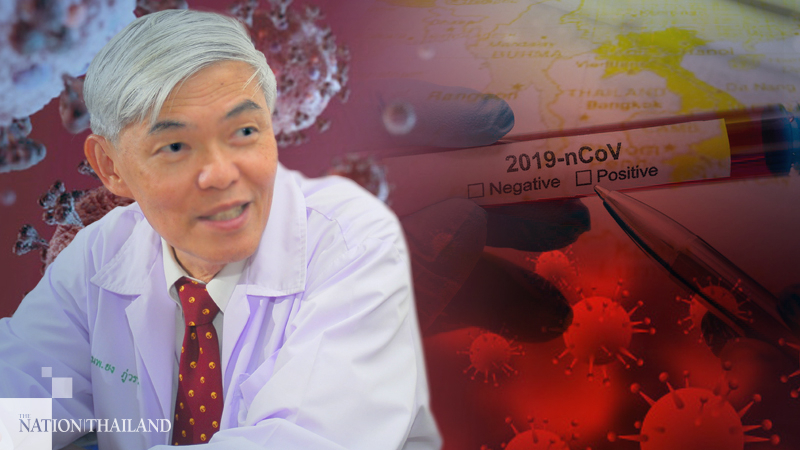
Judging by the fact that the UK strain of the Covid-19 virus has affected more than 1,500 people in Cambodia since February 20, expert virologist Dr Yong Poovorawan believes it may have been brought into Thailand by people crossing the border.
The UK strain was recently found among the recent cluster of cases that emerged in entertainment venues in Thonglor.
Dr Yong said it is unlikely that the strain had been brought in by people coming via official channels because everybody is tested and quarantined for 14 days.
He said Cambodia is still struggling with infections, and it is likely that migrant workers or Thais sneaking across the border may have been carriers of this strain, which is 1.7 times more infectious.
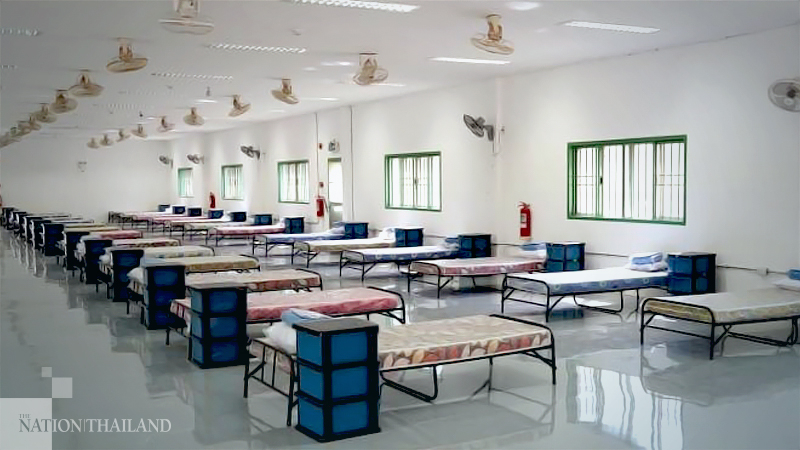
Now that Thailand faces a third wave of Covid-19 infections and many hospitals announced on Thursday that they were running out of beds, the premier instructed the Defence Ministry to set up field hospitals for more than 3,000 patients in Bangkok and its vicinity.
Defence Ministry spokesman Lt-General Kongcheep Tantrawanich said 10 military units have been provided with medical personnel to support the field hospitals.
The Army is looking into turning a military camp into a field hospital in case the situation worsens and infections expand.
A healthcare worker takes a nasal swab sample from a local resident for a COVID-19 test after hundreds of residents of Watthana district and the trendy Thonglor neighborhood tested positive for the coronavirus disease (COVID-19) in Bangkok, Thailand, April 8, 2021. REUTERS/Athit Perawongmetha
By Panarat Thepgumpanat and Patpicha Tanakasempipat
BANGKOK (Reuters) - A coronavirus outbreak in Thailand's capital may take more than two months to control, a health official said on Thursday, as authorities announced a broad ban on nightlife to tackle a new wave of infections and a highly contagious variant.
Authorities expect to arrest the outbreak in one or two months in the provinces, but it will likely take longer in Bangkok, the epicentre, said Kiatiphum Wongrajit, the ministry's permanent secretary.
"The main source of the infections is in Bangkok's entertainment venues, which could take longer to contain, depending on measures," Kiatiphum said in a statement.
The COVID-19 taskforce on Thursday said nightspots in Bangkok and 40 provinces, including pubs and karaoke bars, would be closed for two weeks. It did not specify when.
The taskforce also asked employers to let staff work from home and urged against non-essential travel.
Thailand reported 405 new COVID-19 infections on Thursday, in an outbreak that has reached 20 provinces and forced nearly a third of cabinet minister to self-isolate due to exposure to cases.
The spike in infections comes at a tricky time for Thailand, ahead of next week's annual Songkran festival, known for big gatherings and notoriously crowded water fights that authorities have banned.
Adding to concerns, Thailand on Wednesday confirmed the presence locally of the highly transmissible coronavirus variant B.1.1.7 first identified in Britain.
It has been found in more than 100 countries and has been blamed for fuelling new waves of infections in record numbers. (https://tmsnrt.rs/3dFjSo6)
The army was setting up a field hospital with 3,000 beds in 10 army bases, braced for a possible surge in new patients, a spokesman said.
Thailand plans to start its mass immunisation campaign in June, when a locally-manufactured AstraZeneca vaccine becomes available. It has so far immunised about 300,000 people, mostly health workers.
Thai experts are puzzled at how the UK variant evaded the country's strict quarantine system, which has helped keep overall cases to a relatively low 30,310 and deaths at just 95.
The taskforce said a reduction in the quarantine period introduced this month may be reconsidered.
Yong Poovorawan, a senior virologist, said the UK variant may have been brought to Thailand by land from Cambodia, where it is also present.
(Reporting by Panarat Thepgumpanat, Panu Wongcha-um and Patpicha Tanakasempipat; Editing by Martin Petty)
Entertainment venues in 41 provinces, including Bangkok, will be ordered to close for 14 days in a bid to prevent further spread of COVID-19, according to Thailand's Center for Covid-19 Situation Administration (CCSA) spokesperson Dr Taweesin Visanuyothin.
The proposal is expected to be signed off by the Prime Minister as early as tomorrow (Friday).
Daily News reported the proposal includes shutting down all pubs, bars, karaokes and massage parlours for 14 days in 41 provinces.
It is not known if restaurants will be included in the closure order.
At the time of posting there are no restrictions on domestic travel in Thailand, with the Prime Minister reiterating that there are no plans to enforce a national lockdown.
The news comes after Thailand on Wednesdayreported its first case of the more contagious UK strain of the virus.
Earlier on Thursday, provincial health officials in Phuket and Prachuap Khiri Khan ordered all bars to close for 10 and 4 days, respectively.
At Thursday's daily COVID-19 briefing, the CCSA reported 405 new COVID-19 cases.
*This is a developing story. This post may be updated without notice.
Groups of people at high risk for Covid-19, such as staff at entertainment venues, receive Covid-19 vaccines at a public health centre in Wattana district, Bangkok. (Photo by Somchai Poomlard)
Tourism operators have slammed the government's inefficient public inoculation scheme, which is preventing herd immunity as a fresh outbreak affects the industry for a third time.
Thailand's tourism industry was hurt by a second outbreak of the pandemic late last year and was just starting to glimpse a potential recovery this month with the long Songkran holiday beginning next week.
"We cannot stop operations every time a new cluster causes the government to impose strict restrictions. The most urgent need right now is a pro-active strategy for the country's public inoculation," said Marisa Sukosol Nunbhakdi, president of the Thai Hotels Association.
The government must accelerate the sluggish pace of vaccinations and quickly facilitate firms procuring various types and doses of vaccines to create herd immunity, said Mrs Marisa.
The government has to balance economic and public health concerns, such as allowing interprovincial travel to help the economy move forward, she said.
Hoteliers have already received cancellations for both room and restaurant bookings, but most guests who have already booked for Songkran are still awaiting further updates from the government.
The average hotel occupancy nationwide during Songkran is expected to be around 30%, but the occupancy rate might drop after the report on new infections.
Thanapol Cheewarattanaporn, president of the Association of Domestic Travel, said the recent wave of infections will be more destructive to the tourism industry than the second wave detected in Samut Sakhon because the virus rapidly spread in Bangkok, which is the centre of the country's economic and business activity.
The government should have searched more actively in nearby provinces around Samut Sakhon, as well as Bangkok, when the second wave started in December last year to ensure the virus was under control, he said. Such action would prevent a spike in later cases, such as a third wave, said Mr Thanapol.
Even though tour operators cannot predict the impact of a third wave, domestic tourism is likely to suffer and take longer to recover, he said.
Thai AirAsia said there has not been a significant number of cancellations following the new surge of infections.
However, passengers have shown concern over a 14-day quarantine requirement in Buri Ram province, which had already announced travel restrictions on people from red zones. Airlines are requested to provide them with latest official information.
The Joint Standing Committee on Commerce, Industry and Banking (JSCCIB) also called on the government to speed up administering vaccines to the Thai population.
"Authorities are slow in vaccinating people," said JSCCIB chairman Supant Mongkolsuthree. "They should relax some regulations to facilitate companies that want to import vaccines and give them to employees."
UNCERTAIN OUTLOOK
JSCCIB is preparing to reduce its GDP growth forecast on April 21, following the fresh outbreak of Covid-19 infections recorded earlier this week.
The group is worried the disease transmissions, resulting mainly from a cluster of pubs in Bangkok's Thong Lor area, will plunge the country into a third wave of the pandemic.
He expects the new outbreak will hinder economic recovery as it comes after the government announced a plan to allow vaccinated foreign tourists to visit Phuket without quarantine from July 1.
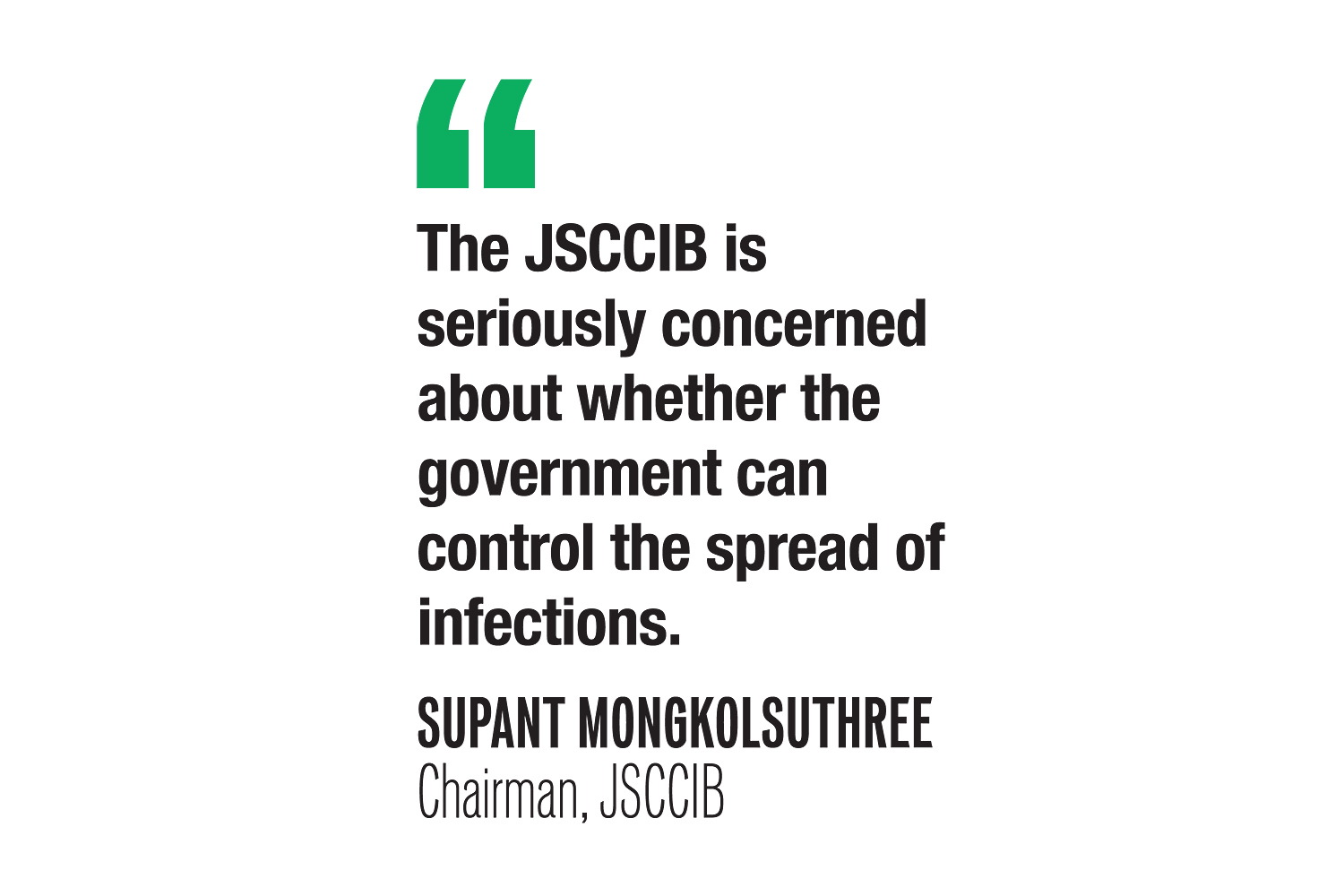
"The JSCCIB is seriously concerned about whether the government can control the spread of infections," said Mr Supant, who is also chairman of the Federation of Thai Industries.
Earlier this year, JSCCIB predicted GDP would grow by 1.5-3.5% in 2021, with exports rising by 3-5%. It projected the inflation rate at 0.8-1%.
The prediction was based on state economic stimulus measures and a hope for global economic recovery, following the distribution of vaccines in many countries.
If the ongoing outbreak causes the government to impose lockdown measures again during Songkran, it will cause an economic impact valued at 5 billion baht, said Sanan Angubolkul, chairman of the Thai Chamber of Commerce.
He recently talked with Bangkok Governor Aswin Kwanmuang about the situation and both agreed to carefully plan appropriate responses to the outbreak.
Public health is the first priority, but any steps against Covid-19 must be carried out with consideration of the impact on the economy. City Hall and the chamber agree only certain businesses will be temporarily shut down, with some areas under strict control, said Mr Sanan.
Chonburi announces forty new cases of the Covid-19 Coronavirus
Chonburi-
The Chonburi Public Health Department announced forty new cases of Covid-19 this morning as cases continue to increase in Chonburi.
Of the forty new cases, 18 were in Mueang Chonburi, 12 in Si Racha, 4 in Banglamung (Pattaya), 2 in Phanat Nikhom, 1 in Ban Bueng, and 3 in Pan Thong. Today is the most new cases since January 10th.
A new cluster was discovered at the Flintstones168(Finstone) Pub, which is in Don Hualor in Mueang Chonburi and had 19 new cases.
The other cases are as follows:
A close contact of a friend who has an infection and is an entertainment establishment employee in Bangkok
A close contact joined the van with a family of 2 infected people who went to the Bangkok motor show.
Another contact of a family of an infected person who went to the motor show.
Two Japanese people exposed to an infected entertainment facility employee in Chonburi (Voice bar).
1 person who contacted the DJ at Crystal Pub, Bangkok, who was infected with Covid-19
2 people who went on a trip with a group of friends in Phuket.
1 Japanese and 1 Thai who is a DJ in a Bangkok pub (Top One)
One Japanese person who is a contact of a patient at the Krystal Pub, Bangkok.
One person who went to MAYA Huahin pub
Family of patients confirmed in Bangkok area, 1 case
In the process of investigating the disease with 7 cases (Siracha 5 cases, Phanat Nikhom 2 cases, one other case)
A total of 510 contacts are currently isolated and being given Covid19 tests. Authorities are also testing in local communities and especially in entertainment districts with proactive testing.
Announcements may come later today from the Center for Covid-19 Situation Administration (CCSA) on possible further zone changes and restrictions.
A scheduled press conference from the CCSA is at 11:30 AM.