Proposals that have come from today's small scale CCSA meeting in Bangkok before a full meeting tomorrow with the Thai Prime Minister in terms of restrictions. Please be advised these are currently only proposals, and not set in stone. Tomorrow's "big" meeting is at 1:30 P.M. through video conferencing. Governors will also be able to strengthen rules, but not decrease them. Additional items could also come up tomorrow, of course.
-Change color zones with 18 provinces red (Including Chonburi, home of Pattaya) and 59 orange provinces.
-Ban alcohol in restaurants, encourage take-out, limit number of customers, earlier closing times depending on color zone.
-Close entertainment venues nationwide.
-Close amusement parks, playgrounds, similar attractions
-Ask for the public not to hold parties, house parties, etc.
-Refrain from teaching and learning in classrooms.
-No activities with more than 50 people
-Ask cooperation for people to work from home if possible.
-Ask provincial disease committees, especially in red provinces, to consider travel restrictions but these will differ by area and not be universal. (Editor's note-Many comments on Thai media have claimed that by enabling essentially 73 separate travel restrictions the confusion could be on purpose, discouraging people from traveling.
-Measures to be until at least the end of April. (extending current closures of entertainment venues in 41 provinces by over another week, at least.)
-It is not a lockdown, and they have asked people not to use that word, and said any sort of overall lockdown is not on the table.
Again, these are all currently ONLY proposals, and nothing is set at this time. Full article shortly.
People queue up for Covid-19 tests from royally-donated mobile units at the Urban Institute for Disease Prevention and Control in Bang Khen district, Bangkok, on Wednesday. People can walk in for tests, without having to make appointments. (Photo by Nutthawat Wicheanbut)
Legal action will be taken against entertainment businesses and people who recklessly spread Covid-19.
Dr Charaspong Sukree, chief of Nakhon Si Thammarat's public health office, said health officials are liaising with authorities in Bangkok in pressing charges against a Covid-19 patient who boarded a plane after being informed of her positive test result.
He was referring to the province's 7th case, a 26-year-old woman who took a flight to Nakhon Si Thammarat from Don Mueang airport on April 11 after she was told she was infected.
Dr Charaspong said the patient, who had caused havoc at the airports and anxiety among passengers, would be charged with withholding information.
"Authorities will determine where the offences were committed and the patient will be summonsed to answer charges there," he said.
He said she did not violate the law in Nakhon Si Thammarat as she informed authorities as soon as she landed. However, a private laboratory would also be held responsible for failing to notify the Department of Communicable Disease Control or the Centre for Covid-19 Situation Administration (CCSA) to initiate the quarantine process.
Based on the patient's timeline, she took the Covid-19 test at a private clinic on April 9 and was informed of the positive result on April 10. She boarded an evening flight to Nakhon Si Thammarat the following day.
In Phuket, three entertainment venues linked to the spread of the Covid-19 would face legal action, Pol Lt Gen Kittirat Phanphet, chief of the Provincial Police Region 8, said on Wednesday.
A committee chaired by Phuket deputy police chief, Pol Col Suwat Kaewphrom, has also been set up to follow up on the legal process and ensure all the parties involved are held to account.
In Chiang Mai, local authorities on Wednesday pressed charges against a hotel for allegedly failing to comply with the disease control measures after it failed to collect information from a guest who had travelled from a high-risk area. The guest checked in at the hotel in San Kamphaeng district on April 11, a day after she took a Covid-19 test at a hospital in Bangkok.
She received the test result, which was positive, on April 12.
The district's disease control operation centre found that the hotel had violated the province's disease control measures.
The province of Chonburi has 97 confirmed and new cases of the Covid-19 Coronavirus today according to the Chonburi Department of Public Health.
34 of the cases are from the Mueang Chonburi area, 9 from Si Racha, 36 from Banglamung(Pattaya area), 1 from Phanat Nikhom, 6 from Sattahip, 6 from Ban Bueng, 4 from Pan Thong, and 1 from Bor Thong.
In a piece of good news of the 807 new confirmed cases the first case was deemed to be recovered and released.
Here are the details on today's cases:
Seven cases of COVID-19 from the Flintstone Pub in Mueang Chonburi (as of April 6th 2021 a total of 144 from this venue)
People infected with COVID-19 From other entertainment venues are as follows 2.1 Bone Pattaya 1 case 2.2 Buzz Pattaya 1 case 2.3 Kitchen Lao, Pattaya, 1 person 2.4 Insomnia, Pattaya: 1 case 2.5 Infinity Si Racha, 1 person 2.6 Mountain Bar Sattahip 1 person 2.7 Replay Bang Saen 1 person 2.8 New Version, Pattaya, 2 people 2.9 The Garden 168 Pattaya, 2 people 2.10 Other entertainment venues in Pattaya, 3 cases 2.11 Class 99 Mueang Chon Buri 3 cases 2.12 Friend Zone Pluak Daeng, Rayong 4 people 2.13 Thongsuk Cafe Hua Hin, Prachuap Khiri Khan, but came to Chonburi, 2 people 2.14 Entertainment places from Bangkok, 3 cases 2.15 Chiang Mai entertainment venues 1 case
28 cases of close contacts and family members infected with COVID-19
In the process of investigating the disease, number 42 cases
1054 proactive tests were taken yesterday from mostly staff at entertainment venues in Chonburi and 433 close contacts. They are all pending results currently.
Authorities have stated most cases are asymptomatic at near 90 percent or with mild symptoms. The main age range is 18-29 years old. They also stated people should continue to use measures like wearing masks, social distancing, and other health measures.
Thousands of tests have taken place over the past week and will continue according to health officials.
People are glued to their phones while waiting for the skytrain at Victory Monument station in Bangkok. Pornprom Satrabhaya
Thais spent almost half the day on the internet on average in 2020, partly driven by the pandemic, while Facebook, YouTube and Line remained the most popular social media platforms in Thailand, according to a survey by the Electronic Transactions Development Agency (ETDA).
"Thai users increased their time spent online to 11 hours and 25 minutes in 2020, an increase of one hours and three minutes from 2019. Generation Y and Z were the main users as they engaged in online study," said Chaichana Mitrpant, executive director of ETDA, citing the "Thailand Internet User Behavior 2020" report.
The report surveyed more than 20,000 respondents in Thailand from April to June last year.
In 2013, when ETDA began the survey, Thais spent an average of only four hours and 36 minutes a day on the internet, which means the amount of time had tripled by 2020, he said.
Some 78.3% of respondents cited easier internet access and broader internet coverage for making it convenient for them to connect online.
"Covid-19 is another factor causing people to engage in more online activities to avoid going out," said Mr Chaichana.
Looking deeper, daily time spent on the internet on weekdays was 11 hours and 23 minutes on average, a jump of one hour and 31 minutes from a year earlier, while on weekends the time spent was 11 hours and 29 minutes, a drop of six minutes from a year before.
Gen Y (aged 20-39) was the biggest user of the internet, spending an average of 12 hours and 26 minutes per day, followed by Gen Z (younger than 20) with 12 hours and eight minutes, Gen X (40-55) with 10 hours and 20 minutes, and Baby Boomers (56-74) with eight hours and 41 minutes.
"Covid-19 caused the closure of education facilities and led to online study," he said.
"Most workplaces also adopted a work-from-home policy."
Social media had the most popular online engagement by Thais, with 95.3% of the respondents, followed by watching TV, clips, movies and online music at 85%, then information searches at 82.2%.
Some 77.8% said they engage in online chat, while 67.3% shop online.
Mr Chaichana said Facebook, YouTube and Line were still the main social media channels for Thais, according to 98.2%, 97.5% and 96% of the respondents, respectively.
Short-form video-sharing platform TikTok saw strong growth with 35.8% of respondents engaged with it.
He said respondents believed only 50% of the news and information shared online is true or credible.
Some 97% said they came across fake news on the internet.
Retailers and malls nationwide have been asked to close earlier at 9pm, following the private sector's most recent bid to help curb the country's third Covid-19 outbreak.
Yol Phokasub, president of Thai Retailers Association (TRA), said on Wednesday the TRA and Thai Shopping Centre Association (TSCA) jointly announced to their members and trade partners nationwide that they must maximise their Covid-19 screening measures.
Both associations asked their members to close earlier at 9pm, starting from today and until further notice.
These businesses are also being advised to suspend all activities that would involve gatherings of large numbers of people. They are further being advised to have their staff work from home as much as possible, said Mr Yol.
He said the two associations hope their move will lead to more action by the private sector in supporting the country's work to contain Covid-19 and ending the latest wave of the outbreak as soon as possible.
Meanwhile, Phuket -- the tourist island that was on track to becoming the country's model for opening up to tourists after the year-long economic devastation Covid-19 has caused -- will be asked to return to lockdown mode again, said Dr Pitakpol Boonyamalik, a public health inspector.
"The number of new Covid-19 infections in this health region continues to soar by the day. I must propose that the provincial communicable disease control committee of Phuket, in particular, considers locking down the province after Songkran in order to contain the outbreak situation there," Dr Pitakpol said on Wednesday during an online conference for health officials in the southern region.
Dr Pitakpol oversees the 11th Health Area of Thailand -- covering Chumphon, Surat Thani, Nakhon Si Thammarat, Phuket, Phangnga, Krabi and Ranong In July, Phuket will be the first province to waive the quarantine requirement for vaccinated foreign visitors, as part of the government's plan to reopen the country.
Dr Pitakpol said that despite the cases in the southern region being relatively low, with none listed in a high-risk zone, the situation is still worrying.
"Many of our current patients did not have a history of travelling into the outbreak zones before, which points to the possibility that they could have contracted the virus from people who were quarantining at home or people who were deliberately concealing their travel history," said the doctor.
The proposed restrictions, which authorities caution against calling a full-fledged lockdown, will be discussed first at a smaller Center for Covid-19 Situation Administration (CCSA) meeting on Thursday, April 15th, 2021, led by General Natthaphon Nakaphanich, Secretary-General of the National Security Council.
The proposals will, according to General Natthaphon, primarily be discussed for Bangkok, Chiang Mai, Chonburi (Pattaya), and the Prachuap Khiri Khan area (Hua Hin.) These are all popular domestic tourist areas and as a result have seen the bulk of the current cases associated with a cluster that originally stemmed from entertainment venues, according to authorities, that have already been closed in 41 provinces for at least two weeks.
General Natthaphon did not specifically state what restrictions would be on the table or possibilities. He noted that the current cases of Covid-19 were over 90% asymptomatic, with most people affected being 18-29 years old. He stated, however, the concern would be cases spreading to the elderly or vulnerable.
On Friday, April 16th, 2021, the proposals will be brought to a full-scale meeting of the CCSA and relevant agencies the Ministry of Public Health at 1:30 P.M. that will be led by Prime Minister Prayut Chan O'Cha and done via video conferencing. It is possible announcements may be made immediately following the meeting.
Provincial governors have already made some closure decisions in the high-risk provinces, with Hua Hin and Chiang Mai stopping alcohol sales in restaurants for instance, or Chonburi closing cinemas.
The Pattaya News will keep you updated as more information is released. As of press time, only entertainment venues and cinemas/theaters remain closed in Chonburi, with no quarantine or entry rules to enter or leave the province.
A brand new baby hippopotamus at the Khao Kheow Open Zoo in Si Racha got her name this week officially and is now called 'Moo Wan'. (Sweet Pork)
The baby is a female hippo who was born on January 14th. The hippo is very healthy, according to zoo officials, and has become a major attraction for the park. The name of the baby hippo was up for voting from the public with prizes on the line.
Read more about our previous story in the link below.
Mr. Taewin Rattanawongsawat, who is the director of the Khao Kheow Open Zoo, told The Pattaya News, "We got more than 20,000 votes from people in Thailand."
"The 'Moo Wan' name had the highest votes. After we ran a raffle for those who voted for a cash grand prize, we got the winner who is Ms. Namfon Viriyapongpan from Bangkok. She received a cash prize for 3,000 baht." Taewin stated.
"Another 10 prizes are zoo tickets. Check out the prize winners at our Facebook page 'สวนสัตว์เปิดเขาเขียว Khao Kheow Open Zoo' or call 0-3831-8444 ext. 212." Taewin added.
"We are keeping strict hygienic measurements during the Covid -19 pandemic. Tourists who are visiting the zoo have to follow these precautions, such as wearing a mask and social distancing as well as limiting the crowd sizes who visit the zoo." Taewin concluded.
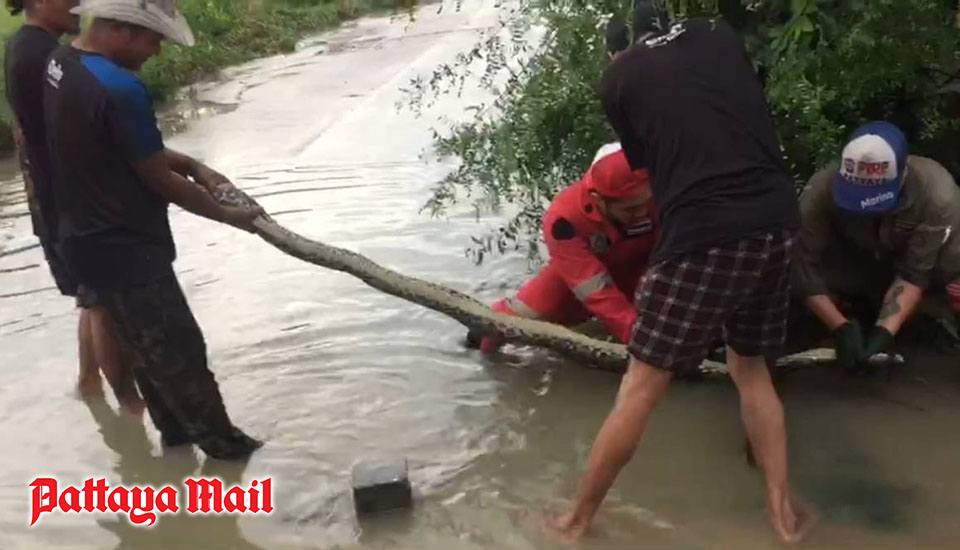
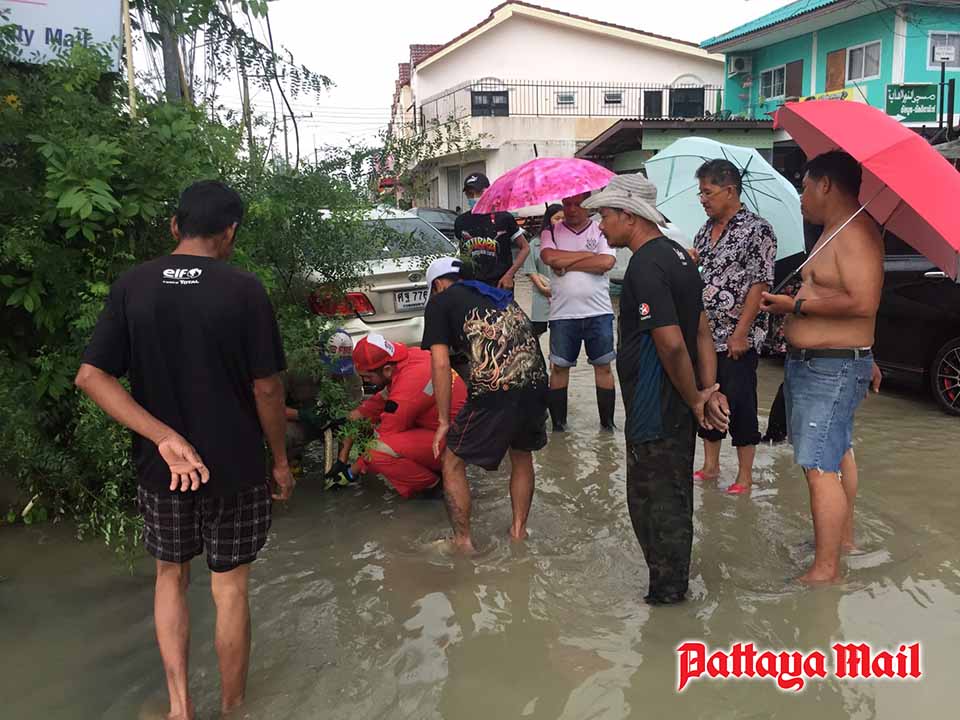
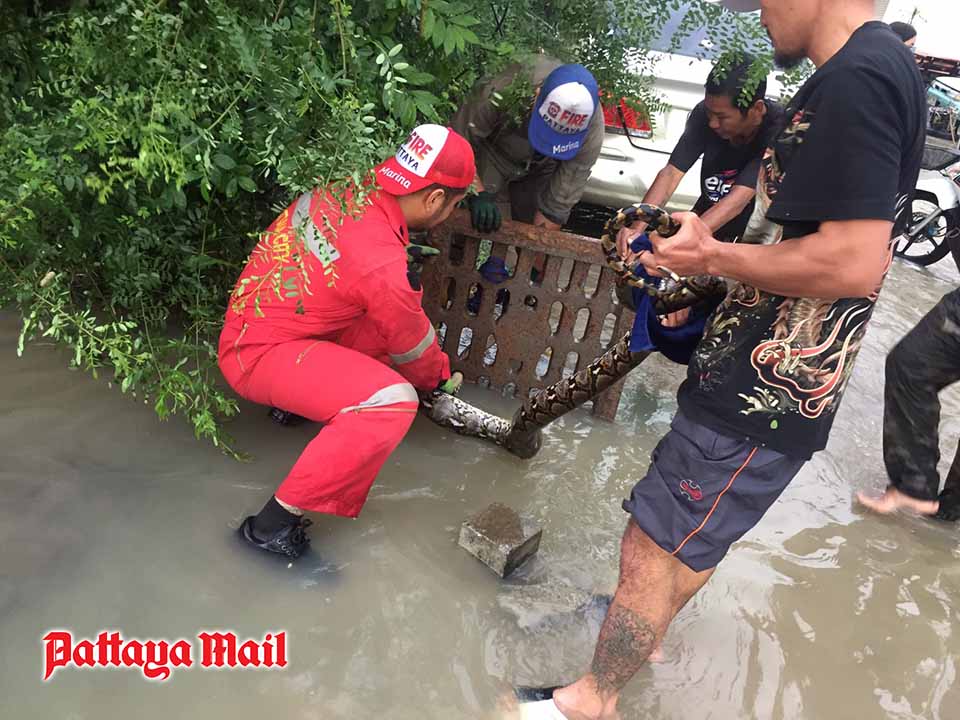
Animal-control authorities managed to corral the huge python before anyone was hurt.
Pattaya's often-raging floodwaters carry more danger than just property damage.
A resident of the Five December Community off Soi Siam Country Club said April 11 that he saw a four-meter-long python swimming in storm runoff from Sunday's big storm.
Community President Surin Yimyai contacted animal-control authorities who arrived in time to find the snake and took it away before anyone was hurt.
Residents watch in awe as the scene unfolds.
These snakes are beautiful creatures – when seen from a distance.
As of Wednesday, at least 42 Thai provinces now have some form of entry restrictions for travellers from so-called high risk locations.
However, the restrictions vary quite drastically from province to province.
Lampang, Phichit and Ubon Ratchathani were the latest provinces to announce restrictions on arrivals.
Requirements for travellers from Bangkok, Pathum Thani, Nonthaburi, Samut Prakan, Nakhon Pathom and in some cases, Chiang Mai, range from being required to self quarantine for 14 days, take a rapid COVID-19 test or confirm whereabouts to local health officials.
Some provinces only require quarantine for people from certain districts in Bangkok, namely Bang Khae, Klong Toey and Wattana, as well as Pathum Thani, Nonthaburi, Samut Prakan.
Whereas other provinces only require quarantine for those who visited high risk venues - mainly the Thonglor bars and nightclubs - which have been confirmed as the source of the major cluster discovered in the capital.
In many provinces, self quarantine is not required if a person takes a rapid COVID test and tests negative.
If you do still plan to travel, the advice is to seek the latest information regarding your destination province before you begin your journey.
The situation is fluid and is ever changing, so try to get as up to date information as you can prior to your departure.
Provinces enforcing entry restrictions for travellers are:
North:
Chiang Mai, Kamphaeng Phet, Lampang, Lamphun, Nan, Phayao, Phetchabun, Phichit, Phitsanulok, Phrae, Tak, Uttaradit.
Meanwhile, in Prachuap Khiri Khan, where on Tuesday the total number of cases surpassed 300, officials are only requesting quarantine from people who visited high risk venues.
There are no plans to implement a nationwide lockdown in order to tackle the latest wave of COVID-19 infections in Thailand, officials have said.
On Tuesday, Dr Opas Karnkawinpong head of Thailand's Department of Disease Control (DDC) said that there were no plans to enforce a nationwide lockdown.
However, further restrictions, including the lockdown of provinces with high numbers of confirmed cases is being considered by the government.
On Wednesday, National Security Council General Natthaphon Nakaphanich reiterated that the government has been discussing possibly imposing provincial lockdown measures, namely in Bangkok and the surrounding areas, Chiang Mai and Prachuap Khiri Khan.
According to Bangkok Biz News, officials are reluctant to impose a national lockdown in order to avert adversely affecting people in areas where the outbreak is not so severe.
Medicine for treating Covid-19 is being stockpiled with more being bought amid the third outbreak which has infected more than 4,000 people, said the Government Pharmaceutical Organisation (GPO).
The GPO has ordered the stockpiling of Favipiravir with the drug now reserved for treating Covid-19 sufferers and being distributed to medical facilities to ensure they receive a constant supply.
As of Monday, the GPO had 411,200 Favipiravir tablets in its stock with half a million more on order.
Meanwhile, privately-imported vaccines from three manufacturers may be made available sometime in the latter half of the year for around 2,000 baht a dose, according to Dr Aurchart Kanjanapitak, chairman of Ramkhamhaeng Hospital.
Dr Aurchart said yesterday that people outside the at-risk groups would probably be able to buy immunisation privately using one of three vaccines that have a chance of being made available domestically later this year.
Two are being produced by US-based Johnson & Johnson (J&J) and Moderna, while the third is Russia's Sputnik V. The likely cost per shot would be around 2,000 baht, he said.
J&J has registered its single-dose Covid-19 vaccine with the Food and Drug Administration (FDA) -- the first shipment is expected around October and will be sold to private hospitals. They would have to insure against any risks or side-effects associated with its administration, according to Dr Aurchart.
The GPO is also likely to import the Moderna vaccine, although the vaccine has not yet been registered with the FDA. If and when the registration is complete, it is expected to arrive in Thailand in August.
Also not registered is the Sputnik V formula and it remains unclear who will be its importer. Dr Aurchart said, however, it was possible the process of registration and importation could be expedited so its use could begin in early June.
Department of Disease Control director-general Opas Karnkawinpong yesterday insisted the national vaccination programme was progressing as planned with the latest batch of one million Sinovac Covid-19 vaccine doses having arrived last week.
The vaccine will undergo quality checks before being distributed to all 77 provinces.
Ni som förstår Thai kan läsa själva. För övriga inklusive mig själv så är detta en uppmaning till de som besökte Replay och Warp här i Bangsaen mellan 5 och 7 april att testa sig då det konstaterats covid-19 på dessa ställen. Ett av dem ligger så gott som vägg i vägg med Cool Bar.
The following information is based on reports from both the Ministry of Public Health as well as public reports posted by people who have gone through the current process after testing positive for Covid-19.
There are generally a few ways one will go about getting a Covid-19 test. Currently, because of the recent outbreaks and tests going to those who are on timelines or contact traced, many hospitals are not giving tests to people with no symptoms and no history of being in contact or at a place with a Covid-19 positive test. Some provinces have even suggested that you self-quarantine if you have no symptoms but were at a place where a Covid-19 positive person went. (If you were a low-risk contact.)
If you are considered a high-risk contact or a close contact and are identified by a positive Covid-19 patient you will generally be called in for a test. You will be asked to self-isolate before and after the test while waiting for results which can take usually a day although there have been mixed reports on how long it can take depending on backlog. Unfortunately, there have been reports of people, including those staying at condos, who have not self-isolated while waiting for results.
If you notice you went somewhere that appears on a timeline but are not contact traced or considered to be a low-risk contact, you can go in for a free Covid-19 test at wherever the local health department is conducting tests, including if you are a foreigner. (You can also choose not to go in, but are supposed to self-isolate and/or monitor your health for symptoms of Covid-19) These notices are posted on local health department pages, which are usually in Thai. We have been translating them to English but if you are outside of Chonburi province you may have to check with your local health department. You will also be asked to self-isolate while waiting for results. Finally, there is proactive testing which is when mobile Covid-19 vans visit places that are considered high-risk, like factories, migrant worker's camps, or entertainment districts, and set up to invite anyone who works or lives there for a free test. As before, you will be asked to self-isolate while waiting for results.
Once your test results come in you will get a phone call if you are positive. Negative people have reported they get a simple text message in some cases. At this point, generally speaking, an ambulance will pick you up to take you to a hospital for initial tests and to gather further information. We say generally because as this current round of infections increases in cases there are also reports of people being allowed to take their own transportation, although they are encouraged NOT to take public transportation.
You will then go through a health checkup with authorities and for foreigners will need to clarify your form of payment/insurance/etc. If you have a work permit and were working Thai Social Security will assist in covering any cost for Covid-19 treatment. (Note: It may not if you are a director of a company, you will need to check this). There have been mixed reports of foreigners having to pay for their treatment, but for the most part, reports say they have had to. Having Covid-19 insurance currently is VERY important. Migrant workers and Thai nationals get free treatment.
After this processing, you will be assigned a place to stay based on your condition if you show symptoms, your age, prior health conditions, and other factors. Importantly, going back to our self-isolation statements earlier, you cannot stay at home if mild or asymptomatic for your entire period of quarantine/monitoring, BUT,you might be told to go home and self-isolate, with medical checks from health volunteers who are also making sure you are not going anywhere, for up to several days until a bed or room becomes available for you in the area, depending on where you are. This depends a lot on your location and the severity of your condition. If you have the money or the right insurance, you may be able to choose your own hospital, however, due to the rising number of cases and full rooms due to the policy that everyone positive must get quarantined under medical attention, this isn't guaranteed.
Thailand authorities have said several times, including today, there are no plans to allow overall self-isolation or self-quarantine for mild or asymptomatic cases at this time, thus all the building of more field hospitals. They claim this is for the ability to better monitor patient's health during their stay as well as to enforce isolation.
So far, foreigners have GENERALLY been sent to either a hospital room or Hospitel (This is a quarantine hotel that is usually used to house people coming back from overseas but is being used for the recent infections as well.) These have private rooms and many have decent facilities. You will have daily basic medical tests depending on if you show symptoms or not. If you are asymptomatic you are given Vitamin C, according to multiple reports.
There is, however, a chance you could get sent to a field hospital, especially if money is tight(Note, if you have moderate symptoms or more you will go to a hospital, field hospitals are for mild or asymptomatic people, which according to the Ministry of Public Health is the majority of the current cases in Thailand.) These are the large dorm-style rooms with up to dozens of people on bunks. So far, it mostly appears to be Thai nationals and migrant workers sent to these places but it cannot be entirely ruled out that foreigners would not be sent there if private hospitals or hospitals had no beds or the foreign national had limited insurance or funds.
The conditions of field hospitals can vary widely, although most have wi-fi. Depending on a few different circumstances you could see yourself spending between 7-14 days in these hospitals, which also takes into account if you spent any time self-isolating at home waiting for a room. Many have limited bathrooms and will be shared with many other people.
You are suggested to bring toiletries, a power bar/surge protector, a pillow and blanket (and possibly even a mattress), snacks, sets of underwear (most hospitals are providing you with a hospital uniform), an eye mask to protect against bright lights on throughout various hours of the day, earplugs, and other personal items. Some field hospitals allow food delivery, but some do not and as staff needs to wear full personal protective equipment to enter the hospital wards they cannot get in easily whenever you want a pizza or a Pepsi, so bringing your own supplies would be a must. Portable hot pots are even allowed at some of the hospitals! Laptops, etc, are allowed.
Some more information on the field hospitals, in Thai, can be found here. In Chonburi, there is a field hospital set up at the Sattahip Naval Base, although we also have many "Hospitels" due to the number of hotels in the area, so it is entirely possible one may never have to see a field hospital in the Pattaya area.
Finally, the best way to avoid potentially testing positive and having to go through this process would be to limit your contacts during the current period of time and follow Covid-19 health precautions according to Chonburi Public Health Officials.
This is all correct as of press time, but once again can change rapidly and is designed only as a general guide and not the definitive answer to everything involving testing for Covid-19 in Thailand.
General public can register for vaccinationsstarting May 1
The Public Health Ministry will start vaccinating the general public against Covid-19 around mid-May, when the first lot of the locally manufactured AstraZeneca vaccine will be ready, Public Health permanent secretary Dr Kiattiphum Wongrajit said.
"The government aims to have 50-60 per cent of the population vaccinated as soon as possible to effectively control the outbreak," he said.
"We will also expand the vaccination units by collaborating with the private sector, which will provide locations such as at shopping malls or other modern trade venues. This will maximise the number of people getting vaccinated per day from the current rate of 500 per day per hospital," Kiattiphum said.
Since February 28, Thailand has been vaccinating people in high risk groups – medical professionals and those who have close contact with patients.
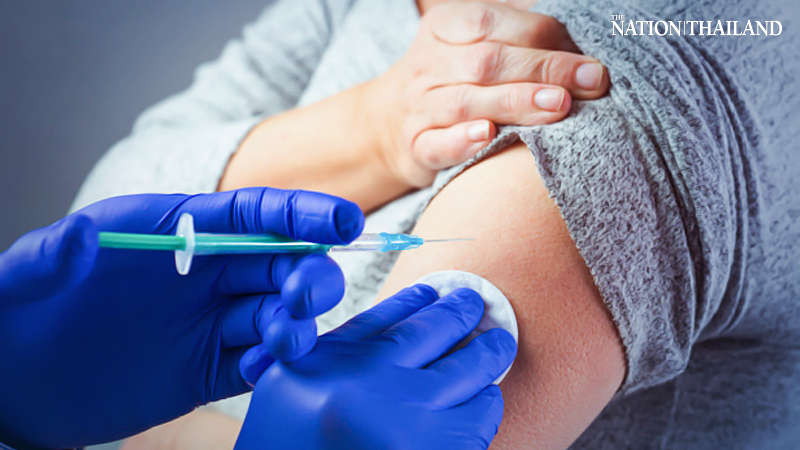
According to statistics from the government's Covid-19 Information Centre, 578,532 doses of vaccine have been given to people in all 77 provinces from February 28 to April 12. Of these, 505,215 received their first jab while 73,317 received a second jab.
"There are four channels where people can register to get the vaccine: via the "Mor Phrom" (Doctors Ready) Line official account; the mobile Mor Phrom application that will be ready for download on May 1 initially on Android phones; at hospital via telephone, or by contacting public health volunteers nationwide," he added.
Those who have been vaccinated will receive both a paper and digital certificate (in the form of a QR code), which they can use to verify their vaccinations. The ministry expects vaccine passports for international travel to be ready in June, once the World Health Organisation finalises the all-important criteria.