Interest in moving out of Thailand takes Internet by storm
views 736
In just two days, over half a million Thais have joined a new Facebook group called "Let's Move Abroad", amid increasing criticism of the Thai government's handling of the COVID-19 pandemic and economic and political issues.
Countless posts by over 524,500 members of the group ask for tips on studying and working abroad in certain fields, while those who have lived abroad promoted countries where they stayed with beautiful photos.
Among countries of most apparent interest are the United States, Canada, the United Kingdom, Germany, Austria, Norway, Sweden, Iceland, Russia, Australia, New Zealand, Japan and Malaysia. Many members also sympathise with the current anti-government movement.
"I really dislike this country in terms of its system of governing and certain people. I want to change the country, but I think relocating is easier," said Piyawat Janta, a member who is looking to the US.
"The group was created to compile information on life in other countries and to exchange tips on how to move abroad, like how to obtain visas etc. It's not aimed at taking political jabs, although it's undeniable that this interest in moving abroad also political, otherwise there wouldn't be this many members," said the creator and administrator of the group, who wished to remain anonymous.
The creator, who owns seven restaurants and pubs in Bangkok, and has been impacted financially by the government's restrictive measures, most notably the current ban on dining in and on-site alcohol consumption, said he has been thinking about doing business elsewhere for a while, but the last straw was the government's mishandling of the pandemic and the failures of the country's justice system.
He cited the repeated denial of bail for prominent anti-establishment leader Parit "Penguin" Chiwarak, who has been on hunger strike for almost 50 days and is now in hospital.
"I initially expected something like 50 members. I believe it's the hopelessness in this country that got so many people joining the group," the businessman said, adding "but this doesn't mean we don't care about our country. We can leave responsibly and continue to push for positive change from afar," he added.
Thailand has been suffering a third wave of COVID-19 infections since early April, which began in clusters in Thonglor nightclubs, resulting in a new round of restrictive measures that have ordered many venues to close. The new wave is spreading much faster than last year, with almost new 2,000 infections a day, due to more transmissible new variants of the virus.
Over 1.47 million doses of COVID-19 vaccine have been administered in Thailand to date. About 200,000 people over 60 and in at risk groups have registered for the British AstraZeneca vaccine, now being manufactured in Thailand for delivery in June.
As of today, a Change.org petition, to oust Deputy Prime Minister and Public Health Minister Anutin Charnvirakul for the slow vaccine rollout and failure to prevent the new wave, has attracted over 36,000 signatures.
The Chonburi Department of Public Health announced 153 new and confirmed cases of Covid-19 with one additional death this morning (May 3rd), following a major increase in community testing.
This makes a total of 2,764 cases of Covid-19 in the current round of infections, with 1,636 still in medical care, with seven recorded deaths since the start of this recent round of infections in early April.
Additionally, 1,121 people in total have now been released from medical care and fully recovered since this current wave began. Today's cases marked an overall increase in infections but were driven by a major increase in community testing.
The district-level new cases were as follows today:
Mueang Chonburi with 59, Si Racha 17, Banglamung (including Pattaya) 70, Koh Jan 5, and two patients from other provinces transferred to Chonburi for medical care.
The details on today's cases given were:
One close contact patient from parties and went to Sukhothai.
Contacts from previous confirmed cases, mostly family, and in the process of investigation
In the process of investigation from active case finding, 39
In the process of investigation, 31
In the last day, a total of 196 close contacts were being tested from contact tracing, and 1557 people were being tested in proactive testing when medical staff goes out into the community. All are pending results. Additionally another 1,146 people were tested from mobile testing vans and are also waiting for results as officials step up aggressive community testing.
Chonburi officials are asking people to continue to stay home, socially distance, and follow other Covid-19 related measures to control the situation. Chonburi officially became deep red according to a government zoning program based on Covid19 cases, which brings additional restrictions for at least two weeks such as closure of dine-in at restaurants.
Eight hospitals in Thailand have been temporarily closed after their medical personnel became infected with COVID-19, or had to be quarantined, because a number of patients concealed facts about their infections.
The hospitals are:
Mae Sai Hospital in Chiang Rai province, closed until May 16th. 88 medics quarantined.
Chumsaeng Hospital in Nakhon Sawan province, closed until May 7th. 1 medic infected.
Ruam Paet Chai Nat Hospital 1 in Chai Nat province, closed until May 12th. 1 medic infected.
Nong Muang Hospital in Lop Buri province, closed until May 14th. 1 one employee infected.
Samphran Hospital in Nakhon Pathom province, surgical ward closed until May 10th. 40 medics quarantined.
Bor Phud Hospital on Samui Island in Surat Thani province, closed until May 14th. 7 medics quarantined.
Pipoon Hospital in Nakhon Si Thammarat Hospital, closed until tomorrow. 2 medics infected.
Ratsada Hospital in Trang province, closed until May 31st. 34 medics infected.
The Department of Medical Sciences reveals that tests show AstraZeneca vaccine samples produced by Siam Bioscience meet all requirements. Photo courtesy of the Ministry of Public Health
The World Health Organisation had hailed Thailand's handling of the novel coronavirus at its peak early last year, noting that cooperation and health measures are the keys to success. However, the third wave of the viral pandemic has thrown us into chaos. It has raised the number of infections to over 65,000 and deaths to more than 200, stretching the country's public health system to its limit. What can we learn from this?
With the benefit of hindsight, we should diversify options to reduce risk. I think the government is too complacent about its vaccine management. When the latest round of the outbreak hit the country last month, it was unprepared for the UK variant that can transmit faster than the original strain. Currently, we have only two vaccine brands, Sinovac and AstraZeneca, with a total of 2.6 million doses administered. The government distributed about 1.3 million doses between Feb 28-April 28, accounting for only 1.7% of the entire population.
In fact, the government has not paid attention to those who raised red flags. On Jan 18, Thanathorn Juangroongruangkit, the leader of the Progressive Movement, criticised the government's vaccine procurement for being too sluggish and betting on one horse. He questioned why the government didn't take action until the Ministry of Public Health ordered the vaccine from AstraZeneca in November last year although the committee of the National Vaccine Institute approved the blueprint for public access to inoculations many months earlier. He also questioned why Siam Bioscience, founded by the late King Bhumibol Adulyadej, has been chosen to produce the vaccine for AstraZeneca.
In terms of risk management, his foresight had a grain of truth, but it went unheeded and instead saw him get slapped with lese majeste charges.
Actually, bureaucratic arthritis can cripple risk management during a crisis such as this. In early February, Somchai Jitsuchon, research director for inclusive development at the Thailand Development Research Institute, who is involved in vaccine management, said procurement regulation doesn't allow for the pre-ordering of products in the development phase because it is at risk of losing deposits. At the time, nobody knew the vaccine would come to fruition. He suggested that the government amend regulations or bypass them to allow betting on many horses.
It was not until former PM Thaksin Shinawatra took aim at the sluggish vaccine rollout that the government immediately began to secure more jabs from Russia's Sputnik V and America's Pfizer a few days later. Public Health Minister Anutin Charnvirakul insisted that he would amend rules to speed up vaccine procurement in an emergency and promised that the country would obtain 100 million doses for 50 million people to achieve herd immunity by the end of this year.
It is understandable that the government wasn't enthusiastic about vaccines last year because the rate of infections remained low. In fact, local production of vaccine supply is beneficial in the long term because it can help reduce our dependence on foreign manufacturers. Unfortunately, the problem is new variants emerged before our vaccines could be made available in the second half of the year.
The price of betting on only a few horses has left the country with no choice but to use current vaccines amid growing public scepticism about their efficacy and side effects, following the report of medical workers suffering stroke-like symptoms after being given the Chinese jab. Frontline medical personnel are no different from guinea pigs at the moment.
While the vaccination plan moves at a snail's pace, those not inoculated remain at high risk of infection. If they develop severe symptoms, it will further tip the balance because the current caseload is putting our public health system on the verge of collapse. New critical patients may have difficulty receiving proper treatment because hospital beds are full, which will increase the mortality rate.
The government should protect the country from this fiasco. Diversifying vaccine procurement will speed up herd immunity and prepare for new variants. The mass rollout will begin in June until the end of this year with 61 million doses of AstraZeneca. However, it remains to be seen whether it can fight mutations. The viral vector vaccine works by putting a small part of the coronavirus on a harmless carrier and injecting it into the patient. If new strains break out, will this kind of vaccine be effective?
At the same time, the country can follow the United Kingdom by thinking about a booster programme. In December last year, Margaret Keenan, 91, was the first person in the world to receive the Pfizer Covid-19 jab as part of a mass vaccination campaign in the UK. It has now ordered an extra 60 million doses of Pfizer's booster jabs. If we don't learn from the worst, our time and money will go down the drain again.
Thana Boonlert is a feature writer for the Life section of the Bangkok Post.
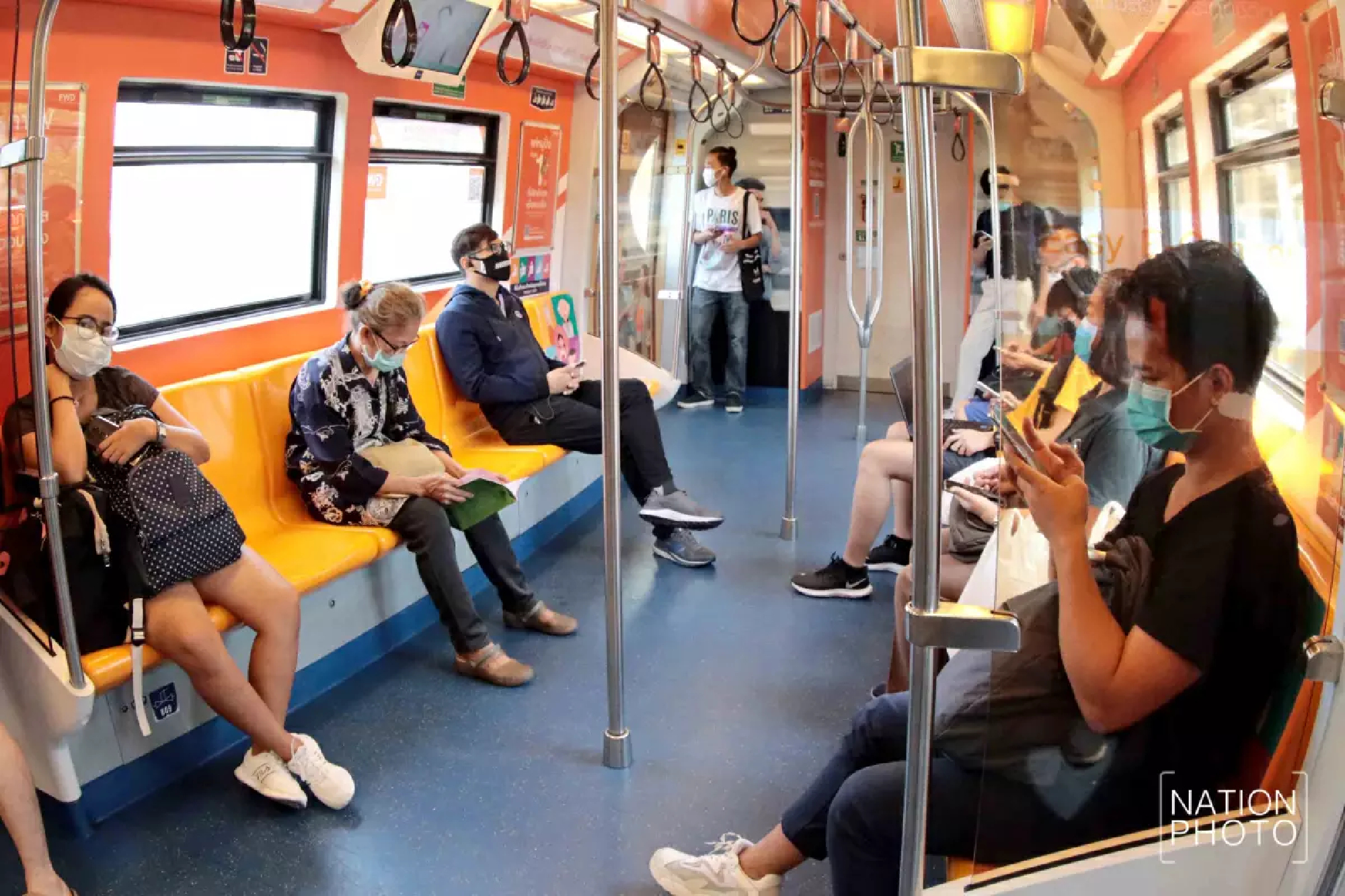
The survey by the Ministry of Higher Education, Science, Research and Innovation, and Sirindhorn International Institute of Technology (SIIT) at Thammasat University, used artificial intelligence to monitor the wearing of face masks in public places in real time.
"We have processed the data from 11,894 people from 30 areas in 28 districts of Bangkok," Prof Dr Thanarak Theeramankhong of SIIT said on Sunday.
"The majority of people were wearing face masks correctly, while about two in 1,000 people did not wear face masks, and about four in 1,000 people wore them incorrectly -- their masks did not fully cover their noses and mouths."
Thanarak added that the survey found eight districts in Bangkok had 100 per cent of the samples wearing face masks in public. They were: Yannawa, Minburi, Phasi Charoen, Phra Nakhon, Bang Khor Laem, Don Muang, Chatuchak, and Khlong Toei.
"We also found that people tend to not wear face masks on Friday, Saturday and Sunday compared to Monday to Thursday. Also, the wearing of face masks tended to drop in the evening compared to the morning periods," he said.
Dr Apisamai Srirangsan, assistant spokesperson for the Centre for Covid-19 Situation Administration, said that "the survey only monitors the wearing of face masks in public places, but people should wear face masks whenever they are in close contact with others, such as in the workplace or with family members".
"Besides wearing face masks, people are advised to maintain social distancing, separate their personal items and wash their hands regularly to limit the spread of Covid-19," she added.
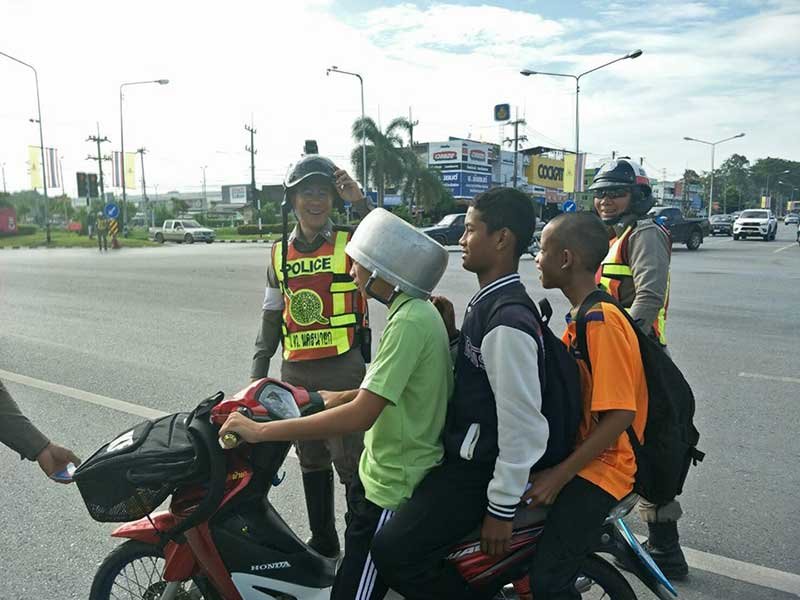
Kid with a pan on his head instead of a helmet amuses Thailand - Photo credit: Tanit Bussabong
The Thai woman was riding on a motorcycle on her way to work when a pickup truck sideswiped her on a rural stretch of asphalt in northeastern #Thailand. The truck's driver was an off-duty police officer. He was drunk.
Orathai Chanhom, the motorcyclist, was catapulted off her bike and killed almost instantly in the crash.
The officer who struck her still has his police job. His driver's licence was not taken away. A court declined to sentence him to prison.
In Thailand, one of the world's most unequal societies, even its roads have a rigid hierarchy, with the poor far more likely to be killed in accidents than the well-off and well-connected.
And there are many deaths: Thailand had the world's second-highest rate of road fatalities per capita, surpassed only by war-afflicted, lawless Libya, according to a 2015 report from the World Health Organisation (WHO).
When it comes to per-capita motorcycle deaths, the country is number one.
The government vowed at a United Nations forum in 2015 to halve the number of road traffic deaths by 2020.
With less than one year to go before the deadline, however, Thailand is a long way from fulfilling that promise, its roads still ranking among the world's 10 most dangerous, with more than 20,000 preventable fatalities a year.
The country has seen a small dip in road deaths since 2015, and Thailand has in place many of the necessary laws to make its roads safer.
But what the government has not addressed is the country's vast gap in wealth, which is the core issue that not only makes its roads so deadly, but has also split the country into two bitterly divided political camps: Thailand's haves and have-nots.
Thailand, named the most unequal country of the 40 major economies surveyed last year by Credit Suisse, has what might be the world's most toxic combination for traffic safety.
Unlike poorer countries, its roads are well paved and made for speed, and the cars driven by the rich and its growing middle class tend to be new and fast.
But many Thai families can only afford a single scooter or motorcycle, and high-quality helmets are a luxury for many, whatever the law says about them being mandatory to wear.
In accidents on the country's crowded roads, it's a devastating mismatch when an air-conditioned SUV collides with a two-wheeler, scattering the detritus of death across the asphalt.
And the aftermath of such accidents are a common, macabre sight on Thai thoroughfares: a shredded tyre, a mangled frame of steel, a bloody plastic flip-flop.
Motorcycle accidents can involve a number of fatalities. Because public transportation is limited outside the big cities, it's not uncommon to see a couple of adults – and even a child or two crammed between them – balanced on a single bike.
Only 12 per cent of Thailand's road traffic deaths involved occupants of cars or other light vehicles, according to the 2018 WHO Global Status Report on Road Safety.
Most of the dead were motorcyclists – or pedestrians.
In many Thai towns, there are few wide, easily usable pavements because, critics say, they are not a priority for the rich and influential, who prefer not to walk in Thailand's oppressive heat.
When there are wide footpaths, they often overflow with street stalls and even motorcycle traffic, pushing people into the roads.
The country's economic disparity is not the only reason Thailand's road deaths are not distributed equally. Justice, too, is handed out unevenly.
For the super rich, or those in positions of authority, the rules of the road may not apply at all.
They know they can speed with impunity and drink heavily before getting behind the wheel, with little fear of the consequences.
In 2012, a young man in a Ferrari – the heir to the Red Bull energy drink fortune – allegedly ploughed into a policeman, dragging him to his death.
The driver, Vorayuth Yoovidhya, was intoxicated, according to a test. Seven years later, he has never been prosecuted.
"What is clear in Thailand is that the roads are not safe for all users," says Evelyn Murphy, who specialises in unintentional injury prevention at the WHO.
"Whether it's cars or motorcycles or pedestrians, the safety of all users of roads must be considered, regardless of income level."
Weak enforcement, compounded by corruption
Speeding, drunken driving and failing to wear proper helmets are the primary causes of traffic deaths in the country, Thai officials say.
While the laws are there to combat each of those factors, enforcement is not.
Wearing helmets is required on two-wheelers, but fines are rarely issued, unless the police need to meet a specific quota during a crackdown period.
Unaccustomed to checkpoints or sirens, speeders or other rule-breakers may not even pull over when caught.
"It's hard to convince people to stop for us when they are not used to stopping," says Jirasunt Kaewsaengeak, the deputy commissioner of the Bangkok Metropolitan Police.
Then, there is corruption. The rich or well-connected know a bribe can often see them on their way if they are nabbed breaking traffic laws.
Bangkok's 3,000 traffic police make an average of £500 a month for working in broiling heat, monsoonal downpours and suffocating smog, which can make even small payoffs highly appealing, and effective.
Twice a year, during the Thai new year in April and the western new year in January, campaigns warn against drunken driving, complete with billboards of gory crashes.
Arrests skyrocket during these periods, but then quickly fall off again.
"If you eat vegetables twice a year and only eat ice cream for the rest of the year, your doctor will think you are crazy," says Tairjing Siriphanich, the secretary-general of the Don't Drive Drunk Foundation of Thailand. "But that's what we are doing with road safety."
A 'sabai sabai' mindset
When asked why so many people die on Thai roads, officials here ascribe it to a "sabai sabai" culture.
Sabai sabai is one of those untranslatable phrases, but it denotes a kind of relaxed contentment. Sabai sabai is one reason Thailand is a great place for a beach holiday.
But it's not a helpful attitude when building national safety standards.
"If police enforce the law, rather than just give a verbal warning, then Thai people are unhappy, and they complain that it's not sabai sabai," Jirasunt says.
A prime example of the effect of the sabai sabai way of life on traffic safety is the approach to helmets. Many motorcyclists simply don't bother.
"People think air pollution is a threat, but they don't think the same way about drunken driving or wearing helmets," says Tairjing of the Don't Drive Drunk Foundation. "We have failed to make people understand that they can save their own lives."
But the authorities can make a difference: in the districts where police are known to hand out fines, helmets are more common.
The government could also do more to educate Thais about helmets, which are often substandard or worn incorrectly.
"When you see someone who makes the effort to put on a helmet without actually strapping it on, it defeats the whole purpose of wearing it," says Murphy of the WHO. "It shows a lack of understanding of basic safety mechanisms."
Shifting the blame
In 2016, 32.7 out of every 100,000 Thais died on the country's roads, according to the most recent WHO estimates. By comparison, the road fatality rate in the United States was 12.4 that year.
In Indonesia, a less-developed southeast Asian country with more potholed roads, the rate was 12.2. Across most of Europe, it was a single-digit number.
Since the government made its promise to halve road deaths, a vow other countries have also made, Thailand has barely inched upwards, moving from the country with the next-to-worst per-capita death tally to the ninth worst.
"No political party has made this an issue. No leader wants to do anything," Tairjing says. "They just make promises to halve the number of road deaths even though they know it's impossible. Maybe they think we'll forget about the promises they made."
The question of who is at fault for Thailand's lack of progress draws a lot of finger pointing by Thai officials.
Chayatan Phromsorn, the deputy director-general of the Office of Transport and Traffic Policy and Planning, the agency that pledged to the United Nations to halve the number of road deaths, said he was not familiar with the document that detailed Thailand's promise. (That English-language document was never made available online in Thai script.)
The official who presented the paper to the United Nations in 2015 said she had done so only because her colleague was unable to attend the conference.
In turn, that colleague, Usanisa Jikyong, said in an email that her office "is not responsible for a road safety initiative in the national level".
Usanisa suggested that another government agency, the department of disaster prevention and mitigation at the Ministry of Interior, was in charge of such matters.
But Chayabol Thitisak, the department's director general, shifted responsibility back to Usanisa's office.
Officials at both agencies said that the blame lay primarily with the police.
"The big factor is law enforcement," Chayabol said. "We have to make people realise that by violating the law they will face severe consequences."
But the police refuse to accept fault.
"As police, there are many things we cannot do," Jirasunt says. "We cannot build more roads and public transportation. We cannot change the number of cars on the road. We cannot change the attitudes of people so they have discipline."
The high human cost
The World Bank estimated in a 2018 study that Thailand could lift its per-capita gross domestic product by 22 per cent by the year 2038 if it successfully halved its traffic fatalities.
Despite that economic upside, the government – led by a retired military general since a 2014 coup – has done little to address the wealth gap that's at the core of Thailand's problem with road deaths.
The country has made a few road-safety improvements. Schools have added road-safety lessons to their curriculums, and there has been some progress in setting new vehicle safety standards.
The numbers do show a slight improvement: road deaths were 7 per cent lower in 2018, with 22,491 deaths compared with 24,237 in 2015.
While the enormous macroeconomic cost of all these road deaths can be measured, what can't be given a money figure is the personal toll inflicted on individuals by the inequality and impunity that menaces Thailand's roads.
The family of Orathai, the killed motorcyclist, has no lawyer to pursue a civil claim. It did not appeal the decision not to jail the officer. There is no further legal action to take.
"In Thailand, the law does not matter," says Chularat, her daughter. "People like us, how can we change anything? Even if we die for no reason, our lives are worthless."
For the poor, Thailand's roads are unsafe at any speed.
The Indian variant was found in foreign travellers during quarantine, said Yong Poovorawan, head of the Centre of Excellence in Clinical Virology at the university's Faculty of Medicine.
The Indian strains are separated into groups B.1.167.1, B.1.167.2, B.1.167.3 and two Bengal strains. However, this was not a concern at all because everyone entering was strictly quarantined, he said.
What is extremely worrisome now is the outbreak of Covid-19 in Malaysia which has seen five outbreaks of these five strains. Based on publicly available database of 74 species in Malaysia, it was found that the South African species made up 31 per cent, or about 1 in 3 in the outbreak in Malaysia.
Therefore, there is a strong possibility of this species entering the South of Thailand. The severe outbreak now can cross natural borders into Thailand, Dr Yong said.
The South African species is a strain that would weaken the effectiveness of the vaccine, he said. This strain should not be allowed to spread in Thailand, the expert warned.
The Chonburi Department of Public Health announced 89 new and confirmed cases of Covid-19 this morning (May second).
This makes a total of 2,611 cases of Covid-19 in the current round of infections, with 1,621 still in medical care, with six recorded deaths in Chonburi since the start of this recent round of infections in early April. -=-=-=-=-=-=–=-
Additionally, 984 people in total have now been released from medical care and fully recovered in Chonburi since this current wave began with over a hundred people recovered yesterday alone. -=-=-=-=-=-=–=-=-
The district-level new cases were as follows today:
Mueang Chonburi with 8, Si Racha 14, Banglamung (Pattaya) 53, Sattahip 7, Panat Nikhom 1, Sattahip 3, Ban Bueng 7, Pan Thong 10, and three patients from other areas transferred to Chonburi for medical care.
-=-=-=-=-=-=-=-=-=
The details on today's cases given were:
-Differ Club Pattaya 1 person, -Yes Club Pattaya 1 person, -6 people who had traveled to other provinces and contracted the disease from close contacts in those areas., -81 cases under investigation.
-=-=-=-=-=-==-=-
In the last day, a total of 241 close contacts were being tested from contact tracing, and 1609 people were being tested in proactive testing when medical staff goes out into the community. All are pending results. Additionally, another 902 people were tested from mobile testing vans and are also waiting for results as officials step up aggressive community testing.
-=-=-=-=-=-=-
Chonburi officials are asking people to continue to stay home, socially distance, and follow other Covid-19 related measures to control the situation. Chonburi officially became a deep red zone according to a government zoning program based on Covid19 cases yesterday, which brings additional restrictions for at least two weeks such as the closure of dine-in at restaurants.