The alarming report of new Covid-19 variants found in a construction worker camp in Bangkok and in the deep South again shed light on the problem of illegal migration.
Migrants crossing Thailand's borders illegally is a chronic problem that puts the country at risk of endless Covid-19 outbreaks unless the government takes decisive action.
On Friday, at least 36 cases of a new variant first found in India were confirmed testing at a workers' camp in Laksi district.
Comprising 21 Thais, 10 Myanmar nationals and five Cambodians, they are among dozens of workers at the site who contracted the coronavirus, though mostly the ordinary strain.
Then, on Saturday, Covid variant B.1.351, first found in South Africa, was detected in samples collected from a cluster of undocumented migrants in Tak Bai district of Narathiwat province.
This is the first time the South African strain has been found outside quarantine centres in Thailand. The two variants may have carried into the country by illegal migrants.
Although Prime Minister Prayut Chan-o-cha has instructed authorities to ramp up border surveillance to prevent the entry of illegal migrants, the problem of migrants being smuggled across border remains.
New cases are found almost every day. Between Jan 1-May 20, a total of 13,956 foreign migrants were arrested for illegal entry.
Among them, 7,365 were from Myanmar, 5,464 were Cambodian, 1,089 were Lao nationals, and 33 were Malaysians.
Unfortunately, those illegal migrants may be just the tip of the iceberg. Many more are thoght to have made it across the border successfully.
Samut Sakhon governor Verasak Vichitsangsri, a recuperated Covid-19 patient, recently expressed concern that the trafficking of migrant workers would hamper disease control efforts in the province. The prime destination for migrants smuggled into Thailand are Bangkok and Samut Sakhon, he said.
"One thing that makes me feel uncomfortable is that some Thais even 'open the door' for illegal smuggling in exchange for cash without being aware that it will result in big trouble of the country," the governor said.
Of course, with a 5,526 km borderline, it is not easy to prevent migrant smuggling. Yet it is impossible that these migrants can just slip onto Thai soil and travel to workplaces as far away as Bangkok without help.
It is not preposterous to think that traffickers are able to operate, despite the strict Covid checkpoints, because they get help from unscrupulous officials.
In a recent operation that netted 77 illegal Myanmar migrants in Kanchanaburi, the migrants told police they had come from Dawei in Myanmar and walked for four days in forests, waiting for their trafficker to take them to their promised employers in Samut Prakan, about 200km away. They said they had each paid the trafficker 13,000-20,000 baht.
Many illegal migrants were arrested. Again, officials nabbed just the underlings, not the people behind these lucrative trafficking networks.
After the May 2014 coup, several laws have been issued to deal with migrant trafficking but the outcome is disappointing.
This is a challenging time for the government as contagious variants of Covid-19 continue to spread.
If it is to win the war against Covid-19, the government must first win the battle against illegal entry and trafficking.
Due to Covid-19, beaches in Chonburi have currently been ordered by the Chonburi Governor, Phakkhrathon Thianchai, to be open only for exercise. This essentially bans eating and drinking in groups, socializing, and other similar activities. The Pattaya News notes that different beaches have their own regulations and measures. Some beaches, such as the Royal Thai Navy Beach, have closed entirely. Some, like Pattaya Beach and Jomtien Beach, do not allow anyone on the sand or to swim and have closed down all umbrella vendors, with people only able to officially walk, bike, or exercise on the sidewalks nearby.
Bangsaen Beach, however, has remained open and has been more "lenient" in terms of the rules, but the Mayor warned today that if people keep using the beach to gather and socialize, especially around alcohol, they may have to take stricter measures and ask the Governor to completely close the beach. Technically, under the Emergency Decree and Communicable Disease Act, all gatherings designed for socializing or mingling outside of direct household members at home are against the law, according to the Thai government.
Alcohol has actually always been banned on local beaches, although rarely enforced due to the beaches being popular tourist destinations. However, due to Covid-19, the drinking of alcohol on beaches has been strictly enforced.
Mayor Khunplome asked for cooperation from local residents, stating he wanted them to enjoy the beach but to stop gathering in large groups and especially stop using the beach to party and drink alcohol.
All photos courtesy Narongchai Khunplome's official Facebook.
IN A warning to the residents of Bangkok the Centre for Covid-19 Situation Administration's (CCSA's) spokesman Dr. Taweesilp Visanuyothin this afternoon (May 23) said the capital's 31 existing clusters require maximum surveillance while two new clusters had been found with these being construction camps in Bangkapi and Pom Prap Sattru Phai districts, TV Channel 7 reported.
Over the past 24 hours 983 new cases appeared in Bangkok, taking the total to 33,745, with there being 15 fatalities.
Meanwhile clusters have also cropped up in adjacent Samut Prakan province at a new housing community in Bang Sao Thong district and four factories. In another neighbouring province, Pathum Thani, there is a cluster at See Mum Muang market.
In Phetchaburi province as many as 968 cases emerged at an electronic components manufacturing plant in Khao Yoi area, with the total here being the second highest after Bangkok. It was found that workers at this factory went back and forth and residents in the high-risk group have been called in to be tested with the goal being to control this cluster of infection in one to two weeks' time.
Another 103 cases emerged in Chachoengsao province, mainly at slaughterhouses, while an additional 91 cases appeared in Chonburi province.
Comparatively, today's tally of cases in the provinces, reaching 1,516, is higher than the total of 1,401 in Bangkok and its neighbouring provinces.
Dr Taweesilp said Bangkok continues to see new cases among migrant workers but the total is staying steady. Aside from the two new clusters at a workers' camp in Soi Soi Ramkhamhaeng 8, Bangkapi, and another one at Pom Prap Sattru Phai district, new cases have also appeared at a cluster that had been closed in the Sampeng area. There are now a total of 33 clusters in the metropolis.
"People must not let their guard down, we will go through this situation together.
"If you ask how long it will stay like this in Bangkok, while in Petchaburi it is coming under control in one to two weeks' time, where Bangkok is concerned, it has many districts and the distribution of the infection is different with the society also being complex.
"Infection has been found in migrant workers' camps belonging to many companies. We ask the entrepreneurs to take care of their people, there must be a bubble and seal (approach)," he said.
Thailand, with 129,500 cases, has now risen to number 88th in the coronavirus world map behind South Korea which ranks 84th with 135,929 cases but had 666 cases today while Thailand had 3,382. Malaysia is higher up, ranking 42nd in the world, with 505,115 total cases and had 6,320 new infections over the past 24 hours and 50 fatalities.
For what it is worth, the Center for Covid-19 Situation Administration in Thailand, or CCSA, is aware of this and has said as the level of people vaccinated increases they will examine guidelines and changes could happen. For tourists to truly return, especially ones from Western countries with "relaxed" rules for vaccinated citizens, this may be something that needs to be looked at sooner than later. The CCSA has not stated anything about requiring proof of a vaccine to enter private businesses, events, or other situations one way or the other but this will likely be a discussion point down the road. However, in a country that quite frankly it is very simple for staff to "look the other way", especially where money is involved, this will be very difficult to enforce.
Of course, like many countries, a private business can implement stricter restrictions and measures if they wish, although there is some concern from some foreign nationals that this could result in xenophobia towards foreigners.
Many countries have also begun to dispense with measures that are considered theater by some, such as wearing masks alone outside, closing outdoor spaces, disinfecting the air, obsession with cleaning surfaces, plexiglass or plastic screens at restaurants, bans on family members sitting together at tables, check-ins, and check-outs at every location, wearing of masks in personal vehicles alone, temperature checks, obsession around alcohol, and other measures. Thailand, however, has not.
Vaccinated tourists will also likely choose other destinations if all these measures remain, especially if they involve strict tracking measures of the tourist's movements.
For now, Thailand has a lot of other things on its plate than to worry about if vaccinated people should have relaxed rules and measures and with the low level of vaccinated people internally, it is a moot question. However, this question is coming soon, especially from tourists (if and when they return) and the CCSA and officials should put some thought into this sooner than later. Otherwise, tourists may choose other destinations. Reassuring the public from social media influencers and trusted medical professionals will be an important step with any such campaign also so that some Thai nationals don't see anyone without a mask, especially if that foreigner is vaccinated, as being a threat, etc.
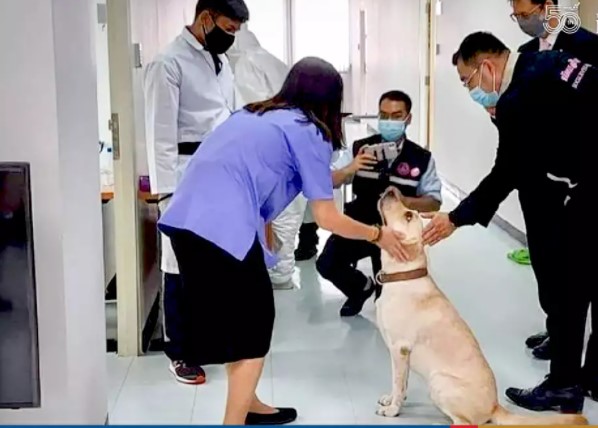
Covid-sniffing dogs led by volunteers will soon be screening Bangkok communities, as the capital battles record daily cases in Thailand's third wave of infections.
The project team has trained six Labrador retrievers to sniff out Covid-19 in human sweat.
Dr Kewali Chatdarong, Chula's deputy dean for research and innovation, said the project utilised the dogs' sense of smell – which is 50 times greater than that of humans – to detect infection in humans.
The project was conducted by placing cotton wool and socks into cans for dogs to sniff. The dogs were successfully trained to sit when they detected Covid-19 in sweat on the fabric.
The Labradors were found to have an accuracy of 94.8 per cent in detecting asymptomatic patients. The dogs will be used to complement normal screening operations.
Juti said at least two ministry volunteers will be sent to each of Bangkok's 50 districts, where they will train others to conduct sniffer-dog screening operations.
They will also be sent to international airports and seaports to help identify asymptomatic cases among arrivals from abroad.
The dogs will offer an alternative, speedy method to testing for Covid-19, especially when it comes to screening bedridden patients.
Commanders of the armed forces, led by Gen Prayut Chan-o-cha (centre), address the nation following the military coup on May 22, 2014.
At 4.30pm on May 22 seven years ago, Thailand saw its 13th successful military coup.
The putsch, silent and bloodless, was staged not with tanks on streets, but in a meeting room full of ministers, to the relief of exhausted protesters who had long urged then army chief Prayut Chan-o-cha to "take up the torch".
It followed several months of protracted street protests aimed at ousting then prime minister Yingluck Shinawatra.
Gen Prayut, pledging to "return happiness to the people", said an election would be held as soon as conditions stabilised. That ended up taking five years.
During that time, two draft constitutions were written and several laws either amended or passed by the National Legislative Assembly handpicked by him.
Not all of the laws were bad ideas. Among the better ones are the inheritance tax law and the land tax law but they have since proved to be ineffectual. The former was so watered-down that it led to collections of only a few million baht each year. The latter has yet to take effect.
A key element of the new constitution was that 250 senators handpicked by Gen Prayut will be able to vote alongside MPs for a prime minister.
A general election was finally held after several delays in March 2019.
While Pheu Thai, with a firm stand of not supporting Gen Prayut as PM, had the most votes, it still had to rely on votes from smaller parties to form a government.
With the support of 250 senators, Gen Prayut was viewed as a safer choice by smaller parties, in particular the Democrats and Bhumjaithai.
Wasted years
Yingluck wrote a message on Facebook on Saturday to mark the 7th anniversary, asking what the country and its people had lost over the years.
She cited competitiveness, jobs, quality of life, skill development and freedom.
"Seven years after the coup has been a period when the country and Thai people lost development opportunities," the exiled former premier wrote. "They have been years when the people's voice means nothing … when people are hopelessly waiting for a new constitution.
"Has Gen Prayut fulfilled his promise of returning happiness to the people? If not, the coup seven years ago, which promised reform before an election, is just an excuse."
Sudarat Keyuraphan, leader of the Thai Srang Thai Party and former chief strategist of Pheu Thai, also wrote on Facebook that she felt sorry for the lost opportunities of Thais.
"In seven years in office, Prayut has spent 20.8 trillion baht in state budgets and borrowed 4.9 trillion baht, sending public debt through the roof at a record 14 trillion, or 89.3% of GDP," she wrote.
She added that spending without a strategy only further impoverished Thais. "The administration flops in every dimension. I feel sorry for the lost opportunities of Thais."
What the future brings
Barring another coup, which is unlikely, the next election will be held in 2023. Gen Prayut is widely expected to secure an even bigger win. He will still have the support of 250 senators since their term ends a year later than that of the current MPs.
For seven years, the patronage system in the provinces has been further entrenched through increased centralisation by the Interior Ministry and bureaucracy.
Trillions of baht in handouts by the Prayut government have also restored local politics to the status quo of a decade ago, when influential local canvassers played a key role in elections and people become increasingly reliant on government support to survive.
Unless the constitution is changed to prevent senators from voting on a PM before the next election, Gen Prayut will likely be the prime minister for another six years, for a total of 13 years, beating Field Marshal Plaek Phibunsongkhram, the longest-serving PM to date with 9½ years in office. – Bangkok Post
Ousted fugitive former Prime Minister Yingluck Shinawatra wrote on her Facebook page on Saturday to say it is bitter and hurtful to see the Thai people failed by the junta led government, seven years after the military backed National Council for Peace and Order (NCPO) took power.
"Throughout the past seven years, I feel hurt and bitterness for my Thai brothers and sisters, who have been tolerating and hoping that the government will eventually do some good for the country. As the years have gone by, however, all the promises they made, to justify the coup against me, have no sign of ever being fulfilled," the former PM said, on the anniversary of the coup, led by now prime minister Gen Prayut Chan-o-cha, which toppled her administration in 2014.
Though a general election has been held, Yingluck said it was only to give an impression that the junta has already returned power to the people.
In reality, the Constitution was designed to ensure their continuation in power and the people's calls for its amendment have been ignored, she added.
"The past seven years, since the coup, are seven years of lost development opportunity and seven years of the people's voice being ignored. It is seven years that people have been hoping for a People's Constitution, which nobody knows whether it will ever be realised," Yingluck wrote.
The ousted prime minister also slammed the Prayut government for lacking empathy for the people and for failing them in taking care of the economy and the COVID-19 situation.
Referring to the NCPO's campaign promise of "Returning Happiness to the People," she asked if the junta had fulfilled that, or whether it was only an excuse to remove her government from power.
Yingluck has been living in self-exile since 2017, when a court ruled she was guilty of negligence in the rice-pledging scheme and sentenced her to five years in prison. – ThaiPBS
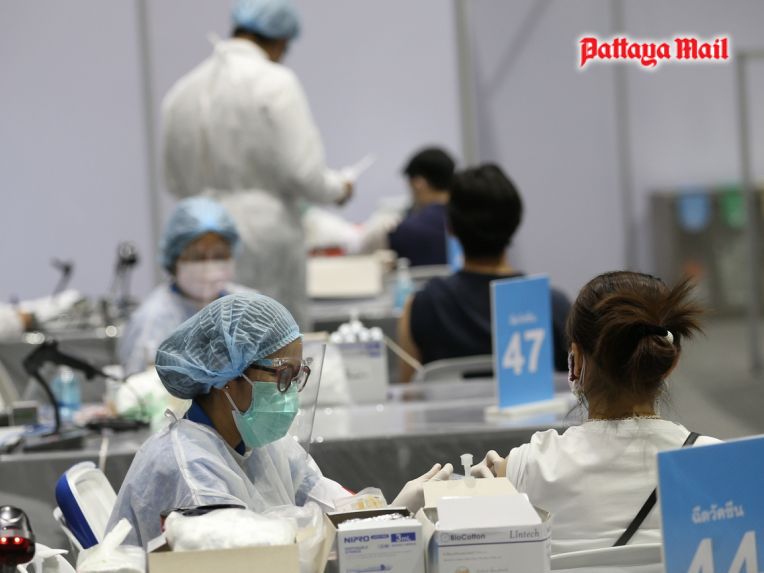
Pattaya health authorities are vaccinating as fast as they are able.
Economic gurus say that Thailand's Sandbox proposal to reopen the country to foreign tourists in coming months is extremely ambitious. The idea is to offer vacations without quarantine to vaccinated foreigners from July 1 in Phuket and from October 1 in Pattaya and several other tourist-friendly locations. The Tourist Authority of Thailand's latest website remains confident about the Sandbox timetable.
But Singapore-based Barclays Bank economists Brian Tan and Shreya Sodhani, in a new report, say that the recent surge in numbers of reported infections in Thailand will likely lead to delays in reopening. "In our base case, we think Phuket will reopen for tourism in September, followed by a few more provinces in December. We expect Bangkok to be reopened last, and only late next year," they wrote.
Thai authorities are aiming to administer one shot of the vaccine to 70 percent of its population, plus foreign residents, by September according to Health Minister Anutin Charnvirakul. But critics say that a mass immunization programme has hardly begun, whilst the country has been forced to secure vaccines from multiple brands after a new Covid-19 outbreak has seen cases quadruple and fatalities increase six-fold since the beginning of April.
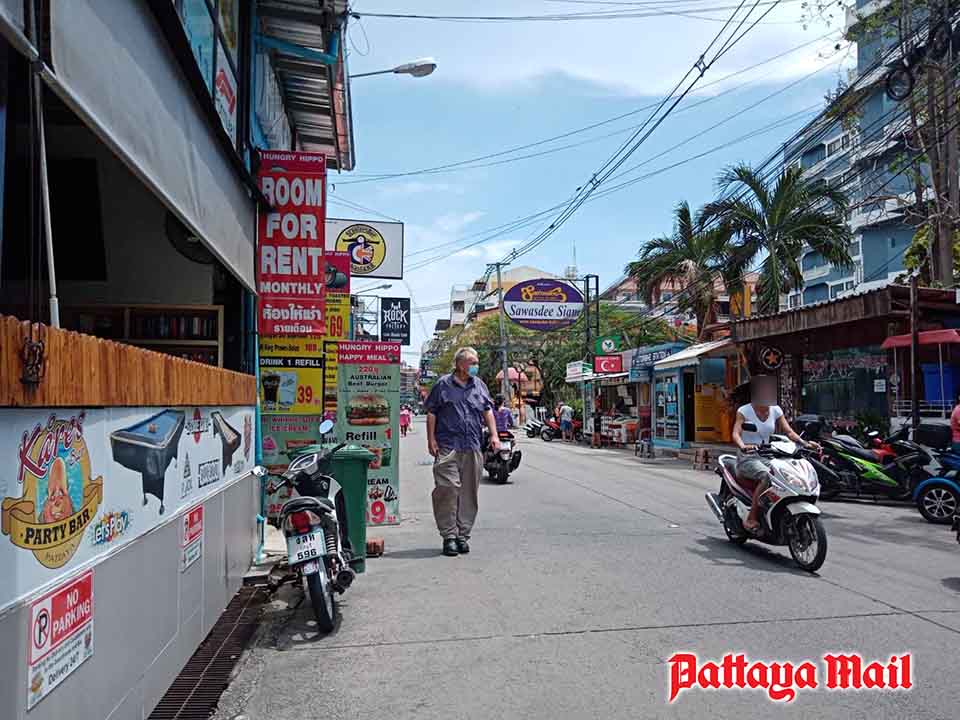
Pattaya's deserted streets reveal the depth of the tourist crisis.
Boonanan Pattanasin, president of the Pattaya Business and Tourism Association, said that the current rate of vaccination in the Pattaya area was too slow to achieve the 70 percent baseline by the end of September. Although there has recently been a decline in the number of coronavirus cases in Pattaya itself – now numbering around 15-20 daily – the key to reopening the city is vaccination. But supplies were hard to obtain, with the priority being Bangkok where clusters of virus variants are still being discovered.
Meanwhile travel agents round the world say the confusion around Sandbox is restricting interest in travel to Thailand. Marc Jouvet, spokesman for Pacific Area Travel, said, "People want to know if the beaches and entertainment facilities will soon reopen. There is no point in admitting holidaymakers if they are faced with padlocks on places they want to visit."
Manchester-based travel agent Hugh West said, "The British grading of travel destinations using traffic light colours has been a disaster with ministers giving different accounts of what they mean." He said the most important things for Thai authorities were to simplify the complex entry and visa regulations and to "let us know when the pubs in Pattaya reopen."
Thailand's goal of developing its domestic tourism market is only helped by its foreign tourism industry and is ultimately dependent on overall economic development and broader access to wealth among the wider population, not on tourism agencies or marketing drives. Chinese tourists will be absent from Thailand in 2021 as the communist government in Beijing has prioritised its own closed internal tourism market by deploying authoritarian command and control techniques. Indeed, similar measures have also been deployed in Europe, the United Kingdom, Australia and to a lesser extent the United States. It is, unfortunately for Thailand, an outcome that is ruinous for international tourism.
Thailand is making progress towards the reopening of foreign tourism to the kingdom without quarantine in Phuket on July 1st despite the ongoing struggle to effectively combat the third virus wave being fought nationwide and particularly in the inner city of the capital, Bangkok. This will be followed by a widening of destinations for foreign tourists including Bangkok itself on October 1st provided the current vaccination drive enjoys the same success as is currently being seen in Phuket. Despite that optimistic outlook, however, and in the midst of stubbornly high infection numbers and deaths, one of the country's top economic agencies is only predicting foreign tourist numbers at 1.25% of the level seen before the pandemic, in effect, a 98.75% wipeout.
The National Economic and Social Development Council, this week, cut its projected foreign tourist numbers to Thailand to 500,000 or only 1.25% of the level seen in 2019, mostly from western countries. This is despite the reported success in Phuket which is on track to open to vaccinated foreign visitors from July 1stwithout quarantine. Yuthasak Supasorn, the Director-general of the Tourism Authority of Thailand (centre) is predicting up to 26 million visitors in 2022 with more of a balance between domestic and foreign tourism.
The National Economic and Social Development Council, this week, reduced the projected number of foreign tourist arrivals to Thailand in 2021 down to 500,000 people or 1.25% of the number the country recorded during the record year for the tourism industry in 2019.
The figure is 7.7% of what was seen last year and is still dependent on the kingdom opening up to foreign tourists in a government plan that is underway and progressing well despite the deadly emergency created by the third virus wave.
Foreign tourist entering with a 14-day quarantine rule and at a rate of less than 1% of 2019 levels
Currently, foreign tourists are still entering Thailand but at less than 1% of the level seen in 2019 with proof of vaccination or a negative test required and subject to a strict 14-day quarantine rule which was reintroduced by the Centre for Covid-19 Situation Administration (CCSA) from May 6th given the increased threat faced by the country from the huge third wave of infection which has seen record numbers of Thais die from the disease.
Fears of the Indian virus variant has led to passengers from four countries being prohibited from entry
In addition, Thailand is currently prohibiting visitors from India, Bangladesh, Nepal and Pakistan since May 10th from entering the country until further notice.
This was achieved by the cancellation of all Certificates of Entry through the Ministry of Foreign Affairs for visitors from these countries due to fears of the Indian B.1.617.1 virus strain which has already been detected in Bangkok.
Vaccine rollout in Phuket working well with 14,000 doses a day being administered and over 50% of all adults already having received one dose
At the same time, work is proceeding on the vaccination rollout in Phuket where over 25% of the population is now vaccinated with an intensive campaign currently administering up to 14,000 doses a day to the adult population of the island of 466,587 people.
Over 52% of adults on the island province have already received their first dose which is cause for optimism that the June target of achieving 70% herd immunity will be achieved.
Stringent controls on entry to Phuket to protect the security of the proposed new haven from the virus
At the same time, authorities on the holiday island in the Andaman Sea have put in place stringent requirements to control the environment and to reduce infection rates within Phuket making it safe for vaccinated foreign tourists and the vaccinated population.
It is understood the measures being adopted have resulted in queues on land crossings onto the island causing some level of complaint from Thai visitors and locals still depending on the scarce domestic tourist trade.
TAT Governor urges sensitivity to local opinion
This week, Yuthasak Supasorn, the Director-general of the Tourism Authority of Thailand defended the measures but acknowledged the need for officials to be sensitive to local opinion on the ground.
'Facing hesitation from residents is unavoidable when reopening some areas to international arrivals,' he said in an interview with the Bangkok Post. 'We have to consider the risk as well as the sentiment of Thai tourists.'
Re-opening of Phuket on July 1st will be a milestone in Thailand's journey to overcome and exit from this pandemic emergency and recover economically
The reopening of Phuket will be a milestone in Thailand's recovery from this pandemic and authorities are hoping it will become a turning point for the country's overall fightback against the pandemic which has severely damaged the country's economy.
Currently, Thailand is reporting record levels of infection and deaths but the underlying figures, apart from the severe outbreak in the prison system, are showing a steady holding pattern even as 35 clusters of infection are reported in Bangkok.
However, authorities are still far from complacent.
Officials fear the virus spreading into the workplace and factories in key manufacturing provinces surrounding Bangkok and also the ramifications of the Indian strain of the virus being detected in Bangkok during the week at a building site in the Laksi district of the city.
9 other key foreign tourist hot spots including Bangkok scheduled to reopen from October 1st
If the July 1st reopening of Phuket to foreign tourists with vaccination and without quarantine goes ahead and is a success then the government is targeting 9 other key areas which accounted as the destinations for the vast majority of foreign tourists seen in the kingdom in 2019 or 75% of the ฿2 trillion in income generated.
These areas are Bangkok, Buriram, Chiang Mai, Chonburi, Krabi, Phang-nga, Phetchaburi, Prachuap Khiri Khan and Surat Thani.
Government spokeswoman said on May 13th it was targeting 9% of the numbers seen in 2019
On May 13th, the government, through Deputy spokesperson, Trisulee Traisanakul, outlined this programme and, at that time, suggested that 3.5 million visitors were expected in Thailand during 2021 spending up to ฿300 billion or ฿85,714 per visitor or $2,764. This compares to an average of ฿50,000 spent by each visitor in 2019 or $1,613.
The figure quoted this week by the National Economic and Social Development Council (NESDC) was ฿150 billion based on 500,000 visitors or an average of ฿300,000 per visitor or $9,677.
Chinese not among the numbers for 2021 as the communist country creates its own tourism options
Absent from the visitors expected before the end of 2021 will be Chinese tourists as the communist country, which in 2019 supplied 25% or 10 million of the country's 40 million visitors, has put an effective ban on outgoing holiday tours and has also, swingeingly, scaled back flights out of mainland China.
The deployment of Communist-style command and control techniques is increasingly in evidence under the present Chinese leadership and of course, easily justified during the pandemic crisis as indeed similar measures have also been deployed in western countries including Europe, Australia and the United Kingdom.
The outcome is ruinous for international tourism which, in a similar way to free trade, undeniably fosters better world understanding and relationships, the restoration of which should be a key priority after the health threat has been lifted.
Unfortunately, the pandemic has also put widespread international tourism under the spotlight as a political issue with questions being raised on the sustainability, in particular, of long haul flights.
The popular Conservative government in the United Kingdom recently raised the tax level on long haul flights including those to Thailand for this very reason.
Flights to Thailand scaled back by 99% from China as internal mainland flights rise above 2019 levels
Flight traffic to Thailand has been scaled back by Chinese authorities by over 99% at this time with no sign that the country's policy is going to change in the immediate future.
Remarkably, China is reporting a boost in internal flights and domestic tourism activity well above 2019 levels as the government there has reportedly developed a closed internal tourism model by developing its resorts such as Hainan and areas in Xinjiang and Yunnan to offer its population of 1.4 billion a range of holiday options while, at the same time, tightening entry regulations as protection against Covid-19 for the country from where the pandemic originated in 2019.
All Chinese travellers entering the mainland including travellers from Hong Kong are now required to submit to a full 28 day quarantine period.
Outlook for the Chinese market is not good
The outlook for the Chinese market was addressed, this week, by the President of the Association of Thai Travel Agents, Sisdivachr Cheewarattanaporn.
'We do not expect the Chinese government to relax international travel in the near future,' Mr Sisdivachr explained. 'Look at Hong Kong, which is close to the mainland and has handled the virus crisis better than us, yet Chinese people still have to quarantine when returning from Hong Kong.'
Thailand will be depending more on western visitors in 2021 especially from the United Kingdom, Germany and Scandinavian countries says minister
Minister of Tourism and Sports, Phiphat Ratchakitprakarn, says that Thailand is expecting most of its foreign tourists in 2021 to come from western countries, in particular the United Kingdom, Germany and Scandinavia.
There is a strong cohort of regular tourists and visitors to the kingdom in these countries as well as visitors from the United States and Australia. This depends, of course, in most cases, on outbound travel restrictions from those countries being relaxed by the end of the year or the fourth quarter.
Tourism industry boss again talks of rebalancing foreign and domestic tourism as a key goal
As the country gets ready to reopen to foreign tourists, the Tourism Authority of Thailand boss, Yuthasak Supasorn, has again suggested that Thailand will aim to balance its dependence on foreign tourism in 2022.
He points to 12 to 13 million Thai nationals who regularly travel out of Thailand on holidays as evidence that the country's population can sustain a stronger domestic tourism market.
However, last year's absence of foreign tourists in the country coincided also with a collapse of domestic tourism which, for instance in Phuket, saw 80% of the hotels on the island close up and overall occupancy in what was left reduced to 20 to 30%.
The same pattern was seen elsewhere.
No easy job to win back foreign tourists says Governor Yuthasak who highlighted scams targeted at visitors and a lack of public transport as drawbacks
The tourism chief also accepted that it will be difficult for Thailand to win back its foreign tourism market and has pointed to deficiencies in the public transport network and the culture of scams as two impediments that must be addressed.
'In the end, no matter the market, if the country cannot improve the supply of tourists by improving public transport and reducing the number of travel scams, it will be hard to win back tourists like in the past,' he admitted.
Aim in 2022 is for 48% of income to come from domestic sources with 26 million foreign tourists
He indicated that Thailand was aiming for a better balance between foreign tourism and domestic tourism in 2022 with a projected income of ฿1.2 billion from domestic tourism, up on the figure achieved in 2019 and ฿1.3 billion from foreign tourism.
At 2019 expenditure levels, this would equate to 26 million arrivals which is ahead of most projections which suggest that Thailand will be lucky to achieve half the level seen in 2019.
'The structure of Thai tourism has leaned towards the international market for too long, and this has proved difficult to change,' Mr Yuthasak points out.
Domestic tourism growth is more linked to overall economic development than marketing efforts
Developing Thailand's tourism economy is in fact, as we have seen, assisted by foreign tourism but depends far more on overall economic development not the marketing efforts of a tourism agency or the many organisations throughout Thailand dedicated to such pursuits.
As Thailand has discovered in 2020 and 2021, there is such a thing as flogging a dead horse to go further than it can otherwise go.
Even giving away money and vouchers for free stays and free flights to boost domestic tourism activity had very limited success.
It did result, however, in several high profile fraud investigations pursued by the Royal Thai Police.
The main driver of Thailand's domestic tourism industry, the same as everywhere in the world, must be economic development itself.
Western countries have a higher GDP per capita while some Asian countries are also far ahead of Thailand
Western countries have a higher GDP per capita than Thailand and this directly affects the kingdom's ability to generate income from tourism both locally and from foreign sources.
In 2019, Thai visitors spent ฿1 trillion within the domestic tourism industry. That's equivalent to ฿15,000 per head of population. Taking the Thai GDP per capita at $7,806 or ฿241,986, that's a generous 6.2%.
Taking the average spend per foreign tourist in 2019 and comparing, for instance to the UK's GDP per capita of $42,330 or ฿1,312,230, the average ฿50,000 expenditure by a foreign tourist comes to 3.8% per capita on each visit.
Asian countries like Taiwan with a GDP per capita of $32,130 or Singapore with a whopping $65,233, Hong Kong $48,713 or Japan at $40,246 indicate how far off, in economic development terms, Thailand still is.
Economic development and a free market
In essence, the goal of developing Thailand's domestic tourism economy is, to a far greater extent, linked to the development of the overall economy in the kingdom and the raising of income levels broadly across the population than it is to any marketing effort pursued by government agencies.
That is, of course, subject to a free travel market with the absence of government interference or control in this area, something most people hope to see a return of in 2022.