måndag 21 april 2025

Thailand’s Digital Arrival Card (TDAC) risks some teething issues. The form also acts as a personal health declaration and will require applicants to answer carefully personal questions and any countries recently visited if they are to avoid questions at Thai immigration on entry. It should be noted that TDAC registrations cannot be processed more than 72 hours ahead of travel.- Pattaya Mail

Thailand's Digital Arrival Card (TDAC) risks some teething issues

With TDAC authorization on your mobile phone, Thai immigration will be a piece of cake.

Other countries which have already introduced a pre-entry online arrival registration advise there are likely to be issues for a minority of travelers.  But Thailand's TDAC from May 1 will be cost nothing and will thus avoid the UK's Electronic Travel Authority's version which requires online payment.  There have been problems over there with processing credit and debit card transactions with tempers raised on social media.

The Malaysian version, which parallels the Thai TDAC, was introduced in 2024 and has sometimes experienced high traffic and slow loading times at busy periods.  One suggestion, if that happens, is to change the browser with Firefox being the favorite.  Certain details in both systems – such as passport number, name, nationality and date of birth – cannot be changed once submitted.  In TDAC, a mistake of that sort will require a totally new application.  Although TDAC has a website in several languages, the actual individual or group written submission must be in the English language and script.

The Philippines' e-travel portal and Cambodia's e-arrival card has caused problems for elderly foreign visitors who are not computer literate.  However, the immigration authorities in both countries have staff at major entry points assisting foreign visitors and even filling in the online application forms.  Thailand is likely to face the same issues and has wisely not instructed airlines to ban from boarding passengers without their QR code.  In other words, at least for now, those without a mobile phone or unable to submit the TDAC will not be barred from entering.  However, delays at immigration entry points are inevitable for defaulters.

One of the more complex systems is Singapore's digital arrival card. SGAC, which exempts several categories of foreigners such as Malaysians, permanent residents and some categories of workers and students.  Thailand does not have this problem as there are few exemptions apart from diplomatic personnel and transit passengers.  There is a TDAC exemption for "border pass" foreigners but they market traders, drivers or other locals crossing the border on a regular basis.  In spite of misinformation on social media, those westerners on visa runs or wanting a border hop are certainly not border pass holders.

The Thai Ministry of Foreign Affairs has recently updated relevant information.  The option of listing your home country as THA (Thailand) will be available in the final online version.  The form also acts as a personal health declaration and will require applicants to answer carefully personal questions and any countries recently visited if they are to avoid questions at Thai immigration on entry.  It should be noted that TDAC registrations cannot be processed more than 72 hours ahead of travel.  The email reply and confirmation should be received within hours.


söndag 20 april 2025

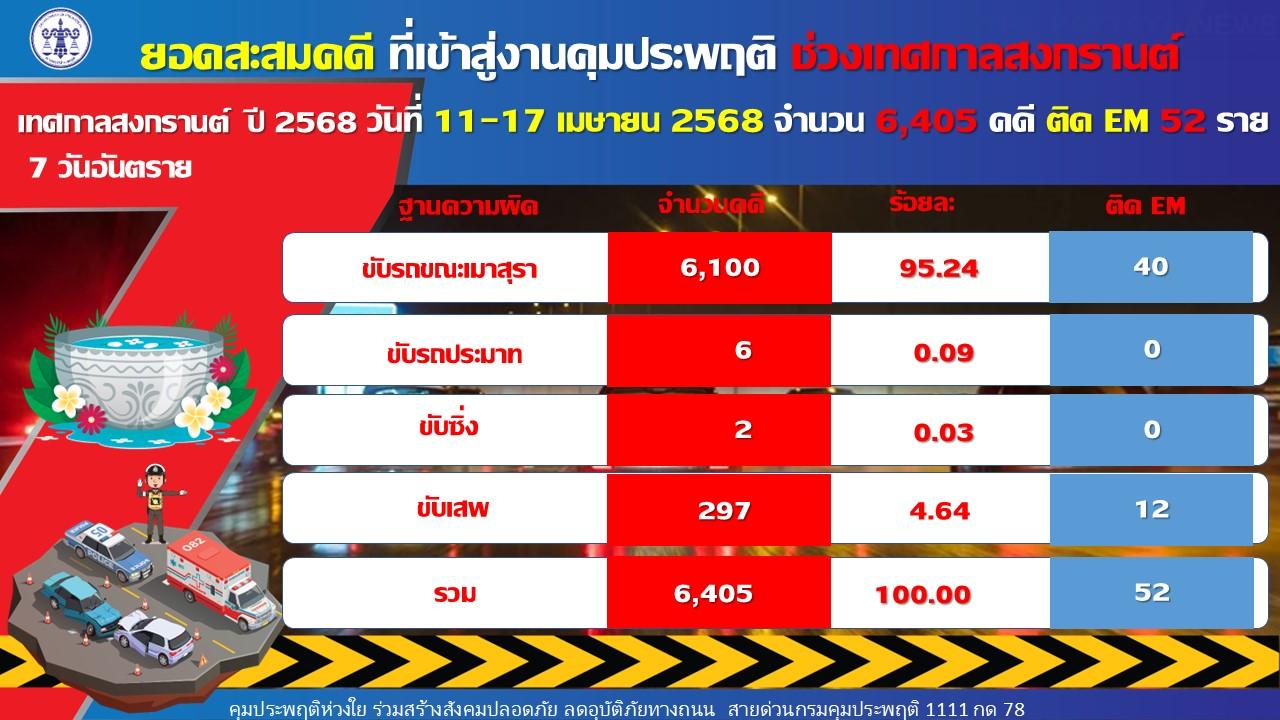
6,100 Cases Entered Probation for Thailand During Songkran For Drunk Driving. The Department of Probation told TPN media that a total of 6,405 cases entered the probation system during the seven-day Songkran campaign (April 11th – April 17th). This marks a 12.63% decrease from last year’s figure of 7,388 cases. The majority of these offenses—6,100 cases, or 95.27%—involved drunk driving, demonstrating the continued prevalence of impaired driving during holiday festivities.- The Pattaya News

6,100 Cases Entered Probation for Thailand During Songkran For Drunk Driving

PHOTO: Pracha Santisuk Rescue Team

Thailand –

The Department of Probation told TPN media that a total of 6,405 cases entered the probation system during the seven-day Songkran campaign (April 11th – April 17th). This marks a 12.63% decrease from last year's figure of 7,388 cases. The majority of these offenses—6,100 cases, or 95.27%—involved drunk driving, demonstrating the continued prevalence of impaired driving during holiday festivities.

Other infractions included reckless driving (6 cases, 0.09%), street racing (2 cases, 0.03%), and driving under the influence of drugs (297 cases, 4.64%). While the overall statistics show improvement, authorities added that drunk driving remains a serious issue, particularly in key urban centers.

Bangkok recorded the highest number of drunk driving offenses with 406 cases, followed by Samut Prakan (351 cases) and Chiang Mai (302 cases). Despite the nationwide drop in drunk driving incidents, these provinces remain areas of concern due to their high traffic volume and nightlife culture.

In addition to legal consequences, authorities have employed electronic monitoring (EM) devices to track repeat offenders. On the final day of the crackdown, 15 individuals were ordered to wear EM bracelets, bringing the total number for the entire week to 52 individuals. This technology allows law enforcement agencies to monitor offenders around the clock via the Electronic Monitoring Control Center (EMCC).


fredag 18 april 2025

Digital arrival bureaucracy spreading throughout Asia. Foreign travellers to south east Asian countries by land, sea or air will need to get used to electronic e-Arrival systems no matter whether they are tourists or business people or long stayers. In most cases, the bureaucracy needs to be completed online prior to arrival and applies to visa and non-visa holders alike.- Pattaya Mail

Digital arrival bureaucracy spreading throughout Asia
Governments want your details before you disembark.

Foreign travellers to south east Asian countries by land, sea or air will need to get used to electronic e-Arrival systems no matter whether they are tourists or business people or long stayers. In most cases, the bureaucracy needs to be completed online prior to arrival and applies to visa and non-visa holders alike.

Thailand's few exceptions, apart from Thai passport holders, are diplomats and official guests of the government, those transferring without going through immigration and "border pass" holders. The latter are local traders who pass regularly through Thai land borders to buy and sell. They are decidedly not visa runners or border hoppers seeking more time in Thailand.

Malaysia and Cambodia already have e-Arrival cards in operation which are similar to Thailand's which begins on May 1. But Malaysia exempts Singaporean citizens and certain longterm residents. Cambodia allows online registration up to 7 days (not 3) in advance. South Korea is introducing e-Arrival, but a paper option remains possible until 2026.

Thailand's spokesperson for the foreign affairs ministry, Nikorndej Balankura, said that passengers who fail to complete the online application in advance of travel will be able to do so at entry points, but warned that delays for individuals would be unavoidable. He stressed that only emergency cases should delay online registration in advance of travel.

He also added the clarification that longterm visa holders would be able to list Thailand – THA – as their country of residence if they so wish. Early drafts of the TDAC (Thailand Digital Arrival System) had not offered this choice. There is no definition of a longterm visa, but it is usually regarded as a 12 months or longer stamp in the passport.

The Thai TDAC is free, but worries have been expressed that fraudulent websites may spring up charging US$100 to issue a QR code. The Times of India reported this illegal practice had already cheated foreign travellers to Malaysia as well as exposing their personal details. Those registering for the TDAC should apply specifically at https://tdac.immigration.go.th within three days of their anticipated arrival.

Click here to watch Thai Immigation Information Video


Thailand’s Songkran: 200 Deaths Mark '7 Dangerous Days' of Festival. As Thailand's Songkran festival, the traditional Thai New Year, unfolds, the joyous celebration has been overshadowed by a grim reality. The Road Safety Centre reports that the death toll has climbed to 200, with over 1,300 injuries during the first six days of the festival, putting a spotlight on the country's persistent road safety challenges. ASEAN NOW


File photo for reference only


As Thailand's Songkran festival, the traditional Thai New Year, unfolds, the joyous celebration has been overshadowed by a grim reality. The Road Safety Centre reports that the death toll has climbed to 200, with over 1,300 injuries during the first six days of the festival, putting a spotlight on the country's persistent road safety challenges.


The yearly "Seven Dangerous Days" campaign, spanning April 11 to 16, recorded a troubling 1,377 road accidents, with speeding and motorcyclists featuring prominently in these incidents. The Deputy Permanent Secretary of the Interior Ministry, Kachorn Srichavanothai, conveyed these unsettling figures at a press briefing, revealing that on April 16 alone, 155 accidents resulted in 22 fatalities and 149 injuries.


The bulk of these incidents are linked to motorcycles, prompting authorities to intensify efforts at checkpoints to ensure helmet compliance. "Although many have returned to work, others are still travelling back from holiday destinations. We will continue strict enforcement," Kachorn emphasised.


A detailed breakdown reveals Lampang bore the brunt of accidents and injuries yesterday, recording nine of each. In contrast, provinces like Khon Kaen, Chaiyaphum, Pathum Thani, Ang Thong, and Phetchaburi each reported two deaths, marking them as particularly hazardous stretches.


Across the entire period from April 11 to 16, Bangkok reported the highest death toll with 16 fatalities, while Phatthalung recorded the most accidents at 52. Lampang, again, reported the highest number of injuries, tallying up to 56.


While the figures are concerning, there is a silver lining with 15 provinces recording zero fatalities, suggesting certain regions have managed to bolster road safety effectively.


Saharat Wongsakulwiwat, Deputy Director General of the Department of Disaster Prevention and Mitigation, issued a reminder to motorists to rest adequately and ensure their vehicles are in safe condition before hitting the road. "Fatigue and mechanical failures are a deadly combination," he warned, urging drivers to remain vigilant.


With one final day of Songkran travel ahead, authorities are on high alert. The overarching message is one of caution: "Drive safely, slow down, and keep your wits about you," officials urge, hoping to prevent further additions to the somber statistics.


As the Songkran festival draws to its close, the recent tragedies serve as a poignant reminder of the pressing need for improved road safety measures in Thailand. The festive season's dual nature—as a time of both celebration and danger—continues to call for vigilant action from both officials and the public alike, reported The Thaiger.


-- 2025-04-17


torsdag 17 april 2025

Thailand Faces High Road Fatalities as Songkran Safety Measures Launch. A recent World Health Organisation (WHO) and Statista report has placed Thailand among the top countries for road accident fatalities, recording a staggering death rate of 25.4 per 100,000 people annually. This drastically surpasses the global average and places Thailand alongside nations like Guinea, Libya, and Kenya in terms of road traffic mortality. ASEAN NOW

File photo for reference only


A recent World Health Organisation (WHO) and Statista report has placed Thailand among the top countries for road accident fatalities, recording a staggering death rate of 25.4 per 100,000 people annually. This drastically surpasses the global average and places Thailand alongside nations like Guinea, Libya, and Kenya in terms of road traffic mortality.


With nearly 18,000 deaths yearly—an average of 50 daily—Thailand's roads pose significant danger. Over 80% of these fatalities involve motorcycles, with issues like not wearing helmets, speeding, and driving under the influence highlighted as key factors.


In response to these alarming statistics, the Thai government has initiated a national road safety campaign coinciding with the Songkran festival period, from April 11 to 18. Led by the Deputy Prime Minister and Interior Minister, this initiative mobilises volunteers and sets up nationwide checkpoints to curb road fatalities during the high-travel holiday season.


Drunk driving, a notable contributor to road deaths in Thailand, tends to spike during holidays. The Department of Probation reported over 1,258 drink-driving cases on April 11 and 12, underscoring the need for stringent measures. Efforts include over 1,037 new probation cases with 94.70% linked to drink-driving on the latter day.


The government aims to leverage these safety measures to mitigate the typical spike in accidents during Songkran, emphasising that participation in festivities should not come at the cost of road safety. These efforts will be crucial in addressing the critical state of road safety in Thailand and reducing the toll on both lives and the economy, reported The Thaiger.


-- 2025-04-16


onsdag 16 april 2025

How Sweden’s Multicultural Dream Turned to a Nightmare of Gangs Violence, and Child Soldiers. Based on a report by The Telegraph 2025-04-16. ASEAN NOW


How Sweden's Multicultural Dream Turned Into a Nightmare of Gangs, Violence, and Child Soldiers


Once admired across Europe for its peaceful society and progressive ideals, Sweden now finds itself grappling with a grim reality: gangland killings, hired assassins, and the use of children as "soldiers" in an increasingly brutal criminal underworld.


To illustrate the severity of the crisis, investigative journalist Diamant Salihu needs only to share a few disturbing phone messages. These aren't ordinary spam texts. They're what have become known as "murder ads"—messages festooned with skulls and pistol emojis offering cash rewards to anyone willing to carry out contract killings. "All types of jobs are available," one reads, luring potential killers with the promise of up to one million Swedish krona (about £78,000). Another adds chillingly: "Age doesn't matter."


That detail is key. Sweden's child assassins are becoming a horrifying norm. Under Swedish law, children under 15 are too young to be prosecuted, which has led gangs to recruit minors with alarming frequency. "We have so many child soldiers that nobody can count anymore," says Salihu, an investigative journalist at SVT, Sweden's public broadcaster. "There are kids as young as 13 being arrested."


It is no exaggeration to say that barely a week goes by in Sweden without another teenager arrested for attempted murder or a hit job gone wrong. For Salihu, a former tabloid reporter with the calm demeanour of a detective in a Nordic noir novel, the story has become a personal crusade. But unlike fiction, the violence in Sweden has no neat resolution, no clear villain. It's a mystery rooted in decades of political choices, social challenges, and shifting demographics.


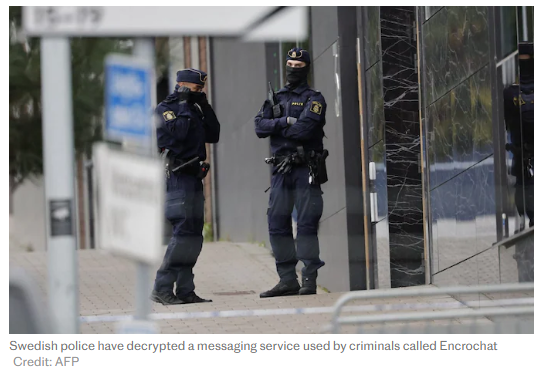
Over the past ten years, Salihu has chronicled Sweden's descent into gang warfare in two best-selling books. His first, Until Everyone Dies, examined the bloody feud between two Somali gangs that left nine young men dead. His latest, When Nobody's Listening, delves into the encrypted world of organised crime, following the revelations unlocked when European authorities cracked Encrochat, the preferred mobile network of criminals across the continent.


The book, newly released in English, expands on Salihu's exploration of a nation in crisis. Himself a migrant of Kosovan heritage, Salihu knows both the promise and pitfalls of Sweden's long-standing commitment to multiculturalism. He spent part of his early career in London, reporting for Expressen during the aftermath of the 2011 riots. When similar unrest broke out in Swedish cities just two years later, he began to see troubling patterns.


"In the Swedish areas that have social problems, I didn't see the same bad standard of housing and class differences that I saw in the UK," he says. "So why, when we in Sweden have a generally better standard of living, do we have this escalation of violence?"


It's a question many Swedes are now asking. In 2022 alone, Sweden recorded 62 fatal shootings—twice the number seen in England and Wales, which has six times the population. Only Albania had a higher rate of gun deaths per capita in Europe that year.


The perpetrators are no longer just motorcycle gangs or fringe thugs. Today's violence is largely driven by ethnically based organised crime groups, including the Foxtrot network—an outfit run by Kurdish criminals that looms large in Salihu's latest reporting. Foxtrot, though heavily involved in drug trafficking, operates more like a chaotic patchwork of freelancers. It was this gang that pioneered Sweden's online murder ad system, equipping teenagers with guns and grenades, often on loan, in exchange for deadly favours.


With even small towns now witnessing shootings and bombings, law enforcement struggles to keep up. Meanwhile, gang leaders are idolised on social media, their exploits glamorised by rappers and so-called "gangfluencers"—a word that entered the Swedish lexicon in 2021.

As Prime Minister Ulf Kristersson grimly put it: "Sweden has never seen anything like it before."


Even native-born Swedish youths are now taking part. "We also now see Swedish kids involved—some from broken backgrounds, but some whose parents are successful," Salihu says. "All they've maybe done before is steal something or play truant. Now they're getting involved in murder."

One especially chilling example emerged late last year when a 14-year-old was filmed committing a gang hit. Armed with a Kalashnikov, the child was captured on camera firing at the door of a residential building, reportedly to provide proof of the killing.


So how did it come to this? According to Salihu, part of the answer lies in social disconnection. Though Sweden has long invested in integration programmes, trying to prevent "parallel societies," those very divisions have nonetheless taken root.


Born on a farm in Kosovo, Salihu's early life was modest. "We had a horse and cart, like in the Borat movies," he recalls. His family fled the country in 1998 ahead of the war with Serbia, resettling in a Swedish town. His mother, he remembers, collapsed in grief upon learning her brother had been killed in the war.


At school, he encountered a Sweden full of promise. About 20 per cent of his classmates were fellow migrants, but many others came from well-off Swedish families. "That makes it harder for them to learn Swedish properly, and they won't see what I saw as a child. Society has become much more segregated," he says. "Swedes welcome people from every corner of the world, but don't actually want to live with them as neighbours."


But he doesn't place all the blame on racism. In his book, Salihu highlights communities where single mothers are left to raise large families alone.


Still, many of the gang members he interviews "actively choose their lifestyle," he says. "They've had all the opportunities, with siblings who've graduated and got good jobs, yet still they've chosen the bad path."


It's a path paved with violence. Murderers are often instructed via smartphone livestreams, sometimes told to record their actions. In December, one assassin even used a GoPro to film himself killing rapper Ninos Khouri in a Stockholm car park.


Salihu's work has made him a target. When Mustapha al-Jubouri, a former Foxtrot member, posted a video from Iraq declaring he had faked his own death—brandishing a gold Kalashnikov for effect—his followers launched a campaign against Salihu via Instagram. "It was being watched by 20,000 people," he says. "How could Instagram not do something about that, knowing what kind of people are involved, inciting murder and threatening journalists?"


The violence has also spilled across borders. In the UK, Swedish gang connections have surfaced in high-profile killings. In 2022, Tunisian kickboxer Anis Hemissi was convicted of murdering Swedish-Albanian crime boss Flamur Beqiri in London. Last year, Swedish police began hunting a gangster accused of killing two British businessmen, Juan Cifuentes and Farooq Abdulrazak, in Malmö.


Some gang leaders operate from abroad, shielded by foreign passports. Al-Jubouri remains in Iraq, while Foxtrot boss Rawa "The Fox" Majid lives in Turkey, having obtained citizenship there to avoid extradition. He is believed to have fled to Iran last year after escalating conflicts.


Majid's influence is even attracting geopolitical scrutiny. A year ago, Swedish officials accused Iran of enlisting local gang members for attacks on Israeli interests in Europe, including a grenade found near Israel's embassy in Stockholm. In response, the U.S. sanctioned Foxtrot, citing Majid's direct cooperation with Tehran.


The Swedish government is scrambling to respond. Juvenile sentencing has been toughened, and thanks to the Encrochat hack, about 400 gang members have been jailed. Politicians now want tighter regulation of social media to curb the spread of murder ads—something Salihu believes is a growing danger far beyond Sweden.


"You too may end up with British child soldiers, just as we are facing this crisis in Sweden," he warns. Though UK gun laws are stricter, knife crime is rampant. In the year leading up to March 2024, 57 people under 25 were stabbed to death, including 17 children under 16.


Despite a recent dip in Sweden's gun homicides—from 62 in 2022 to 45 last year—Salihu sees no cause for relief. The infrastructure of violence remains, he argues, and the stakes are getting higher. "These guys are predators," he says. "You have to stand up to them, not back off."


If Swedish society fails to confront the problem, Salihu warns, the targets of gang violence may one day include far more than just rivals. "I fear that our democratic institutions will come under pressure, be it prosecutors, or journalists – I myself would feel much more afraid."


Based on a report by The Telegraph  2025-04-16


måndag 14 april 2025

Drinking and Driving During Songkran - A dangerous tradition as authorities fight to reduce accidents. As the Songkran festivities continue in Thailand, a concerning trend has emerged: a significant number of revelers are choosing to drink and drive, putting themselves and others at risk. - Pattaya Mail

Drinking and Driving During Songkran – A dangerous tradition as authorities fight to reduce accidents

Drinking and driving continue to plague Songkran celebrations, with over 1,200 cases of drunk driving reported in the first two days.

PATTAYA, Thailand – As the Songkran festivities continue in Thailand, a concerning trend has emerged: a significant number of revelers are choosing to drink and drive, putting themselves and others at risk. Despite widespread awareness campaigns and traffic safety measures, driving under the influence remains a persistent problem during this time of year. The ongoing celebrations, with their heavy drinking culture and festive spirit, often contribute to a spike in accidents, making it a critical public safety issue.

According to the Department of Probation, over the first two days of Songkran, a staggering 1,363 cases of traffic violations have been recorded. This includes 1,258 cases of drunk driving, representing 92.3% of all offenses, with the rest related to reckless driving and driving under the influence of drugs. The statistics reveal a slight decrease compared to last year, where 1,131 drunk driving cases were recorded. However, the number remains alarmingly high.

On April 13, the Director-General of the Department of Probation, Pol. Maj. Col. Suriya Singhakamon, confirmed that 982 cases were reported on April 12 alone. As part of the preventative efforts, offenders are being monitored using electronic tracking devices (EM), with 15 individuals already under surveillance for the first two days of Songkran.

The top three provinces with the highest number of drunk driving cases are Samut Prakan, Bangkok, and Nonthaburi. Authorities have increased patrols and conducted joint operations with volunteer probation officers and local police to monitor high-risk areas and prevent further incidents. These measures include collaborating with traffic police to monitor driving behavior using CCTV cameras on major and secondary roads.

Officials are urging the public to celebrate Songkran responsibly. With the support of the Ministry of Justice, the government is encouraging everyone to follow traffic laws, avoid drinking and driving, and respect the safety of all road users. The goal is to reduce accidents and promote a safer driving culture during this joyous but dangerous time.


onsdag 9 april 2025

Chonburi real estate shifts strategy: From unsold housing projects to townhouse rentals amid declining sales for 2 consecutive years. The Nation

 Chonburi real estate shifts strategy: From unsold housing projects to townhouse rentals amid declining sales for 2 consecutive years

In recent years, the real estate market in Chonburi has been affected by several negative factors, particularly in the housing estate sector, where new sales have consistently declined since 2023-2024.

According to data from the Real Estate Information Center (REIC), new sales of housing estates in Chonburi in 2024 have decreased dramatically, with sales dropping between 10.3% to 51.7% from Q1 to Q4. This trend is similar to 2023, where sales were negative from 14.8% to 38.5%.

So, why has the real estate market in Chonburi experienced such a significant decline in new sales? The answer lies in the "shrinking purchasing power," which has led to financial institutions reducing the number of loans they approve.

#ThailandNews #TheNation #chonburi #REIC #realestate #rent

Full story link is in the first comment


måndag 7 april 2025

Sense and nonsense about Donald Trump. Understanding the American president is a box of tricks that not even his own family has managed to crack open. It is often said by commentators he is in serious mental decline when caught repeating himself or slurring words. On the other hand, he can answer reporters’ quickfire questions on all manner of subjects for an hour when standing up – which no other world leader dares to imitate- Pattaya Mail

Sense and nonsense about Donald Trump

The first foreigners kicked out of America were the Brits 200 years ago. (Photo: Wikimedia Commons)

EDITORIAL

Understanding the American president is a box of tricks that not even his own family has managed to crack open. It is often said by commentators he is in serious mental decline when caught repeating himself or slurring words. On the other hand, he can answer reporters' quickfire questions on all manner of subjects for an hour when standing up – which no other world leader dares to imitate.

Trump is a gifted orator when speaking to domestic audiences craving to hear the Make America Great Again slogan. He has taken clues from the 1930s when the America First Movement campaigned successfully for US isolationism, a grip only broken by the Japanese attack on Pearl Harbor in 1941. He shows some similarities with the rabble-rousing oratory of Adolf Hitler, especially the constant repeating of triumphant populist slogans, but Hitler was the result of an economic disorder whereas Trump is creating one.

The American president has skillfully used unpredictability to his advantage in many scenarios. It was assumed that his alleged sexual escapades and bribery would ruin his political career. Not so and bible thumpers adore him. He remains popular with the "moralistic" anti-abortion and anti-gay rights blocks in the Republican party. Trump claimed in the runup to the 2024 presidential election he would have no time for golf. Ugh! He successfully champions the poorer classes in America whilst indulging an eye-popping luxurious lifestyle.

If there is a key to Trump, it's likely his dyslexia which is obviously denied but is patent. He has no interest whatsoever in books or literature apart from praising his own ghost-written best seller. Many former staff members confirm his sources of information are charts, summaries, phone calls and conversations. Last month, Keith Starmer presented him with an invitation letter from King Charles. Trump was unable to scan it quickly and returned it to the British prime minister for the detail.

Being a slow reader is not a sin and a condition shared by many other influential people. But it leads to a lack of perspective on key issues when you are the so-called leader of the free world. Thus he quotes earlier examples of American tariffs 100 years ago, without any acknowledgement of the world recession which followed. He currently attacks Cambodia and Vietnam for cheating and robbing America without apparently appreciating that US planes bombed these countries almost to oblivion in the 1970s.

Donald Trump is a 20th century guy, in power in the 21st century but wanting to return his country to the 19th century. America then was isolationist, having recently kicked out the Brits, and tariffs on imports were indeed an alternative to federal income tax which was unknown before the American civil war. Trump's second term ends in under four years, assuming there is no palace coup to avoid his facing the electorate. As future British prime minister Winston Churchill said of Neville Chamberlain, "For now, he is somebody up with which we shall have to put."


Thailand Responds to U.S. Tariff Hike with Strategic Trade Measures. Deputy Prime Minister and Finance Minister Pichai Chunhavajira will travel to the U.S. next week to meet with government and business stakeholders, highlighting Thailand’s role not just as an exporter but as a reliable long-term economic partner.- The Pattaya News

Thailand Responds to U.S. Tariff Hike with Strategic Trade Measures

Thailand, April 6th, 2025 — Thai PM Paetongtarn Shinawatra issued a statement on Thailand's stance regarding the United States' new trade policy, which includes a 36% tariff on Thai exports

She acknowledged the serious impact on key sectors such as electronics, processed food, and agricultural products.

PM Paetongtarn emphasized the government's commitment to mitigating these effects. Deputy Prime Minister and Finance Minister Pichai Chunhavajira will travel to the U.S. next week to meet with government and business stakeholders, highlighting Thailand's role not just as an exporter but as a reliable long-term economic partner.

The government plans to propose increased imports from the U.S. in energy, aerospace, and agriculture, while also pushing for investment promotion and addressing trade obstacles. 

Thailand aims to expand new export markets in the Middle East, Europe, and India, and accelerate Free Trade Agreement negotiations. Emergency support for affected SMEs and large industries will also be provided.
A final policy direction will be announced after a national committee meeting on April 8th.


söndag 6 april 2025

Thailand Tourism Authority Moves to Ease Concerns and Fears Over Upcoming MANDATORY Digital Arrival Form. As Thailand gears up to welcome what they hope is an ambitious proposal for 40 million tourists in 2025, the Tourism Authority of Thailand (TAT) is rolling out a big update to its immigration process: the Thailand Digital Arrival Card (TDAC), which we covered in detail here previously.- The Pattaya News

Thailand Tourism Authority Moves to Ease Concerns and Fears Over Upcoming MANDATORY Digital Arrival Form
oplus_2

Thailand-

As Thailand gears up to welcome what they hope is an ambitious proposal for 40 million tourists in 2025, the Tourism Authority of Thailand (TAT) is rolling out a big update to its immigration process: the Thailand Digital Arrival Card (TDAC), which we covered in detail here previously.

Set to become mandatory for all foreign visitors starting May 1st, 2025, this shift from the traditional paper-based TM6 form to a fully digital system has sparked many concerns online, with some travelers afraid it will cause possible problems or delays to their trips. In response, the TAT is stepping up efforts to ease concerns, stating that the TDAC will be, according to them, a painless, user-friendly process designed to enhance—not hinder—the travel experience.

Thailand's tourism industry has seen a remarkable rebound, with over 35.54 million visitors in 2024 alone, a 26.27% increase from the previous year. This surge, fueled by relaxed entry policies and visa exemptions, has prompted the need for a more efficient and secure immigration system.

The TDAC, accessible online at tdac.immigration.go.th, replaces the paper arrival card that travelers once filled out by hand upon entry. The TAT views this as a natural evolution, aligning Thailand with global trends toward paperless travel seen in countries like Singapore and Malaysia.

"The TDAC is about making your arrival smoother and faster," a TAT spokesperson said. "We're not adding hurdles; we're removing them. This is a simple, modern tool to keep Thailand welcoming and accessible." The system allows travelers to submit their details—such as passport information, travel plans, and accommodation—up to three days before arrival, reducing wait times at immigration checkpoints.

Despite the promised benefits, the announcement of the TDAC has stirred some unease online as we have covered here, with travelers voicing worries about technical difficulties, accessibility, and potential delays. Posts on platforms like X and Facebook have highlighted fears of a cumbersome process or penalties for those unfamiliar with digital systems. The TAT is quick to counter these concerns, stressing that the transition will be straightforward and supported at every step.
"There's no need to panic," the TAT reassured in a recent statement. "This isn't a complex application or a barrier to entry—it's just the paper form you already know, now online."

The process is free, takes only a few minutes, and can be completed on any smartphone, tablet, or computer. For those less tech-savvy, the TAT is working with airlines, embassies, and tourism operators to provide assistance, including on-the-ground support at major entry points like Bangkok, Phuket, and Chiang Mai.

The TAT also points out that the TDAC is mandatory only for foreign nationals entering Thailand by air, land, or sea, with exceptions for those transiting without passing immigration or using a Border Pass. Thai nationals are also exempt, but not expats on various types of visas.Once submitted, travelers receive a confirmation—either digital or printable—to present at immigration, ensuring a seamless check-in.

To further calm nerves, the TAT is launching an international awareness campaign ahead of the May 1 deadline. This includes informational guides distributed at airports, partnerships with airlines to notify passengers, and multilingual resources online. The official TDAC website will open for submissions starting April 28, 2025, giving travelers ample time to familiarize themselves with the system. It is currently in beta mode and the TAT has stressed that certain features missing currently, like identifying Thailand as an expat's place of residence, will be added.

"We're here to help every step of the way," the TAT spokesperson added. "Whether it's a tutorial video, a helpline, or staff at the airport, no one will be left struggling or rejected from entry for failure to fill out the form." 

The TAT's message is clear: the TDAC is not a problem to dread. By cutting paperwork and streamlining arrivals, it's designed to keep Thailand competitive as a top global destination while managing the pressures of record-breaking tourism numbers. 

For travelers planning a trip to Thailand after May 1, the advice is simple: log on, fill out the form which is estimated to take less than a minute for most users, and enjoy your journey. The Tourism Authority of Thailand is determined to prove that this digital shift will be as painless as promised.

Photo credit: Adam Judd for The Pattaya News. 


lördag 5 april 2025

Donald Trump could determine the future of Pattaya. The first reaction in Bangkok to Trump’s new international tariffs was to assume they were an April Fool’s joke delivered a day late. The United States is Thailand’s biggest export market and, if a deal can’t be reached, billions of cash income in any currency you care to mention is at potential risk.- Pattaya Mail

Donald Trump could determine the future of Pattaya
Pattaya could be facing its greatest challenge yet in Trump's worldwide shock tariffs.

PATTAYA, Thailand – The first reaction in Bangkok to Trump's new international tariffs was to assume they were an April Fool's joke delivered a day late. The United States is Thailand's biggest export market and, if a deal can't be reached, billions of cash income in any currency you care to mention is at potential risk. The 36 percent tariff on imports to the US was much bigger than the Federation of Thai Industries predicted, but China, India, Vietnam and Cambodia amongst other Asian countries were also singled out.


One consequence, if the world chooses to retreat into 19th century trade wars, will be to send shocks to Asia's international travel ecosystem which leaves tourist cities such as Pattaya exposed. If world trade shrinks, business travel declines as reflected in Thailand's MICE conventions and exhibitions initiative which has to date been very successful in Pattaya. Then global mobility is suppressed as airlines reduce routes, the market for longterm visas becomes smaller and hotels see vacancies mushroom.

The worldwide holiday market also shrinks as it depends on discretionary income, that is what people have to spend after paying their bills. Tariff wars are usually accompanied by both unemployment and inflation, both of which discourage vacations abroad. Travel and Tour World is already predicting a negative impact on Asian beach resorts in Thailand, Vietnam, the Philippines and Cambodia as international numbers shrink. Cruises are another likely victim as cabins become harder to fill.

Pattaya may not be an industrial hub, but it is adjacent to the Eastern Economic Corridor (EEC), the advanced manufacturing and export base with infrastructure designed to attract international investors from many countries. In the past, the United States and the EEC have been linked through US investment in areas such as renewable energy and other strategic industries. US vice-president JD Vance has already ruled out that kind of international cooperation in future.

The Pattaya area has the second most valuable property assets in Thailand outside of Bangkok. The ongoing building program of luxury condominiums and gated estates assumes an ever-expanding number of rich expat and Thai communities. But there is also huge investment being poured into neon-lit entertainment districts across the city. In the past, Pattaya has weathered many challenges, most recently military coups and the covid crisis. But Pattaya's greatest challenge for the future could be unfolding right now before our very eyes.