fredag 16 maj 2025

Quake Risk Lurking Under Bangkok: Fault Lines Spell Trouble. Bangkok's unique geography makes it susceptible to earthquakes, despite Thailand's low overall risk of tremors, warns Prof Pennung Warnitchai from the Asian Institute of Technology. Speaking at the Bangkok Post Knowledge Forum, he shed light on how the city’s soft soil amplifies seismic waves, posing a potential hazard for high-rise buildings even from distant quakes. ASEAN NOW


File photo for reference only


Bangkok's unique geography makes it susceptible to earthquakes, despite Thailand's low overall risk of tremors, warns Prof Pennung Warnitchai from the Asian Institute of Technology. 


Speaking at the Bangkok Post Knowledge Forum, he shed light on how the city's soft soil amplifies seismic waves, posing a potential hazard for high-rise buildings even from distant quakes.


Prof Pennung illustrated the impact of these features by referencing the earthquake felt in Bangkok on March 28, which originated from Myanmar's Sagaing Fault.


"The city's soft soil and basin-like terrain slow and amplify seismic waves, resulting in long-period ground motion," he said. This soil composition can magnify ground motion by up to four times, significantly affecting tall structures.


With the possibility of local and regional earthquakes, Prof Pennung described three hypothetical quake scenarios that could threaten Bangkok.


These include a 7.5-magnitude quake along the Kanchanaburi Fault, an 8.0-magnitude quake along the Sagaing Fault in Myanmar, and a rare 8.5-9.0 magnitude quake from the Andaman Sea fault.


Despite the statistical improbability of these occurrences, with a mere 10% chance of happening in a lifetime, they highlight a non-zero risk.


In response, since 2007, Bangkok has imposed building regulations requiring new constructions to adhere to earthquake-resistant standards.


The city is divided into ten zones, each with tailored building codes to manage local risk levels. Additionally, Bangkok employs five seismic monitoring stations that gather data to support these safety measures.


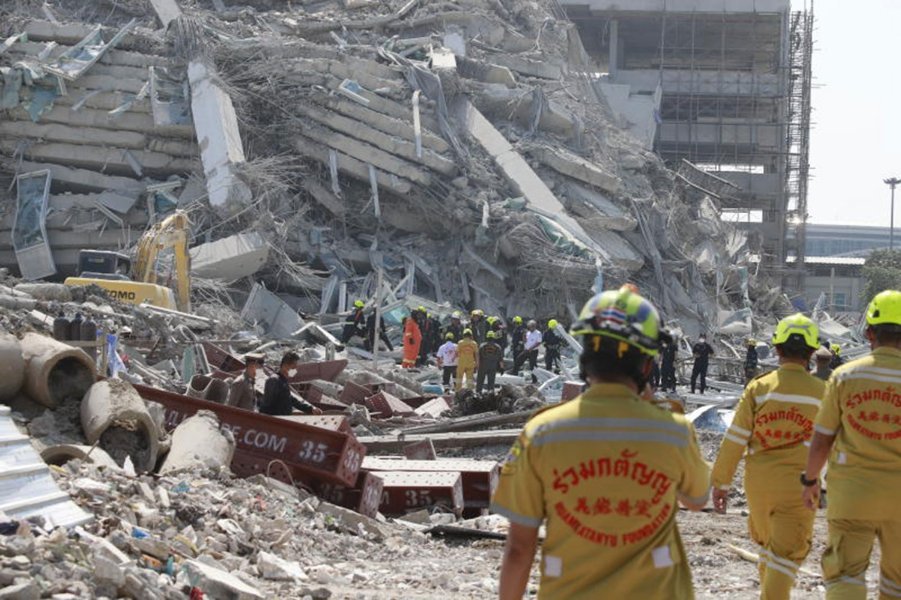
Most damage reported in the capital has been minor, affecting non-structural aspects of buildings rather than causing structural failures. However, the collapse of the State Audit Office building in Chatuchak after a recent tremor suggests lapses.


Prof Pennung, part of the investigation committee, indicated the building's unstable state contributed to its downfall, pending further inquiry into potential factors like corruption, poor materials, or design flaws.


This analysis underscores Bangkok's vulnerability while reminding that robust building practices and monitoring are crucial in mitigating seismic risk.


  Adapted by ASEAN Now from Bangkok Post 2025-05-16 

Bangkok Post - Tourism reform call as foreign arrivals in Thailand plunge. Thailand needs to urgently address the freefall in foreign arrivals, which is more pronounced this quarter among both leisure and corporate travellers, by reforming the sector and creating new destinations, according to a former head of the Tourism Authority of Thailand (TAT).

Tourism reform call as foreign arrivals in Thailand plunge
Roads virtually devoid of vehicles at Pathumwan intersection during the New Year period. Thailand's tourism industry has faced consecutive decreases in tourist arrivals since the start of this year. (Photo: Nutthawat Wichieanbut)
Roads virtually devoid of vehicles at Pathumwan intersection during the New Year period. Thailand's tourism industry has faced consecutive decreases in tourist arrivals since the start of this year. (Photo: Nutthawat Wichieanbut) 

Thailand needs to urgently address the freefall in foreign arrivals, which is more pronounced this quarter among both leisure and corporate travellers, by reforming the sector and creating new destinations, according to a former head of the Tourism Authority of Thailand (TAT).

Yuthasak Supasorn, former governor of the TAT and current chairman of the Industrial Estate Authority of Thailand, said foreign arrivals have contracted 1% this year as of May 11, attributed to a decrease from the East Asian market, which typically comprises 60% of the inbound market.

He said the greatest concern was the Chinese, Hong Kong and South Korean markets, which dropped 31%, 20.8% and 14.9%, respectively.

ADVERTISEMENT

The Southeast Asian market has contracted by 2.2%, with Vietnam dipping 15%, while the only market in the region that grew was Myanmar, by 13.5%.

Tourist arrivals from China previously averaged 900,000 per month, or 30,000 a day. However, in the first four months of this year, only 13,739 Chinese a day visited Thailand, said Mr Yuthasak.

Total daily arrivals have plunged to less than 60,000 this year, down from an average of 100,000 prior to the pandemic.

Moreover, the Mice (meetings, incentives, conferences and exhibitions) segment also declined in the first quarter of 2025, with the international market plunging 15% and revenue dropping 21% year-on-year.

"We must stop this freefall and halt the crisis in Thai tourism, bringing back tourists and using this opportunity to restructure to attract higher-quality visitors," said Mr Yuthasak.

As safety has become a critical tourist concern, rebuilding the nation's image is insufficient to restore the market, as the hospitality sector needs to be elevated to regain travellers' trust, he said.

Mr Yuthasak said fundamental development in the industry has been neglected for many years, as evidenced by the Travel & Tourism Development index conducted by the World Economic Forum (WEF) in 2024.

According to the WEF, Thailand was 47th in the rankings, down 12 places, the sharpest decline among Southeast Asian nations, with an average score lower than the region in all pillars.

On safety and security, Thailand plummeted by 16 places, while travel and tourism demand sustainability also plunged by 59 places.

Competitors have a stronger reputation than Thailand in terms of safety, so the government should accelerate improvement in this field for tourists by upgrading both products and services, Mr Yuthasak said.

Thailand should encourage tourists to visit new destinations to help refresh perceptions of the country, rather than relying on a few popular but crowded beaches and islands, he said.

In terms of tourism products, he said boosting the high-spending segment in particular was necessary, especially the health and wellness segment as well as business travellers who want to blend their leisure trips together.

"It's time to shift the development approach from a demand-driven to a supply-driven model via quality products," said Mr Yuthasak.

"This involves developing high-value products and services to meet the needs of quality tourists, creating satisfaction and excitement, and strengthening a healthy ecosystem that ensures the fair and equitable distribution of tourism income to local areas and communities."


tisdag 13 maj 2025

Thailand Increases Passenger Rights with New Flight Delay and Cancellation Protections. Approved by the Civil Aviation Board, chaired by Deputy Prime Minister and Minister of Transport Suriya Jungrungreangkit, these measures aim to enhance the rights of passengers on both domestic and international scheduled flights, addressing disruptions such as delays and cancellations with a focus on fairness and accountability.- The Pattaya News

Thailand Increases Passenger Rights with New Flight Delay and Cancellation Protections

Bangkok, May 12th, 2025 – The Civil Aviation Authority of Thailand (CAAT) has unveiled new passenger protection regulations under Civil Aviation Board Notification No. 101, set to take effect on May 20, 2025.

Approved by the Civil Aviation Board, chaired by Deputy Prime Minister and Minister of Transport Suriya Jungrungreangkit, these measures aim to enhance the rights of passengers on both domestic and international scheduled flights, addressing disruptions such as delays and cancellations with a focus on fairness and accountability.

The new rules come as Thailand's aviation sector continues to recover and grow post-pandemic, with the country welcoming millions of tourists annually. The regulations are part of a broader effort to align Thailand's aviation standards with international benchmarks.

Enhanced Protections for International Flights

The regulations place a strong emphasis on supporting passengers impacted by unannounced delays or cancellations, particularly those already at the airport. For international flights, the measures outline specific obligations for airlines based on the duration of the delay:

  • Delays Over 2 Hours: Airlines are required to provide complimentary food and beverages or vouchers tailored to the time of day and length of the delay. Additionally, passengers must have access to free communication tools, such as phone calls or email, to manage their plans.

  • Delays Over 5 Hours: In addition to food and communication support, airlines must offer at least 1,500 baht (approximately $45 USD) in cash compensation, credit, travel vouchers, frequent flyer miles, or equivalent alternatives within 14 days. Passengers who choose to cancel their travel plans can opt for a full refund or alternative transportation arrangements, such as flights to the same or nearby destinations.

  • Delays Over 10 Hours: Compensation increases to between 2,000 and 4,500 baht (approximately $60–$135 USD), depending on the flight distance. Airlines must also provide accommodation and shuttle services for passengers requiring overnight stays.

In cases of flight cancellations without at least seven days' notice, airlines must provide the same level of assistance as for delays exceeding 10 hours. However, exemptions apply if the airline arranges alternative flights within three hours of the original schedule or if cancellations are due to unavoidable external factors, such as severe weather or air traffic control issues.

Tarmac Delays and Onboard Protections

The regulations also address tarmac delays, ensuring passengers are not left stranded onboard aircraft for extended periods. Airlines must maintain adequate ventilation, air-conditioning, and access to toilets during such delays. If a delay exceeds three hours without a confirmed takeoff time, passengers must be allowed to disembark unless safety or air traffic control restrictions prevent it. Immediate medical services must be available for passengers in need.

For domestic flights, the new rules increase existing compensation levels to better protect travelers within Thailand. For delays exceeding five hours, compensation rises from 600 baht to 1,200 baht (approximately $36 USD). For cancellations, compensation increases from 1,200 baht to 1,500 baht. Airlines may offer alternatives like travel vouchers or miles, but cash remains an option. As with international flights, no compensation is required for disruptions caused by weather, disasters, etc.

Industry and Passenger Implications

The regulations are expected to place additional operational and financial responsibilities on airlines, particularly low-cost carriers that dominate Thailand's domestic market. Airlines failing to comply could face criminal penalties under the Air Navigation Act, reinforcing the seriousness of the new measures. For passengers, the rules promise greater peace of mind, especially for international travelers navigating Thailand's busy airport hubs like Suvarnabhumi and Don Mueang airports.

As the May 20, 2025, implementation date approaches, CAAT plans to roll out awareness campaigns to ensure both airlines and passengers are well-informed. With these protections, Thailand is positioning itself as a leader in passenger rights in Southeast Asia, balancing the needs of travelers with the demands of a dynamic aviation sector.


lördag 10 maj 2025

fredag 9 maj 2025

Covid-19 Resurgence in Thailand: Over 8,000 Cases Reported in a Week. Thailand is witnessing a worrying resurgence of Covid-19 cases, with over 8,446 hospital visits recorded between 27th April and 3rd May. Following Bangkok, other areas with significant numbers include Chonburi with 680 cases, Nonthaburi reporting 490, Rayong with 380, and Samut Prakan recording 327 cases. This resurgence underscores a pivotal challenge as the country hoped to maintain control over the Covid-19 situation. ASEAN NOW


File photo for reference only


Thailand is witnessing a worrying resurgence of Covid-19 cases, with over 8,446 hospital visits recorded between 27th April and 3rd May. This uptick in cases has been brought to attention by Assoc Prof Dr Thira Woratanarat, a respected public health expert from Chulalongkorn University. Bangkok has emerged as the epicentre of this latest wave, logging the highest number of new infections at 2,377, according to Dr Thira's recent analysis.


Following Bangkok, other areas with significant numbers include Chonburi with 680 cases, Nonthaburi reporting 490, Rayong with 380, and Samut Prakan recording 327 cases. This resurgence underscores a pivotal challenge as the country hoped to maintain control over the Covid-19 situation.


One of the notable trends in this recent surge is the age distribution of those affected. The highest infection rates are among individuals aged 30 to 39 years, accounting for 1,794 cases. Close behind are those aged 20 to 29, with 1,540 cases. Crucially, older adults over 60 also figure prominently, recording 1,536 infections. However, it is the spike in cases among very young children, aged 0 to 4, that is raising special concern, with 682 cases identified.


Dr Thira has highlighted these dynamics to alert public health officials and the general public about the broader implications of this trend. He pointed out that between 4th and 7th May, Covid-19 cases were roughly double the number of influenza cases, spotlighting the severity of the current outbreak. In this period, there were 2,593 Covid-19 cases compared to 1,321 influenza cases.


Worryingly, there has also been one recorded Covid-19-related death during this timeframe. The health expert warns that individuals showing symptoms right now have a two-to-one likelihood of having Covid-19 over influenza, with an estimated 67% chance of contracting the virus if symptomatic.


In response to this renewed threat, Dr Thira stressed the importance of targeted precautions for vulnerable groups such as young children, school students, the elderly, and those already hospitalised. He advises that individuals, particularly those working, should make health assessments a routine to ensure both personal safety and the safety of others. Dr Thira also recommends routine screening for inpatients and those scheduled for surgery, helping to safeguard patients and medical staff within healthcare facilities.


He further called on educational institutions, childcare centres, elderly care facilities, and hospitals to adopt and enforce effective risk management strategies promptly. Quick action is necessary, he emphasised, to prevent a broader outbreak that could affect diverse age groups. The call for vigilance and proactive measures aligns with a global understanding that pandemic control requires collective effort and community-wide commitment.


  Adapted by ASEAN Now from The Nation 2025-05-08

tisdag 6 maj 2025

Immigration issues far too fragmented says Thai interior ministry. The aim of Interior Minister Anutin Charnvirakul to create a new Immigration Affairs department of state would replace an outdated bureaucracy well past its sell-by date. Although foreign tourists and expats only see the Immigration Bureau as responsible for border control regulation, the reality is that many state agencies are involved in policy implementation.- Pattaya Mail

Immigration issues far too fragmented says Thai interior ministry

Another group of unwanted guests in Thailand is hastily deported.

The aim of Interior Minister Anutin Charnvirakul to create a new Immigration Affairs department of state would replace an outdated bureaucracy well past its sell-by date. Although foreign tourists and expats only see the Immigration Bureau as responsible for border control regulation, the reality is that many state agencies are involved in policy implementation.

For example, the Ministry of Foreign Affairs issues new visa regulations to its embassies abroad whereas the immigration police are responsible for who actually enters and for how long. The advent of the Destination Thailand Visa has illustrated the confusion between Thai embassies abroad (under the control of the Foreign Affairs Ministry) and immigration officers on duty at airports and borders.

The Ministry of Labor is responsible for the issuing of work permits, whereas the Immigration Bureau controls the length of visas associated with them. But the Board of Investment's (BOI) one-stop-shop is also heavily involved in establishing separately trading companies, work permits and visas. Applications for the 10-year Long Term Residence, amongst others, go directly to the BOI.

Anutin's proposed reform would also shift the perception of immigration from simply a security issue to border management and human welfare concerns. Current policies categorize illegal entrants and overstayers as threats. But there are also humanitarian concerns such as political refugees and asylum seekers. Even some western tourists have been inhumanely treated when "accidental" overstay occurs, for example because of prolonged hospitalization.

The existing immigration framework can lead to mass forcible return of Myanmar political refugees, even though the Thai economy is in dire need of unskilled and semi-skilled workers from neighboring countries. The deportation of Uyghurs back to China reflects rigid immigration rules contrary to the suppression of torture act of 2022 which explicitly bans deportations to locations where torture or persecution is likely. Human rights cannot be exempted from all immigration matters.

A new department of state would have very broad duties. They would include residency permits to foreigners including the 5-20 years Elite (Privilege Card), granting work authorization, administering citizenship and naturalization processes and managing civil registration for both Thais and foreigners. The last over-arching immigration reform was in 1979 when the agenda was focused on the shifting populations after the end of the American war in south east Asia.

However, the barrier to all progress on immigration issues remains corruption. Currently there is rampant people smuggling, foreigners running proxy businesses, illegal working and chronic abuse, as reflected in recent scandals about student visas being awarded to applicants with nefarious intentions. Unless corruption is tackled, changing structures won't get very far.


måndag 5 maj 2025

Thailand Enforces Stricter Education Visa Rules to Combat Misuse. BANGKOK, May 5, 2025 — Thailand has rolled out a crackdown on Non-Immigrant ED (education) visas, introducing five new measures to address widespread misuse by foreigners exploiting these visas to extend their stay without pursuing studies.- The Pattaya News

Thailand Enforces Stricter Education Visa Rules to Combat Misuse
Oplus_0

BANGKOK, May 5, 2025 — Thailand has rolled out a crackdown on Non-Immigrant ED (education) visas, introducing five new measures to address widespread misuse by foreigners exploiting these visas to extend their stay without pursuing studies. Announced on April 30 by the Ministry of Higher Education, Science, Research and Innovation (MHESI) and the Immigration Bureau, the reforms aim to restore integrity to Thailand's international education system while aligning with broader immigration controls.

The crackdown was spurred by cases of visa abuse, notably at a Chiang Mai campus, where over 500 Chinese students held ED visas but did not attend classes. Authorities also flagged instances of scammers and individuals involved in illegal activities using these visas, prompting a reevaluation of the system. Below are the five measures now in effect:

  1. Mandatory Program Approval: Educational institutions must submit detailed information about non-degree international programs to MHESI for approval before enrolling foreign students. This ensures that courses meet educational standards and are not merely fronts for visa issuance.

  2. Enhanced Data Reporting: Schools are required to provide regular, detailed reports on student enrollment, attendance, and program progress. This measure aims to create a transparent record, making it easier to identify discrepancies or non-compliance.

  3. Random Compliance Inspections: The Immigration Bureau and MHESI will conduct unannounced checks at educational institutions to verify that students are actively attending classes. These inspections target institutions with suspicious enrollment patterns to ensure visa holders are genuinely studying.

  4. Data Sharing for Investigations: Any irregular or suspicious data identified during inspections or reporting will be shared with MHESI for further investigation. This could lead to visa revocations for students and penalties for institutions failing to comply.

  5. Program Revocation Penalties: Institutions found violating the new regulations risk having their programs revoked. Such penalties could also impact their ability to offer international programs in the future, incentivizing compliance.

The measures come amid Thailand's broader immigration reforms. While the crackdown aims to protect Thailand's reputation as an educational destination, it may pose challenges for legitimate international students, who now face increased scrutiny, and for institutions, which must navigate heightened administrative requirements.

Authorities added that the reforms target visa abusers while preserving opportunities for genuine students. However, some worry that overly stringent rules could deter prospective learners, potentially impacting Thailand's education sector. The Immigration Bureau has pledged to monitor the measures' impact and adjust as needed to balance security and accessibility.

Photos: Stock photos of Thai law enforcement. 


Surely it’s time to stop bashing Pattaya. The last few weeks have seen a veritable explosion of negative news about Pattaya in both mainstream and social media. The main emphasis has been on the loutish behavior of tourists (often Brits) variously found peeing disgustingly in public places, attempting copulation on the beach with varying degrees of success, attacking strangers or policemen in a drunken stupor and getting badly beaten up.- Pattaya Mail

Surely it's time to stop bashing Pattaya

Pattaya's Walking Street in the 2020s and in the 1980s, but has the city really changed?

PATTAYA, Thailand – The last few weeks have seen a veritable explosion of negative news about Pattaya in both mainstream and social media. The main emphasis has been on the loutish behavior of tourists (often Brits) variously found peeing disgustingly in public places, attempting copulation on the beach with varying degrees of success, attacking strangers or policemen in a drunken stupor and getting badly beaten up. The professional name for such news is doomscrolling, though it's actually click bait or enticement to click on the story. Pattaya Mail is certainly no exception.

The most recent moan is that the 60 days visa-exempt policy is responsible for a decline in the number of quality tourists and a rise in the arriving hordes of riff-raff. Yet there is absolutely no evidence that naughty boys need two months to create mischief, or that a reduction to 30 days visa exempt would reduce their quantity. In any case, these guys could easily double their 30 days visa exempt to 60 days by obtaining an easy extension at local immigration. The belief that shuffling round how many days tourists can receive on entry will actually improve the respectability of arriving visitors is a doomscroller's fancy.

Pattaya or Sin City, of course, is well used to being rubbished in the media. The shock-horror began in the 1970s when the News of the World found out there were actually brothels for foreigners in Walking Street. In the 1980s, the magazine Your Travel predicted that the advent of AIDS would drive the cesspool Pattaya back into the stone age. Next came the unsavory publicity about underage boys servicing pedophiles via bars in Sunee Plaza (all of which were permanently closed by 2014). The COVID crisis of the early 2020s also gave rise to the Facebook clairvoyance that Pattaya would remain a permanent ghost city.

City Hall's attempts to reorientate Pattaya's future have been mostly ignored by doomscrollers: they don't want to know about luxurious condos and hotels, family entertainment venues, the expansion of sports facilities, international music festivals and high class restaurants to rival those in Bangkok or most other Asian capital cities. Critics have also ignored the establishment of the internationally-funded Eastern Economic Corridor which has already transformed Pattaya's hinterland with circular roads and improved communications. To the doomscroller, nothing much has happened to change Pattaya since the end of the Vietnam war, except the influx of Chinese and Indian tourists who are invariably seen as bad news.

Nobody denies that night revelry and commercial sex are still part of the vibrant Pattaya scene. But many of the traditional playgrounds have been knocked down in redevelopment programs, whilst Walking Street has radically diversified and now contains many fewer gogo clubs actually still open. These days the main night spots are Soi Buakhao and Soi Six, whilst the gay crowd can relax in Pattaya's Boyztown or Jomtien's Complex. Mayor Poramet Ngampichet believes that the sex trade has declined substantially, as a percentage of gross revenue, and stresses the region's economic growth potential for both Thai and foreign investors.

Of course, Pattaya's transition is far from complete. Many of the same historic problems, flooding in particular, remain in parts of the city. Chaos on the roads is getting worse as traffic police retreat to clamping vehicles and towing away motorbikes rather than actually being on duty. The "new" or "neo" Pattaya may be years away from completion. But the idea that the city is sinking into the abyss is as ridiculous as ever it was.


söndag 4 maj 2025

Re: From Honk to Harm - When a simple car horn turns violent in Pattaya. In many countries, a short honk of the horn is nothing more than a harmless signal — a polite way to alert another driver or express impatience in traffic. But in Pattaya, Thailand’s bustling seaside city known for both its nightlife and chaos, a single honk can quickly spiral into something far more dangerous. For foreigners behind the wheel, this seemingly minor act could provoke road rage, confrontation, or even violence.- Pattaya Mail

Hallo Ola , meine Freundin Lada hatte mir gesagt ich solle nicht Hupen mit den Tuk Tuk das könnte schnell zum Boxing führen
LG Thomas


Ola Jansved <olajnsvd@gmail.com> schrieb am So., 4. Mai 2025, 09:31:
From Honk to Harm – When a simple car horn turns violent in Pattaya
Pattaya MailMay 4, 2025
Pattaya-7-From-Honk-to-Harm-When-a-simple-car-horn-turns-violent-in-Pattaya-1-copy.jpgWhat's just a beep in your country could be seen as a fight in Pattaya. (File Photo)

PATTAYA, Thailand – In many countries, a short honk of the horn is nothing more than a harmless signal — a polite way to alert another driver or express impatience in traffic. But in Pattaya, Thailand's bustling seaside city known for both its nightlife and chaos, a single honk can quickly spiral into something far more dangerous. For foreigners behind the wheel, this seemingly minor act could provoke road rage, confrontation, or even violence.

Stories abound of minor traffic interactions turning ugly. In one recent case, a foreign driver tapped his horn after being cut off by a local motorbike rider. Instead of an apology or even indifference, he was met with aggressive shouting, intimidation, and an attempted assault. What started as a reasonable response to careless driving nearly turned into a physical altercation — all over a horn.

This isn't an isolated incident. Pattaya's roads are filled with unspoken rules, and for foreigners, not understanding these "norms" can carry unexpected consequences. Unlike in the West, where honking is often used casually, in Thailand — especially in places like Pattaya — the sound of a horn is often taken personally. It's interpreted not as a signal, but as a challenge or insult.

Should Foreign Drivers Adapt to Local Sensitivities?

Absolutely — if they value safety. While no one should have to fear violence over a traffic signal, the reality in Pattaya suggests that self-preservation might require more cultural sensitivity than logic would suggest. Local drivers, especially in chaotic urban settings, often interpret honking as a sign of disrespect. This can trigger knee-jerk reactions, especially when the perceived "offender" is a foreigner.

Pattaya has a long-standing tension beneath its tourist-friendly surface. That tension — combined with high emotions, congested roads, and occasional nationalist undertones — can create a powder keg on the streets. Something as simple as a horn becomes a spark.

Driving in Thailand: Beyond the Rules of the Road

Foreign drivers are advised not just to follow traffic laws but to understand local behavior. Be patient. Let things go. Avoid honking unless absolutely necessary — and even then, consider whether it's worth the risk. Avoid eye contact after a confrontation. Don't engage with anger.

Because while Thailand is known as the "Land of Smiles," on the roads of Pattaya, those smiles can disappear fast.

Pattaya-7-From-Honk-to-Harm-When-a-simple-car-horn-turns-violent-in-Pattaya-2-copy.jpgCultural sensitivity isn't just polite — on Pattaya roads, it might just keep you safe. (File Photo)


From Honk to Harm - When a simple car horn turns violent in Pattaya. In many countries, a short honk of the horn is nothing more than a harmless signal — a polite way to alert another driver or express impatience in traffic. But in Pattaya, Thailand’s bustling seaside city known for both its nightlife and chaos, a single honk can quickly spiral into something far more dangerous. For foreigners behind the wheel, this seemingly minor act could provoke road rage, confrontation, or even violence.- Pattaya Mail

From Honk to Harm – When a simple car horn turns violent in Pattaya
What's just a beep in your country could be seen as a fight in Pattaya. (File Photo)

PATTAYA, Thailand – In many countries, a short honk of the horn is nothing more than a harmless signal — a polite way to alert another driver or express impatience in traffic. But in Pattaya, Thailand's bustling seaside city known for both its nightlife and chaos, a single honk can quickly spiral into something far more dangerous. For foreigners behind the wheel, this seemingly minor act could provoke road rage, confrontation, or even violence.

Stories abound of minor traffic interactions turning ugly. In one recent case, a foreign driver tapped his horn after being cut off by a local motorbike rider. Instead of an apology or even indifference, he was met with aggressive shouting, intimidation, and an attempted assault. What started as a reasonable response to careless driving nearly turned into a physical altercation — all over a horn.

This isn't an isolated incident. Pattaya's roads are filled with unspoken rules, and for foreigners, not understanding these "norms" can carry unexpected consequences. Unlike in the West, where honking is often used casually, in Thailand — especially in places like Pattaya — the sound of a horn is often taken personally. It's interpreted not as a signal, but as a challenge or insult.

Should Foreign Drivers Adapt to Local Sensitivities?

Absolutely — if they value safety. While no one should have to fear violence over a traffic signal, the reality in Pattaya suggests that self-preservation might require more cultural sensitivity than logic would suggest. Local drivers, especially in chaotic urban settings, often interpret honking as a sign of disrespect. This can trigger knee-jerk reactions, especially when the perceived "offender" is a foreigner.

Pattaya has a long-standing tension beneath its tourist-friendly surface. That tension — combined with high emotions, congested roads, and occasional nationalist undertones — can create a powder keg on the streets. Something as simple as a horn becomes a spark.

Driving in Thailand: Beyond the Rules of the Road

Foreign drivers are advised not just to follow traffic laws but to understand local behavior. Be patient. Let things go. Avoid honking unless absolutely necessary — and even then, consider whether it's worth the risk. Avoid eye contact after a confrontation. Don't engage with anger.

Because while Thailand is known as the "Land of Smiles," on the roads of Pattaya, those smiles can disappear fast.

Cultural sensitivity isn't just polite — on Pattaya roads, it might just keep you safe. (File Photo)


lördag 3 maj 2025

Thailand Faces Tourism Crisis – Minister Sorawong urges urgent action amid foreign visitor slowdown. Pattaya Mail

Thailand Faces Tourism Crisis – Minister Sorawong urges urgent action amid foreign visitor slowdown
Minister Sorawong Thienthong chairs a high-level meeting with key tourism industry leaders to address the decline in foreign tourist arrivals.

PATTAYA, Thailand – Minister of Tourism and Sports, Sorawong Thienthong, chaired an urgent meeting with key private-sector tourism associations—such as the Association of Thai Travel Agents (ATTA), the Thai Hotels Association (THA), the Tourism Council of Thailand (TCT), and the Airline Association of Thailand—to address the growing concerns over the sharp slowdown in foreign tourist arrivals to Thailand.

Minister Sorawong acknowledged that the situation is reaching a crisis point. From January 1 to April 27, 2025, Thailand recorded 11,841,911 international visitors—an increase of just 0.12% compared to the same period last year. Despite the stagnation in numbers, total revenue from foreign tourists reached 565.6 billion baht, reflecting a trend toward higher-spending, quality tourists. The top five source markets during this period were China (1.6 million), Malaysia (1.48 million), Russia (865,634), India (729,414), and South Korea (571,409).

The Minister attributed the drop in tourist numbers mainly to safety concerns and negative perceptions spread through international media, particularly in Chinese and English, sometimes due to mistranslations. He emphasized the importance of collaboration across all sectors to improve Thailand's global image and communicate accurate, positive news.

Addressing complaints about the rising costs of travel in Thailand—including accommodation, tourist attractions, and airfare— Sorawong stated that the focus should be on value and fairness rather than low prices. He also proposed reducing the excise tax on aviation fuel and increasing charter flights to attract more tourists. Furthermore, discussions are underway with the Ministry of Transport to standardize public transport fares across land, rail, and sea.

Sorawong warned that if negative media trends persist, they could damage Thailand's overall international reputation beyond just the tourism industry, highlighting the increasing competition from countries like China aggressively targeting the same tourist markets.

From Jan–Apr 2025, Thailand welcomed 11.84 million tourists—just a 0.12% increase from last year, signaling a looming crisis.


fredag 2 maj 2025

Re: Latest news on Thailand Digital Arrival Card. Pattaya Mail

Danke Ola , ich hoffe dir geht es gut 👍 und du bist gesund. LG Thomas und Lada


Ola Jansved <olajnsvd@gmail.com> schrieb am Fr., 2. Mai 2025, 10:27:
Latest news on Thailand Digital Arrival Card

Pattaya MailMay 2, 2025
Pattaya-9-Latest-news-on-Thailand-Digital-Arrival-Card.jpgThe introduction of the digital arrival card has been less bumpy than feared.

Same day border hoppers – those obtaining extra time in Thailand by crossing briefly into Cambodia or another neighbouring country – do have to fill in the online TDAC form whilst waiting an hour or two before returning here. Those travelling with an agency may find the TDAC form is filled in by accompanying staff, but those travelling alone will need to deal alone with the new bureaucracy.


Most of those undertaking border runs are Destination Thailand Visa holders seeking another six months' sojourn, visa-exempt foreigners looking for a further 60 days and some multiple entry non-immigrant visa holders who must leave Thailand after three months stay. Immigration officers at land entry points say that the rules and regulations for border hops are under renew by a governmental working party examining visa exempt regulations and their many repercussions. For now, there are no national changes.

In other developments, foreign visitors at Thai airports who have not filled in the TDAC in advance may find computer desks and helpful officers on duty to assist the forgetful and the computer illiterate. The foreign affairs ministry has stated again that the TDAC has to be filled in 72 hours or less (not more) prior to arrival in Thailand. In general, inauguration day on May 1 went smoothly at airports and land and sea entry points, although some passengers believed they must print the confirmatory email to give to the immigration officer on arrival. In fact, it is OK simply to show him or her the email on your mobile phone.


Foreign visitors are reminded by the Thai cyber police about fake websites which charge a processing fee for completing TDAC before absconding with people's biometric information and credit or debit card details. Investigations are underway and at least one fake site has been blocked already. The legitimate TDAC service is presently free but must be repeated before every entry to Thailand. It's http://tdac.immigration.go.th


Latest news on Thailand Digital Arrival Card. Pattaya Mail

Latest news on Thailand Digital Arrival Card

The introduction of the digital arrival card has been less bumpy than feared.

Same day border hoppers – those obtaining extra time in Thailand by crossing briefly into Cambodia or another neighbouring country – do have to fill in the online TDAC form whilst waiting an hour or two before returning here. Those travelling with an agency may find the TDAC form is filled in by accompanying staff, but those travelling alone will need to deal alone with the new bureaucracy.


Most of those undertaking border runs are Destination Thailand Visa holders seeking another six months' sojourn, visa-exempt foreigners looking for a further 60 days and some multiple entry non-immigrant visa holders who must leave Thailand after three months stay. Immigration officers at land entry points say that the rules and regulations for border hops are under renew by a governmental working party examining visa exempt regulations and their many repercussions. For now, there are no national changes.

In other developments, foreign visitors at Thai airports who have not filled in the TDAC in advance may find computer desks and helpful officers on duty to assist the forgetful and the computer illiterate. The foreign affairs ministry has stated again that the TDAC has to be filled in 72 hours or less (not more) prior to arrival in Thailand. In general, inauguration day on May 1 went smoothly at airports and land and sea entry points, although some passengers believed they must print the confirmatory email to give to the immigration officer on arrival. In fact, it is OK simply to show him or her the email on your mobile phone.


Foreign visitors are reminded by the Thai cyber police about fake websites which charge a processing fee for completing TDAC before absconding with people's biometric information and credit or debit card details. Investigations are underway and at least one fake site has been blocked already. The legitimate TDAC service is presently free but must be repeated before every entry to Thailand. It's http://tdac.immigration.go.th


Fake Thailand Digital Arrival Card website alert. The first fake Thailand Digital Arrival Card (TDAC) website has already been spotted on the day that the real system made its debut for foreign visitors to the kingdom. The fake website, claiming to be from an official third-party service provider, asks users to pay a processing fee of US$10 while the real one is free. Bangkok Post

 Fake Thailand Digital Arrival Card website alert
Beware: Any website asking you to pay money for a Thailand Digital Arrival Card, such as the one above, is a scam. (Screenshot)
Beware: Any website asking you to pay money for a Thailand Digital Arrival Card, such as the one above, is a scam. (Screenshot) 

The first fake Thailand Digital Arrival Card (TDAC) website has already been spotted on the day that the real system made its debut for foreign visitors to the kingdom.

The fake website, claiming to be from an official third-party service provider, asks users to pay a processing fee of US$10 while the real one is free.

The TDAC system replaces the paper TM6 arrival cards that travellers used to fill out. It is required for all foreign nationals entering Thailand by air, sea or land and took effect on May 1.

Travellers can fill out their details at the official TDAC website, after which they will receive an email that they can show on arrival in the country.

Responding to confusion about the deadline for applying, the Immigration Bureau has clarified that applications can be submitted within a three-day period prior to arrival, but not earlier. Some previous reports said applications had to be made at least three days before arrival.

"The system is fully ready, and backup measures are in place to ensure smooth operations. During the initial phase, travellers who encounter any issues can temporarily use a paper immigration form," the Ministry of Tourism and Sports said in a statement.

There are also computer terminals available at Immigration at Suvarnabhumi Airport for travellers who need to fill out a TDAC form when they arrive.

This is the official TDAC website run by the Immigration Bureau.