The UN Security Council debates the ThaI-Cambodian border violence. (UN file photo)
The United Nations Security Council (UNSC) has drawn a non-partisan conclusion about the ongoing Thai-Cambodian border rows. Thai foreign affairs minister Maris Sangiampongsa, returning from New York, said the 15 UNSC members had advocated neighborly dialogue and peace, but had not issued a formal declaration nor taken sides. They had expressed support for Asean's role in enabling dialogue under the charter of the 10 grouped states in southeast Asia. But Asean is customarily very reluctant to become involved in the detail of territorial disagreements between members, many of which hark back to rulings by colonial powers 100 years or more ago.
The decision has been received with relief in Bangkok. Cambodia initiated the UNSC meeting held in New York on July 26 and several of the current members (5 permanent and 10 temporary) were thought to have closer ties with Cambodia than Thailand has. UNSC has the power actually to order a fact-finding mission, or to deploy its military forces to troubled areas or to fast-track the dispute to the International Court of Justice (ICJ) at The Hague, but has evidently not taken any such course. The ICJ in 1962 and in 2013 previously voted to endorse Cambodia's position on some border issues, especially the Preah Vihear temple, but left ambiguous ownership of surrounding land. However, Thailand had declined to accept ICJ rulings as early as 1960.
In fact, many countries have opted out of ICJ verdicts. Israel and China have both refused verdicts against their national interests, whilst the US has done so on multiple occasions. Only last week the US State Department said that an ICJ ruling that all states were obliged under international law to tackle climate change was no more than advisory. Donald Trump's administration has embraced a fossil-fuel agenda under the slogan Drill Baby Drill. The British government has also indicated it will study the international decision before deciding whether or not to accept it.
Associate professor Panitan Wattanayagorn, a security expert, said the UNSC outcome was promising for Thailand but was only the beginning of a long diplomatic struggle. Cambodia has already appealed independently to the ICJ, although the matter could take years without UN backing. The ICJ is already deluged with depressing cases including Haiti, the Congo, Syria and the Red Sea. Dr Panitan advised proactive engagements with third party countries and providing comprehensive information on Cambodia's alleged violations of Thai sovereignty. These include landmine placements, artillery shelling of hospitals, schools and civilian targets. These actions could even be classified as crimes against humanity.
Meanwhile, Thai activists at the border regions told reporters that it was obvious Cambodia had started the violence last week. Their evidence was that, whilst Thai children were at their desks when the trouble began, Cambodian youngsters had already been sent home in order to avoid any gunfire retaliation. It has also been suggested that satellite data imaging also shows that Cambodian forces attacked first, although this information was not presented to the UNSC.
Cambodianess reports on Sunday afternoon, July 27, 2025, that the conflict between Cambodia and Thailand goes back to the 13th century, cting a Cambodian expert saying that, "following the decline of the Angkorian Empire. Thailand, as the successor to the Sukhothai and Ayutthaya Kingdoms, gradually encroached upon Khmer territory. Facing potential extinction, Khmer leaders sought French protection in the late 19th century, preserving their territory through the Franco-Siamese Treaties of 1904-1907, which resulted in the return of three provinces: Battambang, Siem Reap, and Sisophon."
Khaosod English's Pravit Rojanaphruk initial take: This is an important admission, reflecting how history is dragging the two nations into endless conflicts and animosity.
Thailand, if you look beyond a narrow ultranationalist lense, is also an heir to the great Angkorian civilisation. We can choose our own favourite timeline to suit our nationalistic ideology, and some Thais still yearn for the days when Siam Reap, including Angkor Wat, was part of Thailand (Siam), before the French colonialists took it away from Thailand.
While it's imperative to remember the pasts, in which we cannot change, our focus should be on how to put an end to the current senseless undeclared war between the two nations.
The Royal Thai Army Clarifies the Use of Cluster Munitions, Stating Consideration for Use as Necessary to Enhance Capabilities Against Military Targets Only
On 25 July 2025, Major General Winthai Suvaree, Army spokesperson, clarified the case regarding Cambodia's statement about the Thai side's use of cluster munitions, stating that the Royal Thai Army will consider its use as necessary against military targets to enhance target destruction capabilities.
With cluster munitions, when the main projectile impacts the target, the submunitions contained within will detonate continuously. Such munitions are not anti-personnel landmines and have no long-term residual effects on civilians following their use.
Regarding the Convention on Cluster Munitions (CCM), which prohibits parties from using, producing, or stockpiling this type of weapon, it is not binding on Thailand, as Thailand is not a party to that convention, similar to many other countries, such as the United States, Russia, and others.
The Royal Thai Army affirms that its military operations adhere to the principle of "proportionality," whereby cluster munitions will be employed to enhance explosive destruction capabilities against military targets only.
………………………………………………………………………… Royal Thai Army Public Relations Center, Army Spokesperson Team,
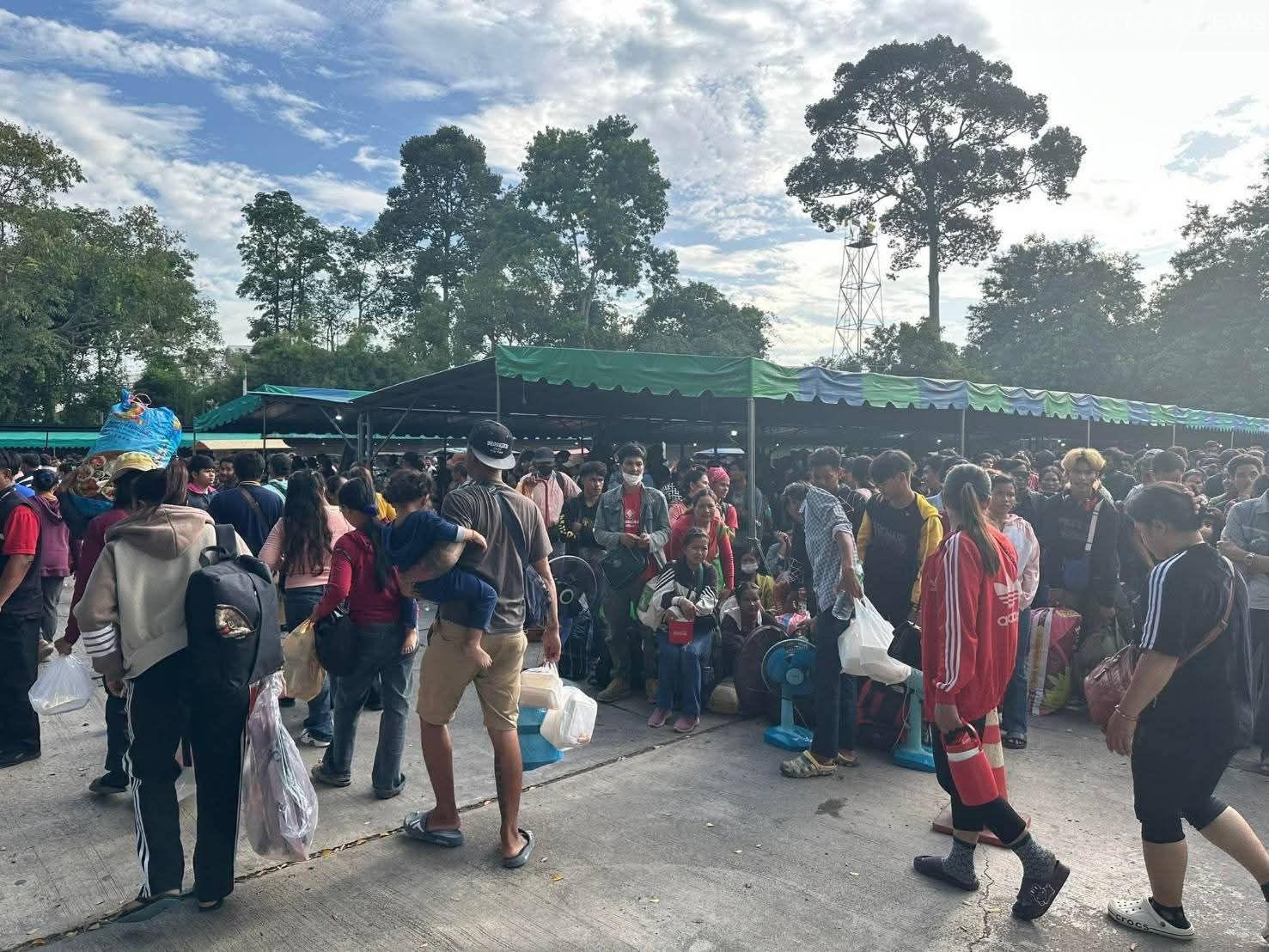
Thai citizens shelter in emergency accommodation after a Cambodian rocket attack in a disputed zone.
Although several governments have issued travel warnings, none has advised against visiting Thailand and Cambodia. The British Foreign, Commonwealth and Development Office simply warns travellers not to go within 50 kms of the border in the at-risk provinces. The most popular destinations – Bangkok, Pattaya, Phuket, Chiang Mai, Hua Hin – are hundreds of miles from the scene of any shootings or panic. Cambodia's main attractions in Phnom Penh and the famous archaeological site at Siem Reap are similarly free from border-related violence.
Few western vacationers to Thailand include border regions in their holiday itinerary, except to see the remains of 1,000 year-old temple ruins such as the magnificent Preah Vihear. These are closed anyway from either side for the duration of the conflict. Most of the land border's 800 kms are not under dispute. There is separately a longstanding warning by British authorities not to visit three deep-south Thai provinces with Muslim secessionist movements. They are rarely visited by holidaymakers and irrelevant to the current crisis.
Travellers intending to visit both Thailand and Cambodia should bear in mind that all land border crossings between the two countries are currently sealed. Although they occasionally open to let through emergency cases, such as the sick or young students, international tourists are banned from crossing. Air schedules between the two countries are reported as normal, but flights are said to be heavily booked. If the ongoing conflict were to get worse, air travel between the protagonists could be compromised in tat-for-tat name calling.
Thai citizens shelter in emergency accommodation after a Cambodian rocket att
Pattaya immigration lawyer Jessataporn Bunnag said, "Most western tourists coming to Thailand, including all Brits, now receive 60 days visa-exempt on arrival with the offer to extend a further month at local immigration. Thus there is no need for them to go on border hops or visa runs to neighboring Cambodia." He added that all international visitors should fill in the online form Thailand Digital Arrival Card not more than three days before arriving.
Border rows between the two neighbors go back over 100 years when disputed maps were drawn up by French colonialists who then ruled Cambodia but not Thailand. Over the years, 200 people have been killed or injured in periodic flareups at sensitive spots which mostly include temple ruins. Whilst Cambodia invariably seeks international rulings in its favour, Thailand's position is that territorial disputes should be settled by the two parties alone.
Both countries are members of the regional trading block ASEAN, but the organization almost never becomes seriously involved in disputes between members. Both the United States and China have offered to mediate the current issue, but there is unease in both countries and beyond about appealing to divergent superpowers. The most likely outcome at present seems to be a mutual withdrawal to perceived lines of control. Thailand and Cambodia have too much in common, economically and culturally, to declare war. Assuming, of course, that insanity doesn't break out.
The following is an official Statement by the Royal Thai Government on the Thailand-Cambodia Situation
My fellow Thai citizens,
Currently, Thailand is facing threats to our sovereignty and territorial integrity from Cambodia. Although in the past few months we have exercised our utmost restraint and patience in the face of provocations and aggression, and have chosen to adhere to peaceful means in accordance with international law and humanitarian principles.
Therefore, it is deeply regretful that Cambodia has chosen to use military force and opened fire first. This is a severe violation of international law and humanitarian principles as their attack has targeted hospitals and residential areas resulting in the immense loss of lives and properties, including 13 civilian fatalities among which are women, children and the elderly. This can be considered a war crime.
Yesterday, the Thai Foreign Minister briefed the United Nations Secretary-General on the facts of the current situation.In addition, the Thai Government sent a letter to the United Nations Security Council to inform the Council of the facts and to condemn in the strongest terms these indiscriminate and armed attacks, especially against innocent civilians, as well as invite the international community to also condemn this inhumane attack.
The government expresses its deepest condolences for the loss suffered by our citizens and reaffirms that throughout this period, the government has not stood idle since Cambodia fired the first shot. The Thai armed forces have responded within a limited perimeter targeting only key bases from which attacks against Thai civilians have been made, based on the inherent right of self-defense under international law and the United Nations Charter. They have destroyed Cambodian military bases.
We have now had to evacuate people numbering in the hundred thousand from the affected areas. We will also issue assistance in the form of compensation for the families of the deceased totaling 1 million baht per person; 700,000 baht for the disabled; 200,000 baht for the severely injured; and 100,000 baht for the injured.
Furthermore, we have coordinated with all airlines to arrange special flights to bring Thai nationals in Cambodia back home safely in the case of emergency. Tomorrow, the minister assigned will travel to the affected areas covering four provinces namely, Ubon RatchaThani, Si Sa Ket, Surin and Buriram. This is to instill confidence in the people in the affected areas to feel safe and togive them moral encouragement and support.
This is a time when all Thais must unite as one to send encouragement and moral support to all our soldiers who are on duty to protect our sovereignty and territorial integrity as well as the safety of the people in the affected areas.
I would like to emphasize that the current situation is a dispute between the governments and armed forces of both countries and not between the people. This is not a declaration of war but merely a clash along the border in order to protect our sovereignty and territorial integrity and to respond to the aggression.
Finally, it is with our utmost gratitude that Their Majesties the King and Queen have expressed their concern and given their encouragement to their subjects that have suffered losses from the current tensions in the area and have graciously placed all of the injured and wounded under their royal patronage.
Cambodia's Hun Sen's hidden agenda for unprovoked, deadly and destructive actions may involve China
As Cambodia bombed Thai civilians and military sites, Hun Sen's secret China flight sparks global alarm. Thailand hits back fast, urges UN action. With China's shadow looming and ASEAN stability at risk, a hidden agenda may have driven the two countries to war.
Thailand hit back hard and fast after Cambodia's unprovoked assault on civilians and military targets Thursday. The response was both decisive and effective. At the same time, the Ministry of Foreign Affairs wasted no time. With Minister Maris Sangiampongsa already in New York promoting Thailand's sustainability agenda, the crisis was immediately raised at the United Nations. Meanwhile, Thai military intelligence tracked Cambodian strongman Hun Sen's private jet heading to China. Despite rapid denials from Phnom Penh, few in Bangkok are convinced. Analysts believe the Cambodian regime is trying to pull Beijing into the conflict—a dangerous play Thailand must reject at all costs.
There was sudden violence on the Thai-Cambodian border on July 24, 2025. Cambodia launched a fierce military assault on Thai provinces. Consequently, Thai military intelligence closely monitored the situation. It gathered information that Hun Sen's private jet had departed Phnom Penh and was headed to China.
However, within hours, Hun Sen denied the allegations. Instead, he posted photos showing him meeting senior officials at his home. Moreover, he insisted he was commanding the military via video calls. Despite his denial, the verified reports highlight the close relationship between Cambodia and China.
Furthermore, intelligence indicated that other Cambodian officials might have travelled to China on the same day. This occurred as Cambodia's military attacked Thai civilian areas.
Cambodia attacks Thai civilians as reports emerge of officials and Hun Sen flying secretly to China
Meanwhile, analysts in Bangkok noted that Hun Sen might want China involved in the conflict. Perhaps, China would act as a mediator. Such involvement would strengthen Cambodia's and China's position in their relationship with Bangkok.
At the same time, most analysts agree that Thailand must use this crisis to bolster national unity. In addition, Thailand should present its case firmly to the United Nations as an independent and sovereign nation.
Certainly, Hun Sen's recent actions are puzzling. Particularly, his destruction of Cambodia's relationship with Thailand is difficult to understand. In addition, he sundered a personal friendship with Thailand's Shinawatra family.
Inside Cambodia, seeds of revolt are emerging. Furthermore, an international crackdown on scammer compounds is gaining momentum. At the same time, China is cutting back on funding through its Belt and Road Initiative.
Both developments have financial implications for the Phnom Penh regime. Thus, understanding Hun Sen's motives is vital to Thailand's interests. Put simply, there appears to be an unknown agenda behind this crisis.
Hun Sen's internal pressure grows as Bangkok warns against China's quiet hand in regional escalation
According to the Army Military Force Facebook page, Hun Sen's private jet—a Hawker 800XP—departed Phnom Penh toward China on July 24. The page posted an image of the plane and its flight number, MEDIC77. Consequently, this news attracted significant public and media attention.
However, Hun Sen countered the narrative. He claimed he was still in Cambodia, issuing orders through online communication. Yet, many remain sceptical given the close economic and military ties between Cambodia and China. Indeed, Chinese investment in Cambodian infrastructure and ports is extensive. These projects play a key role in China's Belt and Road Initiative strategy.
Moreover, China's military involvement is evident in Cambodia's Ream Naval Base and Kampot Port. Such proximity raises regional security concerns. Meanwhile, speculation continues that Cambodia may request Chinese weapons to bolster its military. This possibility alarms many observers.
Although officially denied, the chance of negotiations or military support from China cannot be ignored. Therefore, the situation demands close monitoring. It could affect ASEAN's security balance and future Thailand-Cambodia relations. At the same time, China's government stresses a neutral stance. It has expressed "deep concern" over the border clashes and offered to mediate the dispute.
Jet sightings, naval bases and arms speculation feed suspicion of Beijing's growing role in conflict
A Chinese foreign ministry spokesperson stated that China hopes both sides resolve their issues through dialogue. Furthermore, China emphasises its impartiality and long-term interests in the region. Despite this, analysts in Bangkok remain wary. They suspect China's involvement may be more strategic than neutral.
Meanwhile, hostilities between Thai and Cambodian soldiers have escalated on the border. Cambodian forces targeted civilians and sensitive sites, including homes and hospitals. In response, Thailand struck military targets selectively, using aircraft.
Lt. Gen. Pongsakorn Rodchomphu, former deputy secretary-general of Thailand's National Security Council, advised proportionate response tactics. He noted that Cambodia's use of multiple rocket launchers justified Thai air strikes. At the same time, he warned artillery should be avoided due to disproportionality.
Importantly, Cambodia's military aims resemble past clashes, especially at Preah Vihear. Cambodia seeks to provoke fighting and then appeal to the World Court.
This time, Thailand claims ownership of contested areas, such as Ta Muen Thom Temple. Historical treaties support Thailand's position, as no objection was raised during the French colonial era.
Military escalation mirrors historic tensions as Thailand strikes back with restraint and legal confidence
Moreover, Cambodia's use of rocket launchers has limits. They possess only six multiple-barrel systems with a 130-kilometre range. If expended, Cambodia will lose its main firepower. Thus, the use of F-16 jets, with a longer range, on Thursday highlighted not only Thailand's measured response but its military superiority.
Thai analysts recommend that the government continue to respond quickly and decisively. Delays could weaken Thailand's position. So far, the Royal Thai military forces have responded with professionalism and skill.
Meanwhile, China offers to mediate, but Thailand's acceptance might disadvantage it. Some observers suspect China wields power within the Cambodian regime. For instance, Beijing has established an unofficial naval base in Cambodia's Ream Port. Therefore, relying on China as a mediator poses a risk for Thailand.
Thai air power asserts dominance as warnings rise over China's mediation offer and hidden leverage
Instead, Thailand should pursue international platforms such as the United Nations. However, securing U.S. involvement may be complicated due to Thailand's close ties with China. The coming weeks will be critical for all parties involved.
Undoubtedly, the Thai-Cambodian border conflict has escalated with serious implications. Cambodia's aggressive military actions and attempts to secure Chinese involvement threaten regional stability. Consequently, Thailand must act swiftly to protect its sovereignty. In short, it must strengthen national unity and seek international support.
AFTER a clash erupted between Thai and Cambodian troops near the disputed Prasat Ta Muen Thom temple, Surin province, at 8.20 a.m. this morning (July 24) the fighting has now spread to six locations, Naewna newspaper said.
Lt. Col. Richa Suksuwanon, deputy army spokesperson, said at 9.20 a.m.that clashes are taking place along the entire Pha Mor E Daeng – Khao Phra Viharn Temple zone.
The Cambodian side opened fire using all types of weapons including BM-21 Grads, a Soviet truck-mounted 122mm multiple rocket launcher, while Thai troops responded with artillery fire. Two Thai soldiers got injured in the fighting near Prasat Ta Muen Thom Temple.
Reporters in the area said the six areas where the two countries are clashing include Prasat Ta Muen Thom Temple, Prasat Ta Kwai Temple, Chong Bok, Khao Phra Viharn (Huai Ta Maria/Phu Makhuea), Chong An Ma, and Chong Chom.
Bullets fired by Cambodian soldiers also hit a house in Surin's Ka Choeng district belonging to Mr. Suthee Boontaeng injuring one person.
Officials quickly evacuated residents at this border area as more bullets are expected to fly towards their homes.
The fighting erupted after the task force responsible for Pasart Ta Muen Thom temple heard the sound of a drone flying in front of the compound at 7.35 a.m. although they were not able to see it.
This was followed by six Cambodian troops bringing weapons, including rocket-propelled grenades (RPGs), to the barbed wire fence in front of the Thai base of operation, which is around 200 metres away from the temple. The Thai side tried to negotiate to avoid conflict.
However, at approximately 8.20 a.m.the Cambodian side opened fire.
In a deeply unsettling incident at Bang Saen Beach, Chon Buri, a video capturing a man abusing a rabbit has sparked a wave of outrage across Thailand. The footage, shared by witness Pattanapong Sririmala on the "Rabbit Lovers' Community" Facebook page, shows the man repeatedly hurling the rabbit into the air and letting it fall onto the hot sand.
The shocking video, posted on July 21, records the man not only throwing the rabbit but also pouring sand over its body, seemingly attempting to bury it. Pattanapong, who captured the distressing scene, noted that this cruel act had been repeated multiple times before he began filming.
Following the post, the man, identified online as "Aruneelengpo," reportedly contacted Pattanapong, demanding the video be removed and threatening legal action. Unfazed, Pattanapong refused to delete the footage.
The video quickly went viral, igniting widespread condemnation from Thai netizens. Comments ranged from despair at the rabbit's suffering to calls for justice and reflections on the man's upbringing.
Some distraught viewers questioned, "How was this man raised?" Others expressed immediate concern for the rabbit's well-being, fearing it could suffer severe stress and injuries.
Animal welfare organisations, including Watchdog Thailand, have been alerted by concerned citizens urging for the man's arrest and prosecution. The gravity of public sentiment underscores a collective demand for swift action against animal cruelty.
In an interview with ThaiRath, Pattanapong revealed that a local food vendor intervened to rescue the rabbit. The animal was reportedly found in a drowsy and lethargic state, illustrating the distress it endured.
Locals have informed reporters that the man resides near the beach and has a history of purchasing and mistreating rabbits.
As of now, authorities have not provided updates on any legal proceedings or arrests linked to this incident. The lack of immediate action has left many hoping for a robust response to underscore that such cruelty will not be tolerated.
This incident has not only highlighted the importance of animal welfare but also brought community vigilance into sharp focus. It serves as a clarion call for stronger protective measures and heightened awareness regarding animal treatment in Thailand.
Thailand faces an uphill battle to restore its tourism industry to its pre-pandemic heights. Despite a 26% increase in visitors, reaching 35.5 million in 2024, the nation remains unable to surpass its 2019 peak of nearly 40 million tourists. For the first half of 2025, only 16.6 million arrivals have been recorded, suggesting that previous records may remain unbroken for some time.
Today, the Tourism Authority of Thailand (TAT) unveiled a new campaign, "Healing is a New Luxury," aiming for 36 million visitors and 1.63 trillion baht in revenue by 2026. Yet, this figure still falls short of the 1.9 trillion baht generated in 2019. An ambitious 2.8 trillion baht target for next year looms large, but reaching the 3 trillion baht milestone of the past remains elusive.
Although tourism saw a rebound in 2023 with the reopening of China's borders, enthusiasm has waned. The once-robust Chinese market, which comprised a quarter of Thailand's foreign tourists, has dwindled significantly. A significant rise in Chinese visitors in January 2024 was followed by steep declines, with first-half arrivals in 2025 down 34% year-on-year.
Former TAT governor Yuthasak Supasorn warns that only 4-5 million Chinese tourists may visit this year, marking a 12-year low, excluding the COVID-19 period. The issue isn't solely China's slowing economy, as Vietnam and Japan have seen substantial increases in Chinese visitors, while Thailand grapples with safety concerns stemming from high-profile incidents like the kidnapping of Chinese actor Wang Xing and the collapse of a Bangkok building.
Thailand's safety ranking has tumbled to 102nd out of 117 countries in the World Economic Forum's Travel & Tourism Index. Concerns over policing and personal safety at night have grown, with Chinese travellers' confidence in Thai safety plummeting from 26% in 2024 to 19% in 2025.
The challenge extends beyond numbers. Malaysian tourists have surged to become Thailand's top market in 2025, but they spend significantly less compared to Chinese visitors. A Chinese tourist spends an average of 42,428 baht over 7.35 days, whereas a Malaysian spends just 21,450 baht over 4.17 days.
Efforts to attract European travellers, who spend more on average, have helped locations like Phuket, but only temporarily. Occupancy rates in Phuket's low season dropped to 59% in June, down from 72% the previous year, with room rates dipping to 2,394 baht.
Thailand's appeal as a budget destination is fading, with its cost competitiveness ranking slipping to 48th. The rise of "Qióngyóu," budget travel among Chinese millennials, has diverted price-sensitive tourists elsewhere.
Yuthasak argues for a strategic pivot: attracting fewer, high-spending tourists to maximise economic impact. The country's historical resilience in crises is being tested amid this prolonged recovery effort.
To regain its stature, Thailand must focus on rebuilding trust, enhancing safety, and offering better value. Transforming from a budget haven to a quality destination could redefine its future. The clock is ticking, as regional rivals forge ahead.
Yuthasak underscores Thailand's potential: "We can't rest on past glories. It's time to evolve, or risk being left behind."
As Pattaya bounces back, understanding visitor spending is key. Chinese tourists lead in numbers, while Indian and Western travelers pack a financial punch. (Photo by Jetsada Homklin)
PATTAYA, Thailand – Pattaya's vibrant tourism scene has long been fueled by a diverse mix of visitors, but the question of who truly drives the local economy with their spending remains a hot topic among business owners, locals, and tourists alike.
Chinese Tourists: Leading in Numbers
Chinese tourists have historically been a significant presence in Pattaya. Although their numbers have dropped by half since Songkran, Chinese travelers remain a vital force in retail, dining, excursions, and beach activities, known for traveling in groups and spending heavily on shopping and meals. Many locals anticipate a strong comeback from the Chinese market as the Tourism Authority of Thailand (TAT) works tirelessly to bring them back following pandemic-era travel restrictions by increasing service standards on chartered flights, fast lanes at airports, and personal security.
Indians: Increasing Spending Power
Indian tourists are rapidly gaining recognition for their growing presence and economic influence in Pattaya. According to the Tourism Authority of Thailand (TAT), Thailand welcomed approximately 1.18 million Indian tourists in the first half of 2025, making India the third-largest source market after Malaysia and China. The TAT projects a total of 2.5 million Indian arrivals by year-end.
Indian visitors' average spending ranges from 40,000 to 70,000 baht per person, often linked to destination weddings, business events, and leisure travel. This spending is notably high and contributes significantly to Pattaya's economy, especially through shopping, dining, and cultural experiences. Some insiders suggest Indian tourists' financial impact may be underestimated compared to other groups.
Western Tourists: Still Significant but Facing Challenges
Western visitors, particularly retirees and tourists from Europe, have traditionally been key contributors, especially in nightlife and hospitality sectors. Bar owners and hotel managers often highlight Westerners' willingness to spend generously on drinks, entertainment, and services. "Retirees can easily drop 10,000 baht a night," noted one bar owner, underlining their importance during the city's quieter periods.
However, recent economic factors, including a strong Thai baht, have caused some hesitation among Western tourists. Despite these challenges, the European market is showing signs of recovery, with double-digit growth reported from countries such as Germany, Italy, and Switzerland, whose visitor numbers have also increased steadily since January — as well as from the British, who are often drawn by the prospect of semi-retirement investments. What many of these travelers seek in Pattaya isn't the loud atmosphere or late-night chaos, but rather quiet corners, sunsets by the sea, and companionship during their retirement years.
Beyond Per Visit Spending: Frequency and Sector Impact
The debate over who is the "biggest spender" in Pattaya is nuanced. Western tourists may spend more per night on entertainment and nightlife, but Chinese and Indian tourists often contribute more overall through higher frequency visits, larger group sizes, and substantial spending during their limited days of stays.
As Pattaya continues to diversify its tourism base, understanding these spending patterns helps local businesses tailor their services and marketing strategies to attract and retain high-value visitors from all regions.
While Chinese tourists lead in sheer numbers, Indian tourists are emerging as powerful contributors with increasing spending capacity. Western visitors, though currently facing some economic headwinds, remain essential to Pattaya's tourism economy. The city's future success depends on leveraging the combined economic strength of all its guests — a true melting pot of global travelers.