When the time came to renew this expat's retirement visa, his bank balance fell below the 800,000-baht threshold — not through excess or mismanagement, but because the money had been spent on medical care.
How rigid bank balance rules are colliding with real life for Thailand's retirees.
PATTAYA, Thailand – For many years, Thailand's retirement visa was one of the country's most straightforward arrangements. The understanding was simple enough, live quietly, respect the law, and demonstrate that you have sufficient financial means to support yourself. No drama. No surprises. At least, that was the theory.
In recent times, however, that clarity has begun to blur, replaced by a rigidity that seems increasingly detached from the realities of ageing, illness, and ordinary life. Take the case of a European retiree who has lived in Pattaya for more than a decade. He has never overstayed, never caused trouble, and never asked the Thai state for assistance. Last year, he became seriously ill and required prolonged treatment in a Thai hospital. The bills were paid in full from his own savings openly, transparently, and exactly as savings are intended to be used.
When the time came to renew his retirement visa, his bank balance no longer met the required 800,000 baht threshold. Not because of extravagance. Not because of missing funds. But because the money had been used to stay alive. The response was brief and procedural: the requirement had not been met.
This story is no longer unusual. Around Pattaya, similar accounts are shared quietly over coffee or in hospital waiting rooms. Long-term retirees many with spotless compliance histories stretching back 15 or 20 years find themselves suddenly on the wrong side of the rules due to medical emergencies, family crises, or abrupt changes in how banks interpret longstanding requirements.
For retirees, savings exist to manage uncertainty, especially health crises. Yet when those funds are used as intended, they can jeopardize the right to remain in a place called home.
When rules drift away from reality Few would dispute the rationale behind financial requirements. Thailand has every right to ensure that retirees are financially independent and not a burden on public services. The difficulty arises in how these rules are enforced.
Over the past year, expatriates have reported:
Sudden changes to required holding periods for funds.
Retroactive application of new banking policies.
Mandatory "freeze agreements" signed under time pressure.
Refusal to issue certification even after Immigration requirements are satisfied.
One long term resident holding a Long Term Resident Visa recently remarked that while banks appear increasingly vigilant with retirees, they seem far less animated when it comes to mule accounts, nominee structures, or the movement of vast amounts of so called grey money. The question many ask is not whether rules are necessary, but whether they are being applied with the right sense of proportion to the right people.
Money that must exist, but not be used Perhaps the most curious feature of the current system is its underlying assumption, that funds required for visa purposes must remain untouched, regardless of circumstances. In other words, the money must be there but it should not be used.
For retirees, this is a striking contradiction. The very reason one sets aside savings is to deal with uncertainty, particularly health related uncertainty. Yet when those savings are used for their intended purpose, they can suddenly undermine a person's right to remain in the country they call home. A system designed to prove self-reliance ends up penalizing those who demonstrate it most clearly.
Long-term retirees, many with 15 or 20 years of spotless compliance, suddenly find themselves on the wrong side of the rules after medical emergencies, family crises, or abrupt shifts in how banks interpret long-standing requirements.
A quiet policy gap There is little appetite among expats for abolishing financial requirements altogether. What many are asking for instead is clarity, consistency, and a measure of realism.
Clear rules that are not applied retroactively.
Better coordination between banks and Immigration.
Reasonable allowances for documented medical expenses.
And recognition of long term compliance and good faith.
Thailand has benefited for decades from a stable retiree population that spends locally, supports communities, and lives largely below the political radar. Policies that treat these residents as potential risks rather than proven contributors may deserve a second look. Sometimes the issue is not the amount of money in the account. It is the assumption that life, illness, and ageing will politely conform to a banking timetable.
Amid increasing cases of travellers being denied entry to Thailand, tourism operators are urging the government to consistently publicise updated rules and enhance pre-screening measures, as the nation clamps down on multiple visa runs.
Recently, the Immigration Bureau launched four strategies to stop foreigners from entering as tourists while engaging in unlawful activities, including cybercrime and money laundering. Restrictions on multiple 90-day visa-exempt entries have been tightened, limiting foreigners to two visa runs, with excess runs leading to denial of entry.
Thienprasit Chaiyapatranun, president of the Thai Hotels Association, highlighted incidents where guests were turned away under visa-free privileges, with similar reports surfacing on social media. Such occurrences could lead to confusion among potential tourists planning to visit Thailand.
Thienprasit stressed the need for clear communication of these updated rules to ensure tourists entering under the visa-free scheme are informed.
To alleviate any misconceptions, agencies must clarify why certain social media cases resulted in entry denial. "The situation now leads to speculations about tourists inadvertently breaking rules or potential exploitation by officials," said Thienprasit. He criticised the current random screening methods and suggested implementing pre-screening and automated immigration gates, similar to those used in other countries, according to a report by the Bangkok Post.
The Thai government is exploring a pre-approval system for visa-free travellers, akin to South Korea's model, which the private sector supports as a way to improve entry procedures and assure smooth travel. With the Thailand Digital Arrival Card already in use, these adjustments could streamline the process. As of December 7, Thailand has welcomed 30.2 million foreign visitors, a decrease from the previous year, with the majority arriving from Malaysia, China, and India.
Key Takeaways
Calls intensify for Thailand to publicise entry rule changes.
New measures limit visa runs, aiming to reduce illegal activities.
Tourism sector supports improved screening for seamless travel.
The Thai army is warning Cambodia against using cultural heritage sites as bases for military operations, as such actions constitute a violation of the Hague Convention, according to Royal Thai Army spokesman, Maj Gen Winthai Suvaree, on Thursday.
The warning came as Cambodia's Ministry of Culture and Fine Arts issued several statements accusing Thailand of carrying out operations which resulted in damage to Ta Khwai and Preah Vihear temples along the border.
Maj Gen Winthai said that Thailand remains committed to the 1954 Hague Convention, which mandates the protection of cultural heritage sites and prohibits attacks or actions that could cause damage to such sites.
"In this instance, Cambodia deliberately used these heritage sites as military bases, establishing surveillance and strategic positions to target Thai forces," he said.
"Therefore, it is Cambodia, not Thailand, that is violating humanitarian and international conventions, as well as showing disregard for cultural heritage," he said.
He added that Thailand has the right to neutralise such threats in a proportionate and necessary manner, in line with international law, because Cambodia itself forced the situation.
Unesco has also voiced its concern over the renewed fighting between Cambodia and Thailand, warning that the escalating border conflict is putting cultural heritage sites in the area at risk, especially the Preah Vihear temple, which is inscribed on the World Heritage List.
Thai F-16 fighter jets carry out airstrikes on a casino target in Chup Koki, Oddar Meanchey, Cambodia, on Wednesday. (Photo courtesy of Army Military Force Facebook Page)
The United Nations' cultural agency stressed that it is ready to provide technical support and emergency measures to protect cultural property "as soon as conditions allow".
Separately, Culture Minister Sabeeda Thaised said on Thursday that while ancient monuments must be protected, national sovereignty should come first.
She said that the permanent secretary of the Culture Ministry and the Fine Arts Department director-general had already discussed the matter.
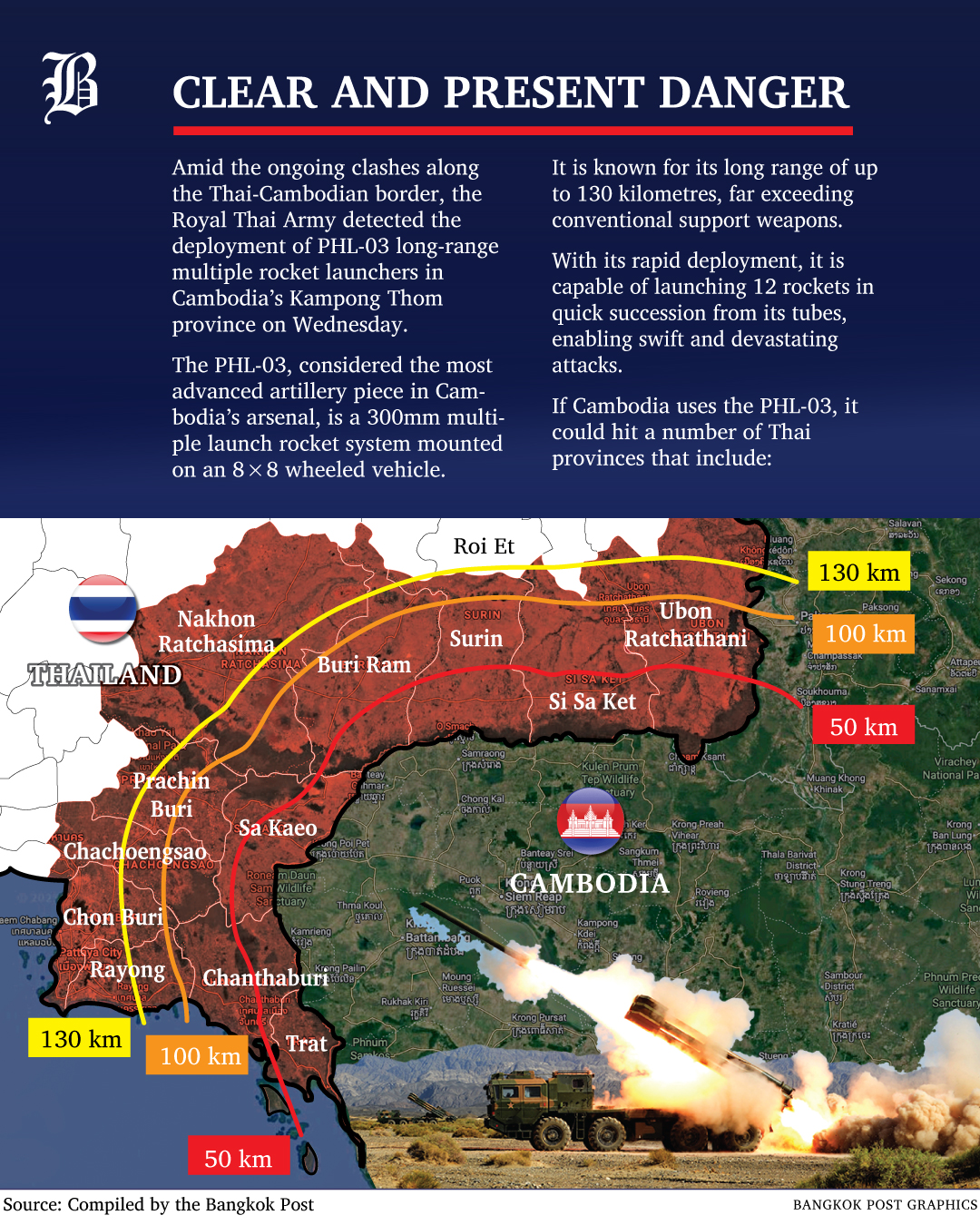
Armed clashes along the Thai-Cambodian border continued into a fifth day on Thursday. According to the latest figures released by the Thai armed forces, three civilians and nine soldiers have been killed since the most recent clashes broke out. Approximately 200,000 residents have been evacuated from high-risk areas as the fighting continued.
The Second Army Region released a summary of operations along the Thai-Cambodian border from Dec 7 to Dec 11.
According to the report, 102 Cambodian soldiers were estimated killed, six T-55 tanks destroyed in Phanom Prasittho, one BM-21 multiple rocket launcher destroyed, 64 drones neutralised and one anti-drone system destroyed.
Lt Col Thitiphong Fuangchan, assistant spokesman for the Operations Centre of the Second Army Region, summarised key developments as of 9am yesterday.
At 10.42pm on Wednesday, a firefight broke out when Cambodian forces fired on Thai positions using artillery and mortars. They also deployed unmanned aerial vehicles to conduct surveillance over several critical areas, including Chong Bok, Chong Sa-ngam, Chong An Ma, Prasat Khna, Prasat Ta Khwai, and Preah Vihear temples.
The army responded in kind by employing artillery and mortars to destroy high-value military targets belonging to the opposing forces.
Thai forces also took control of the Chong Rayi-Plot Tang area in Surin's Kap Choeng district to prevent a counterattack.
Thailand has clarified 2024 tax regulations: individuals staying over 180 days are now tax residents, making foreign income brought into the country potentially taxable. A Bangkok Post podcast, featuring tax experts, addresses the complexities of these new rules.
Experts addressed what constitutes a taxable remittance, covering ATM withdrawals, credit card use, and the status of specific income like government pensions. They also clarified the tax implications of pre-2024 funds transferred later and money received from joint accounts.
Further guidance detailed how Double Tax Agreements operate, the limits of Thai access to overseas account information, and the requirement for Destination Thailand visa holders (digital nomads) to file tax returns.
The Royal Gazette published on December 2, 2025, a new announcement from the Alcohol Control Committee revising the permitted hours for alcohol sales nationwide.
The regulation, issued under the Alcoholic Beverage Control Act 2008 and its 2025 amendment, replaces an earlier directive from the Prime Minister's Office dated June 23, 2025, and takes effect from the day after its publication.
Under the new rules, the sale of alcoholic beverages is only allowed between 11am–2pm, 2pm–5pm, and 5pm–midnight, with the 2pm–5pm window approved on a trial basis for 180 days.
- From February 14, 2026, Mobile Banking apps will only support iOS 14 and Android 10 or higher to enhance cybersecurity and protect user data.
- This change is part of efforts to enhance cybersecurity and reduce risks from outdated operating systems.
The Thai Bankers Association (TBA) has announced that starting February 14, 2026, all Mobile Banking apps in Thailand will support only iOS 14 and Android 10 or higher.
This move is in response to the growing cybersecurity threats, especially attacks targeting devices with outdated operating systems, which are vulnerable to data theft, financial fraud, and malware installation.
According to the TBA, this change is a preventive measure aimed at reducing risks from various cybersecurity threats, such as malware, phishing, data interception over public networks, and remote control of devices.
Outdated smartphones, particularly those no longer receiving security updates from their manufacturers, will no longer be able to access Mobile Banking apps starting February 14, 2026.
✈️ Thai Airways announces a new baggage policy under the Piece Concept
To enhance the travel experience and elevate service standards in line with leading global airlines, Thai Airways will transition its baggage policy from the Weight Concept to the Piece Concept, which defines baggage allowances based on the number of pieces and class of travel
This policy change aims to:
• Improve convenience and consistency for international connections and interline travel
• Provide passengers with clear and transparent baggage entitlements based on the number of pieces and travel class
• Strengthen THAI's service standards to be globally aligned with our partner airlines
📌 Effective Dates of the New Policy
Effective 25 November 2025
Applicable to ticket sales, ticket issuance, and reissuance of totally unused tickets,
for travel commencing on or after 02 March 2026.
Applicable routes:
• All domestic routes within Thailand
• Journeys within TC3 (Asia, Australia, New Zealand)
• Journeys between TC2 (Europe, Africa, Middle East) and TC3
Effective 28 November 2025
Additional routes across THAI's global network will follow the new policy.
🧳 Baggage Allowance Summary by Travel Class
📍 Domestic Sector (Within Thailand)
Each passenger is entitled to 1 piece, with weight based on travel class:
• Royal Silk Class — 1 piece | 32 kg
• Economy Class (Flexi / Full Flex / Standard / Saver) — 1 piece | 23 kg
• Infant without a seat: 1 piece according to the adult's applicable allowance
🌍 International Sector
Royal First Class
3 pieces — 32 kg per piece
(Redeem tickets: 2 pieces — 32 kg per piece)
Royal Silk Class and Redeem
2 pieces — 32 kg per piece
Premium Economy Plus
2 pieces — 32 kg per piece
Premium Economy Class
2 pieces — 23 kg per piece
Economy Class
• Flex / Full Flex — 2 pieces | 23 kg per piece
• Standard / Saver / Redeem — 1 piece | 23 kg per piece
• Infant without a seat: 1 piece according to the adult's applicable allowance
📐 Baggage Size Requirement
Each piece must not exceed a total linear dimension of 158 cm (62 inches).
Thai Airways remains committed to elevating our service standards to deliver a seamless and memorable travel experience for all passengers
Immigration police target visitors making multiple visa runs
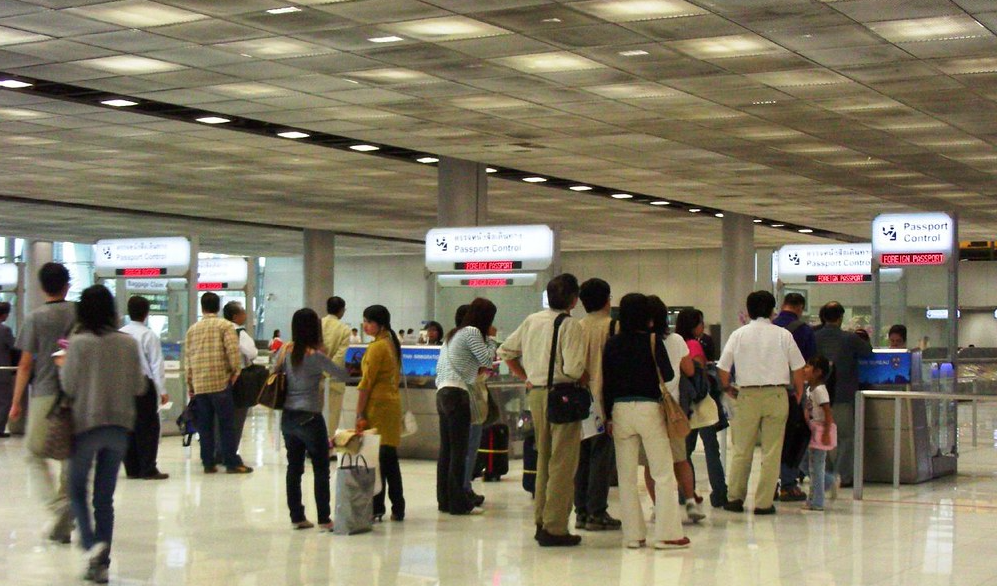
Travellers at Suvarnabhumi airport. Immigration is targeting arrivals making multiple visa runs. (file photo Somchai Poomlard)
Immigration police are focussing on blocking foreigners, especially scammers, who do visa runs to extend their stay in Thailand by abusing the government's visa-free entry scheme.
Pol Maj Gen Choengron Rimpadee, deputy chief of the Immigration Bureau, said on Tuesday that immigration police would carefully question foreigners making a third consecutive visit with repeated back-to-back visa-free requests to stay in the country for up to 90 days each time.
Officers would look into those who had stayed at least 45 days during their previous stays.
"These foreigners do not visit Thailand for tourism. Many of them work or operate business with Thai nominees as their front. They use the visa-free scheme to avoid official visa requests before travelling, and their data is not included in Thailand's systems controlling occupations and taxation," the deputy commissioner said.
Some of these visitors had made as many as seven visa runs in a row and their accumulated stay exceeded 200 days, he said.
Immigration police would deny such visitors repeated entry. This would enable them to prevent scammers who fled suppression in neighbouring countries relocating their illicit businesses to Thailand, he said.
Pol Maj Gen Choengron said suppression efforts had affected parties that cash-in on visa run services. They had started to disseminate false information, claiming that immigration had targetted visitors from countries including China.
The deputy immigration chief said such measures were applied fairly to visitors of all nationalities, and did not affect real tourists.
Genuine tourists stayed in Thailand for an average 15 days per visit, and presented clear information about their accommodation, trips around Thailand and departure dates, Pol Maj Gen Choengron said.
Immigration police welcomed real tourists, he added.
Tourism leaders warn Thailand risks falling from a top global destination to just one of many choices; PM Anutin pledges strong government support and fast-track measures.
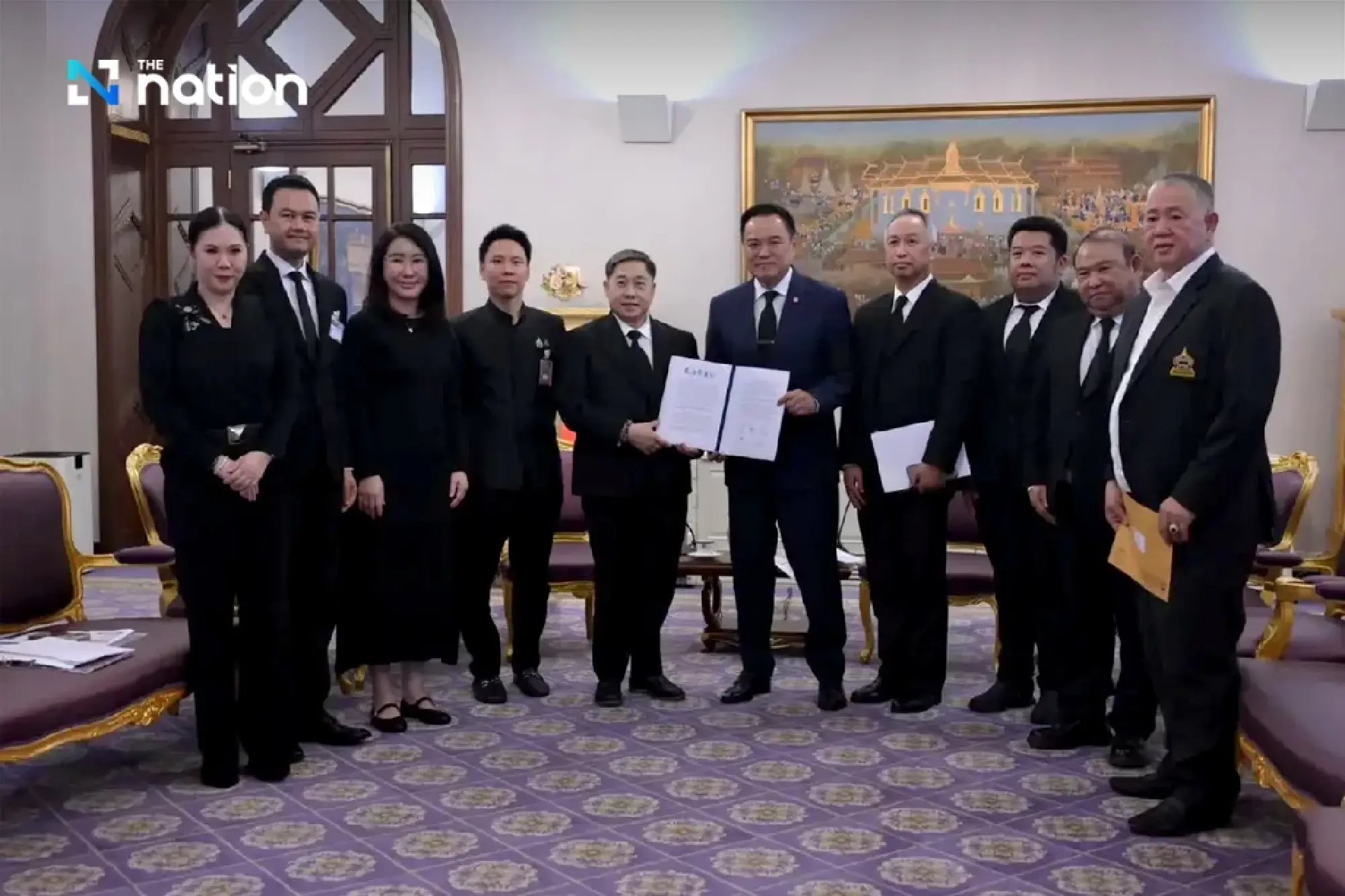
A delegation representing five major tourism associations met Prime Minister Anutin Charnvirakul on Tuesday to present urgent recovery measures for Thailand's tourism industry in 2025, amid signs of a regional slowdown. Several Asian and ASEAN markets are experiencing declining outbound travel, and foreign arrivals to Thailand could drop by around 7% next year compared with 2024.
The delegation — comprising the Tourism Council of Thailand (TCT), Association of Thai Travel Agents (ATTA), Thai Travel Agents Association (TTAA), Thai Hotels Association (THA) and the Airlines Association of Thailand (AAT) — proposed immediate three-month measures focused on boosting safety, restoring confidence, and countering negative social-media sentiment.
Key proposals included:
A global safety campaign to rebuild trust
Stronger price incentives for domestic and international air tickets
Tourism-stimulating tax measures
Proactive communication to prevent reputational damage
For the medium and long term, the private sector urged the National Tourism Policy Committee to drive six key workstreams:
Reform tourism laws
Raise national service standards
Improve infrastructure, particularly in secondary cities
Promote investment in new, world-class tourism products
Build a refreshed, compelling brand identity for Thailand
Strengthen competitiveness through sustainable development
They warned that without timely government action, Thailand faces a serious risk of being downgraded from a "top destination" to merely "one of many options" in future travel decisions.
Prime Minister Anutin reassured the associations that tourism is a top priority for his government.
He noted that his recent visit to China had opened new opportunities through government-to-government (G2G) dialogue, creating space for the private sector to negotiate increased travel between China and Thailand.
He added that if the Chinese premier visits Thailand for further bilateral talks, the Tourism Authority of Thailand (TAT) may propose a tourism MOU to strengthen long-term cooperation and promote sustainable travel between the two countries.
🇹🇭 SKAFFA ETT RIKTIGT VISUM
Visafritt är fortfarande 60 dagar.
Du som på riktigt är turist med hembiljett inom 60 dagar behöver inte oroa dig. Det är för dig visafritt finns. Ha en skön semester.
Idag kom ingen kortning till 30 dagar, som man förvarnat visaagenterna. Men det är inte läge att ropa hej än.
Alldeles oavsett behöver långliggare som ska stanna längre tänka till. Skärpningen i polisordrarna gör att det inte är alldeles säkert att du kan stanna längre än 60 dagar visafritt.
📌 Om din resehistoria är helt ren
Om du inte gjort visa runs i år - då kan du få en förlängning på 30 dagar samt ytterligare en på sju dagar. Du kan stanna 97 dagar på visafritt.
Möjligen kan du resa ut och in och stanna ytterligare 97 dagar. Men för den som har fel resehistoria finns en risk både vid gränsen och på immigration.
📌 Inresa inte självklar
Har du gjort fler än två in och utresor i år kan du bli nekad inresa med visafritt.
📌 Förlängning inte självklar
Du kan inte längre räkna med förlängning på 30 dagar. Extension är inte längre självklart att få på immigration.
📌Ingen förlängning över landgräns
Den som gör en visaresa över en landgräns får ingen förlängning alls på sitt uppehållstillstånd. Du kan stanna 60 dagar. Sedan är det stopp.
📌 Mål att fylla
Det nya är att visaresor och "misstänkt" resehistoria kommer att granskas även på immigration, inte bara vid gränsen.
Varje immigrationskontor har fått ett mål att fylla för att tvingas vara hårdare. De kommer att neka fler förlängning på både visafritt och Non Immigrant-visum.
📌 Risk indraget uppehållstillstånd
En annan nyheterna i de två nya polisordrarna: tjänstemännen har rätt att dra in uppehållstillstånd.
Den som missbrukat visafritt eller inte uppfyller nya kriterier för förlängning och byte av visa kan därför få indraget uppehållstillstånd.
📌Immigration tuffare
Skärpningarna vid gränserna är bara en del av förändringen. Skärpningen på immigration är den största. Både långliggare och bofasta kommer att granskas hårdare.
Vissa kontor har redan börjat arbeta efter de nya reglerna, som Krabi och Phuket där vi redan sett att regelverket skruvats åt för hårdare granskning av arbetstillstånd, konverteringar och förlängningar.
✅ MINA RÅD
• Sluta res in och ut på visafritt om du ska stanna längre än 60 dagar.
• Skaffa ett riktigt visum.
• Ha en hembiljett inom 60 dagar med visafritt- 90 med turistvisum.
• Se till att din ekonomi är verifierbar om du är långliggare eller bofast.
• Sköt din TM30 och TM47-rapportering minutiöst som långliggare och bofast.
Den som vill läsa om samtliga förändringar i de bägge polisordrar som nu förändrar i princip allt på immigration kan göra det på Koh Lanta Approved nyhetsrum.
Flera av åtgärderna är helt nya. Det är alltså inte bara en fråga om en skarpare tillämpning av redan existerande regler.
Det här är ett systemskifte – och alla kommer att beröras.
Public criticism has intensified following the government alcohol control committee's decision to extend alcohol sales and drinking hours, with campaigners warning that the move lacks legitimacy and poses public health risks. Concerns have been raised that the decision was made without a full quorum and may undermine efforts to reduce alcohol-related harm. Critics argue that despite being legal under the new Alcohol Control Act, the decision could have severe consequences for communities.
The issue follows recent government efforts to relax alcohol regulations, including extending bar closing times and widening sales windows for beer and spirits. Supporters of the policy have cited economic benefits, including claims of 600 billion baht in spending, but opponents argue the figures do not align with current accident data. A reported 10% rise in drunk-driving incidents has further fuelled doubts over the policy's justification.
Chuwit Chantaros, coordinator of the Campaign for Protection from the Dangers of Alcohol Drinking, said the public network would continue to monitor the matter closely, calling it a life-and-death issue. He warned that while some drinkers might welcome the change, non-drinkers could form a larger bloc of opposition in upcoming elections. Chuwit also questioned whether the committee's decision could be challenged in court due to concerns over quorum and procedural legitimacy.
He stated that although the Alcohol Control Act permits officials to make such decisions, lawmakers must listen to all parties and follow due process rather than rushing measures through. Chuwit added that any extension of drinking hours past midnight should be confined to designated entertainment zones with proper oversight. He maintained that the government could ultimately be held accountable for any rise in alcohol-related accidents.
Teera Watcharapranee, Director of the Stop Drink Network Thailand (SDN), criticised the proposed extension of late-night alcohol hours to 4am, arguing that the decision prioritises economic interests over health. He said any review during the government's six-month trial must rely on scientific data and research rather than economic projections. SDN plans to organise public forums across communities to assess local sentiment and increase awareness of the policy's implications.
Teera said he opposed lifting alcohol-sale restrictions nationwide, insisting that any relaxation should be limited to designated zones or 'sandbox' areas. He also urged authorities to clarify enforcement procedures and confirm whether sufficient officers would be deployed for inspections. Questions remain over whether the extended hours apply to venues such as grocery shops, highlighting the need for clear criteria and venue classifications.
Teera noted that alcohol is classified as a Group 1 carcinogen and said the move contradicts Thailand's ambition to become a wellness hub, reported The Nation. Citing World Health Organisation findings from recent years, he reiterated that there is no safe level of alcohol consumption and dismissed the belief that light drinking can be beneficial.
Chuwit Chantaros, coordinator of the Campaign for Protection from the Dangers of Alcohol Drinking
Key Takeaways
• Campaigners argue the decision to extend alcohol sales and drinking hours lacks legitimacy and increases public health risks.
• Experts warn that rising drunk-driving incidents and unclear enforcement could worsen community safety.
• A six-month government review is planned, with calls for scientific assessment and stricter zoning.
🇹🇭 NYA INRESEREGLERNA
– En polisorder behöver inte publiceras i Royal Gazette och ambassaderna blir inte informerade
Den senaste veckans besked från thailändska Immigration Bureau har lett till flera missförstånd. Många tror att åtgärderna är ny lagstiftning som skulle kräva publicering i Royal Gazette. Det stämmer inte.
I Thailand finns flera juridiska nivåer som ofta blandas ihop – lagar, ministerförordningar, ministernotiser, regelföreskrifter och polisordrar. Bara lagar, kungliga dekret och ministerförordningar måste publiceras i "Gazetten".
Polisordrar behöver det inte.
▪️Det som trätt i kraft är två polisordrar, utfärdade av Immigration Bureaus generalkommandör. De skrevs i september, publicerades på thailändska i oktober och som engelska översättningar den 12 november.
Det är framför allt de thailändska dokumenten jag har översatt och byggt mina artiklar på.
Polisordrarna är tillägg och förtydliganden till två tidigare administrativa riktlinjer från år 2557 (2014) och 2564 (2021).
En polisorder (คำสั่งสำนักงานตรวจคนเข้าเมือง) är en intern instruktion inom Royal Thai Police / Immigration Bureau som gäller omedelbart och som styr hur befintlig lag ska tillämpas.
Polisordrarna gäller alltså redan, och konsekvenserna har börjat märkas på immigration i Krabi i form av hårdare krav och fler dokument och bilder för arbetstillstånd och Non immigrant O.
En polisorder behöver inte godkännas av regeringen, parlamentet eller Royal Gazette.
Men i praktiken är det vanligt att ansvarig minister ger klartecken innan den utfärdas.
I detta fall är det inrikesminister Anutin Charnvirakul som har gett sitt godkännande eftersom åtgärderna ingår i hans kampanj mot cyberbrott och missbruk av visumregler.
▪️Polisordrar är interna tillämpningsföreskrifter som styr hur Immigration ska bedöma:
• Inresor
• Visumbyten (change of visa type)
• Förlängningar (extensions)
Eftersom de inte rör visumansökningar utanför landet utan immigrations arbetssätt vid gränser brukar ambassaderna inte få informationen när de förändras. Ambassader informeras bara vid ändring i immigration Act eller ministerial regulation.
▪️Man kan alltså inte ringa ambassaden och räkna med att få information om frågor som rör immigration eller vad som händer med visafritt, vilket många också tror.
Ambassaderna lyder under thailändska UD och hanterar visumansökningar. Visafritt är inget visum och sorterar därför under Immigration, inte ambassaderna.
Jag har lusläst de två nya polisordrarna på thai och reder ut exakt vad de innebär i Koh Lanta Approveds nyhetsdel.
‼️VISAFRITT FORTFARANDE OKLART
Det enda frågetecknet är visafritt 60 eller 30 dagar. Enligt flera oberoende visaagenter, som samarbetar nära med Immigration, ska visafritt begränsas till 30 dagar från i morgon.
Detta är ännu inte bekräftat skriftligt. Inget står om detta i polisordrarna, men Immigration har informerat visaagenterna så att de kan anpassa sin verksamhet.
Därför har många agenter lagt in extraturer i helgen – många vill hinna göra en sista visaresa innan reglerna ändras och många bussar samlas vid gränserna i detta nu.
Det kan dock komma en positiv nyhet i morgon. Det KAN vara så att visafritt ENDAST begränsas via landgränserna - inte för alla de som flyger in. I morgon vet vi mer.
Protesters from community networks and drunk-driving victims carry a mock dead body to Government House on Oct 24, submitting a petition to Prime Minister Anutin Charnvirakul opposing the government's plan to extend alcohol sales and pub hours until 4am and lifting the 2-5pm alcohol sales ban. Apichart Jinakul
The uproar triggered by the newly amended Alcohol Beverage Control Act has underscored a recurring dilemma for the government: how to balance social order and public health with a tourism-driven economy that demands flexibility and international friendliness.
The controversy that erupted after the law took effect on Nov 8 -- particularly its ban on alcohol sales between 2pm and 5pm and the midnight cut-off time for drinking -- spiralled into one of the most disruptive regulatory shocks for bars, restaurants, nightlife operators and tourist hubs since the pandemic era.
Within just a week, the business backlash was loud enough to force a policy retreat.
On Nov 13, the National Alcohol Policy Committee chaired by Deputy Prime Minister Sophon Zarum, and the Alcohol Beverages Control Committee chaired by Minister Public Health Minister Pattana Promphat, jointly approved a set of relaxations: lifting the widely criticised afternoon sales ban, and extending drinking hours at licensed venues until 1am, even though alcohol sales are still prohibited after midnight.
The six-month trial period for the change signals the government's intent to measure economic impacts while maintaining a cautious public health tone.
The rapid about-face was welcomed by the private sector, but the episode also laid bare structural weaknesses in the alcohol control regime -- particularly unclear communication, patchy enforcement, and fragmented policy goals.
As tourism surges back and nightlife regains momentum, the government faces intensifying pressure to craft rules that are both enforceable and aligned with the country's status as a global travel destination.
Relief for business, tourists
In Bangkok's nightlife districts, the initial regulations landed like a hammer. Operators complained of sudden cancellations, confused tourists, and inconsistent on-ground enforcement.
Nowhere was this more visible than in Khao San Road, a magnet for foreign backpackers and a nightlife economy heavily dependent on European tourists.
Sanga Ruengwattanakul, president of the Khao San Business Association, thanked the government for reversing what he called an outdated and economically damaging restriction.
"The 2pm-5pm ban dated back to 1972 and no longer reflected economic realities," he said, pointing out that tourists on holiday do not follow the same time-bound consumption patterns as office workers.
While operators along Khao San Road were less affected, given its 80% European tourist base, Mr Sanga said tourism areas reliant on Chinese tourists, such as Yaowarat and Banthat Thong, had suffered sharply.
Operators had long complained that restrictive rules push businesses toward informal or underground operations.
Mr Sanga added that many restaurants have attempted to register as entertainment venues but faced cumbersome approval processes, forcing some to operate in legal grey zones. "If rules are too strict, businesses will simply find ways to avoid them," he warned.
Other business owners and communities echoed similar views. Some argued for targeted zoning to keep nightlife visible but controlled. Others pressed the government to bring underground venues "to the surface," allowing them to operate legally and transparently while removing incentives for bribery or informal payments to local officials.
For many in the service sector, the six-month trial is viewed as a window of opportunity: a chance to generate more revenue in a sluggish economy, create jobs and stabilise tourism sentiment ahead of the tourism high season.
Sanga: Hails alcohol policy reverse
Sounding the alarm
While businesses celebrated, public health specialists were far less enthusiastic. They argue the government's quick concession to economic pressure could undermine long-term safety goals and erode the alcohol control framework.
Dr Polathep Vichitkunakorn, director of the Centre for Alcohol Studies, warned that easing restrictions was an abnormal and concerning move.
He said the law contains loopholes that could tilt policymaking toward commercial interests, including the unprecedented decision to allow the private sector to sit on the National Committee on Alcohol Control.
This inclusion contradicts World Health Organization (WHO) guidance, which cautions governments against allowing industry stakeholders to shape public health policy.
Dr Polathep also highlighted the risk posed by potential vending machines for alcohol -- now legally permissible -- given the difficulty of ensuring they remain inaccessible to minors.
"If the committee fails to protect public safety, we will see more relaxations designed to facilitate the liquor business," he warned.
Citing a six-month study on extended nightlife hours, he said accidents could rise by 13% and drunk-driving offences by more than 100% if venues are allowed to serve until 4am as previously proposed.
Even a one-hour extension, from midnight to 1am, must be closely monitored, he argued, because "every day of extended drinking hours is an exchange for more injuries and deaths on the road."
Polathep: Warns of commercial interest
Fix arbitrary rules
The Thailand Development Research Institute (TDRI), which has studied the alcohol law for over a year, takes a nuanced position.
Senior researcher Thanthip Srisuwannaket said the afternoon ban -- originally implemented during Field Marshal Plaek Phibunsongkhram's era to discourage civil servants from drinking during work hours -- was "irrational, outdated and inconsistent." She recommended a consolidated timeframe instead, such as a universal ban starting from midnight.
However, TDRI does not endorse unlimited drinking hours. Their research supports keeping restrictions after midnight due to higher accident risks, including harm to early-morning street vendors and commuters.
Ms Thanthip also noted blanket bans on major Buddhist holidays help reduce prolonged binge drinking, which is often linked to spikes in road accidents.
TDRI's core recommendations focus not on when alcohol is consumed, but on enforcing laws that directly address public harm: tougher penalties for selling alcohol to minors; clearer rules on advertising directed at youth; reducing reliance on officer discretion; and graduated penalties for drunk driving based on blood-alcohol levels.
Where nightlife and tourism are concerned, TDRI proposes a compromise: if venues are allowed to operate late into the night -- say until 3am or 4am -- they should be required to provide safe transport services, with the cost incorporated into customer bills. The aim is to discourage drunk driving without undermining tourism competitiveness.
Thanthip: 'Blanket bans curb binge drinking'
Enforcement tough
Even with the new relaxation measures, both business operators and experts agree on one critical point: regulations will fail without clear, consistent and well-publicised enforcement.
Tourism-heavy areas such as Pattaya have already reported miscommunication: some police stations apply the law strictly, others loosely; some foreign visitors are unaware of time-based restrictions; some restaurants interpret the rules differently to avoid penalties, said Damrongkiat Pinitkarn, secretary to the Entertainment & Tourism Association of Pattaya City.
As Thailand enters the peak tourism season, unclear messaging risks damaging the country's image, he said.
"At this point, the high season has begun, but tourist numbers remain weaker than two years ago in Pattaya, down by roughly 20 per cent. If negative news about alcohol-control policies emerges, the impact will be even more severe -- travellers might well turn to Vietnam or Laos instead," he said.
Industry associations have also urged the government to disseminate multilingual guidelines through embassies, airports and tourism campaigns; standardise enforcement across provinces; and ensure frontline officers have clear instructions.
Failure to do so, they warn, will lead to repeats of the confusion seen earlier this month --confusion that tourists are unlikely to forget.
Damrongkiat: Calls for clear messaging
Balancing act
The alcohol law debate has revealed deep divides within policymaking. On one side are public health experts concerned about long-term social costs, hospital burdens and road fatalities.
On the other side are businesses desperate to recover from years of pandemic-era losses, and a government that relies on tourism as a core economic driver.
Prime Minister Anutin Charnvirakul -- who also built much of his political identity on public health reform -- finds himself squeezed between two competing imperatives.
The government's retreat on the afternoon sales ban is widely interpreted not just as responsiveness, but also as recognition that inflexible moral-framed regulations can clash with the country's global positioning.
According to experts, the government must decide whether alcohol regulation is primarily a public health tool, an economic instrument, or a hybrid of both.
Each approach leads to distinct policy pathways, and inconsistent blending creates the confusion the public has now witnessed.
Looking ahead
The six-month trial period gives the government time to gather data, refine messaging, and re-establish coherence. But it also gives industries and local authorities time to test the boundaries -- something that could trigger new waves of adjustment if problems arise.
For the policy to succeed, experts say the government must: strengthen enforcement against drunk driving; clarify licensing pathways for nightlife venues; actively communicate rules to foreign visitors; close loopholes that give undue influence to commercial entities; and align its health, economic and safety objectives into a consistent framework.
The alcohol law saga is more than a regulatory hiccup -- it is a test case for how the country positions itself in a post-pandemic economy. Striking the right balance between safety and economic vibrancy will determine whether the country can preserve its global tourism appeal while protecting public health, the experts say.
If the government manages this balance, Thailand can avoid the pitfalls of uncontrolled liberalisation while still supporting a resilient economic recovery. But without clear implementation and principled policymaking, the experts warned the confusion seen this month could become a recurring challenge.
Confused but undeterred: Foreign visitors enjoy a night out in Pattaya as Thailand's rules on afternoon alcohol sales keep changing, leaving locals and tourists alike guessing. (Photo by Jetsada Homklin)
PATTAYA, Thailand – Thailand has long been a favorite destination for long-term visitors and tourists seeking sun, culture, and a relaxed lifestyle. But recent policy gyrations—from sudden alcohol bans to abrupt visa changes—are making even seasoned travelers wonder if the country is serious about welcoming foreigners.
Take the afternoon alcohol sales ban, which officials now hint could be lifted to boost tourism. One week it's "off-limits," the next week it's "on again." For foreigners, it feels like watching a lunatic run the asylum: rules come and go as unpredictably as street vendors on Soi 6. The government performs more backflips than an Olympic gymnast, leaving visitors unsure when they can enjoy a simple cold beer with their meal—or even just a leisurely afternoon on their balcony.
It's not just alcohol. Cultural contradictions abound: monks now use smartphones, cannabis is legally sold, yet casual rules about when you can drink are treated with arbitrary severity. Tourists see regulations changing faster than the weather, while enforcement varies street by street. For those who don't drink, the absence of visitors may even be a relief—but for the rest, the inconsistency is frustrating.
Many long-term visitors are quietly exploring alternatives. Vietnam and Cambodia are emerging as attractive substitutes, offering clear rules, reasonable prices, and a less confusing environment for enjoying food, drink, and daily life. Some travelers, frustrated by Thailand's flip-flopping, are already making plans to spend holidays elsewhere, checking into apartments with balcony views in neighboring countries rather than hoping to guess the next "off-and-on" regulation.
Thailand's challenge is simple: if the country wants to remain a top destination, it must choose stability over capricious policy swings. Tourists are savvy and impatient; they will not wait around for rules to make sense. Flip-flop societies may be amusing in theory—but when your livelihood or vacation depends on clarity, inconsistency is simply exhausting.
In short: Thailand's charm is undeniable, but if the government wants foreigners to return, it needs to stop playing musical chairs with regulations and let visitors enjoy their beer—and their balcony views—without anxiety.