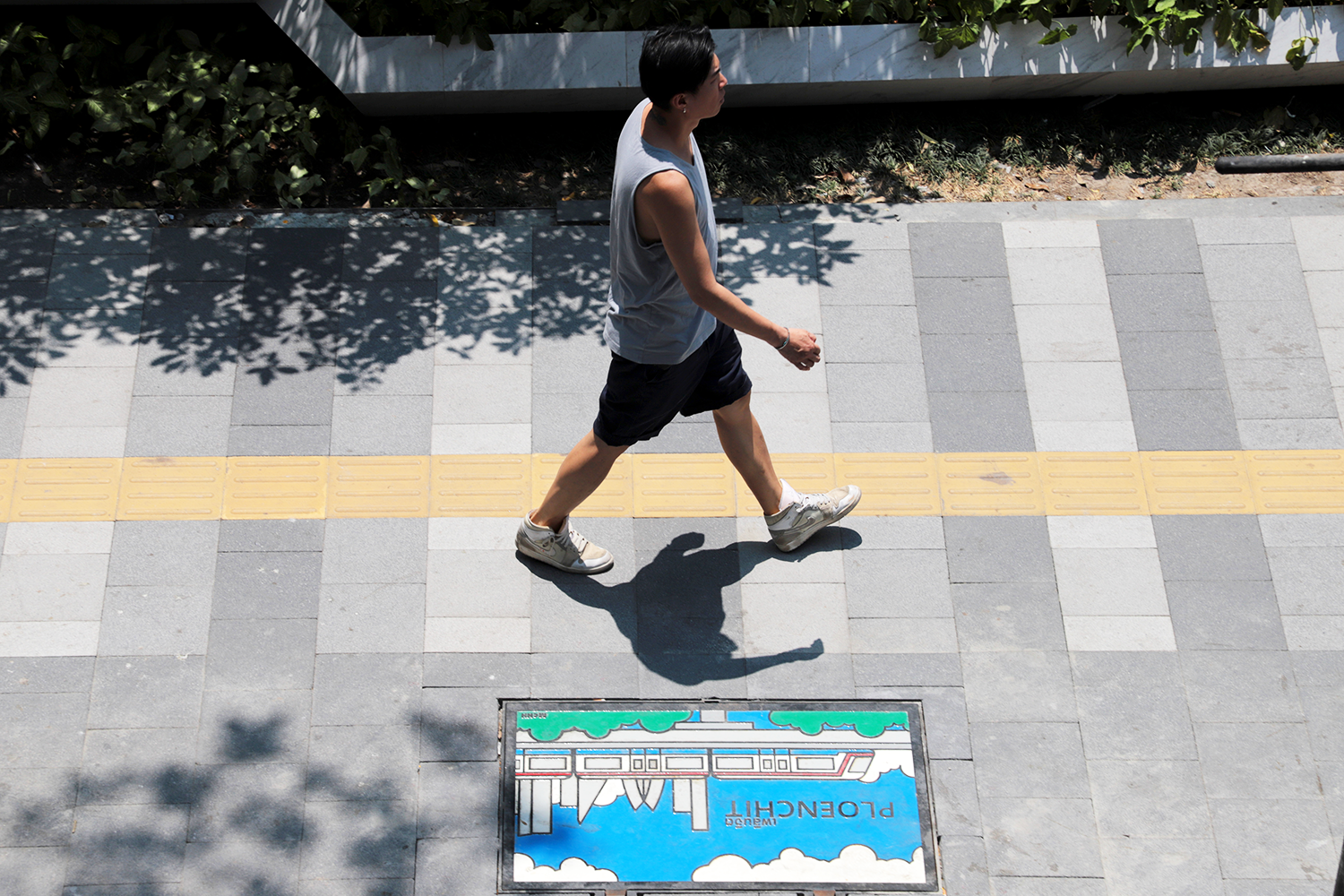
A pedestrian on a hot walkway in strong sunlight, along Ploenchit Road in Bangkok. (Photo: Chanat Katanyu)
Temperatures are rising as the hot season settles in and health authorities are warning people to stay out of the sun if possible with the heat index having already hit the orange "dangerous to health" level.
The heat index for March 5-14 showed temperatures of 42-51.9ºC in some areas, which was considered dangerous to health. People in the southern, central, eastern and northeastern regions were all at risk, a top health official said
People should check the weather forecast and avoid outdoor activities if possible, and drink water frequently, during hot weather, Thiti Sawangtham, deputy director-general of the Department of Health, said.
Heat rash, heat exhaustion and heat stroke could lead to death, Dr Thiti said.
The most sensitive groups were the elderly, the obese, outdoor workers and imbibers of alcohol, and people with underlying health conditions including mental issues, he said.
On Tuesday, the Department of Meteorological reported 10 provinces where temperatures peaked at 38-39ºC on Monday, all in the North.
The upper part of Thailand would see cooler temperatures through to Saturday as cold air now covered parts of the Northeast. The forecast was for strong winds, but less rainfall, the report said.
The weather from March 23-28would get to hot to very hot again. There would be scattered summer storms, especially from March 29into next month. However, this summer was not expected to be as hot as last year, it said.
Foreign arrivals wait to go through the immigration process at Suvarnabhumi airport. (Bangkok Post file photo)
The period of visa-free stays in Thailand is set to be reduced from 60 days to 30 days as related authorities have agreed in principle to the move in an effort to curb the risk of illegal businesses exploiting the visa exemption scheme, according to the Tourism and Sports Ministry.
Tourism and Sports Minister Sorawong Thienthong said the Foreign Ministry acknowledged the issue as it had been widely discussed among all related stakeholders in the past few weeks.
He said they all agreed in principle to reduce the period of stay from 60 days to 30 days for citizens from countries granted a visa exemption under the programme. However, additional details would be discussed before formally announcing the adjustment to the regulation.
Since July 2024, the government has allowed passport holders from 93 countries to enter Thailand for tourism purposes for a period not exceeding 60 days. This had earlier been granted to citizens of 57 countries.
However, tourism operators expressed concern over the extended period as long-haul tourists typically stayed for only 14-21 days on average, while short-haul travellers spent less than two weeks per trip or around seven days on average.
The Association of Thai Travel Agents earlier raised this concern with the ministry as there is a growing number of foreigners illegally working or conducting businesses in the country, while the Thai Hotels Association believed this was partly to blame for the increase in the number of condos being illegally rented out to guests on a daily basis.
Given the recent call by a former member of parliament in Phuket urging the government to crack down on foreign businesses using nominees and reduce the visa-free period to 30 days, Natthriya Thaweevong, the ministry's permanent secretary, said the ministry has instructed the Tourism Department to enforce the Tourism Business and Tourist Guide Act more seriously.
She said the special joint operational centre operated by six authorities, including the Tourism Department and Tourist Police, has consistently investigated illicit activities taking place in Phuket and five other popular tourism-related areas, namely Chiang Mai, Pattaya, Hua Hin, Koh Samui and Bangkok.
She said the department revoked the licences of 40 companies in 2024 as they were found guilty of secretly changing the authorised directors and the proportion of directors and shareholders, resulting in their disqualification from operating a tourism business.
In Phuket, 15 tour companies' licences have been revoked. She said there was also the case of a Thai committee of a tour company also being registered under five different company names.
The Thai government is set to reduce the visa-free stay period from 60 days to 30 days, following an agreement in principle by relevant authorities to prevent illegal businesses from exploiting the exemption scheme, according to the Tourism and Sports Ministry.
Tourism and Sports Minister Sorawong Thienthong stated that the Foreign Ministry acknowledged concerns raised by stakeholders in recent weeks. While the reduction has been agreed upon in principle, further discussions are needed before the regulation is officially adjusted.#ThailandNews#tourists 🧐
With a surge in British travellers to Thailand post-Covid, there is an increasing demand for consular assistance from the British Embassy in Bangkok.
In the past year, the embassy reported handling 2,007 assistance cases, encompassing various serious issues such as deaths, arrests, detentions, hospitalisations, and missing persons, illustrating the often-unforeseen challenges travellers may encounter abroad.
Deaths accounted for over a third of these cases, while more than 10 percent involved arrests, highlighting the need for urgent consular support in severe situations.
Additionally, the team provided over two thousand notarial services and issued around six hundred emergency passports, ensuring that British citizens receive essential consular services when needed.
With upwards of a million British visitors recorded in Thailand in 2024, the substantial caseload is hardly surprising.
Yet, it's crucial to understand that entry figures, often cited from Thai immigration records, can be misleading because they treat each arrival as a unique instance, irrespective of the frequent border-hopping and visa runs by expatriates, painting an exaggerated picture of tourist numbers.
Behind the stats, there are the heart-wrenching cases like the recent plight of pensioners desperate for assistance, such as Des and Mary Byrne.
Similarly, many accident victims on Thailand's notoriously perilous roads find themselves overwhelmed by hefty medical bills. These situations often trigger complaints from UK relatives regarding perceived inaction by the embassy.
It's important to remember that the embassy, like others, is limited in scope: it cannot settle personal debts, provide loans, or meddle in legal proceedings. Instead, it offers vital support such as contacting family, visiting institutions, and providing local legal contacts.
The British Foreign Office's extensive website details crucial advice for travellers, from property investment warnings to insistent reminders on securing adequate insurance—yet, it remains uncertain how many heed these pre-travel advisories.
As technology influences embassy operations, from digital correspondence to Zoom prison visits, consular work has evolved.
Embassies now require pre-booked appointments, spurred by the digitisation of many travel-related processes, leading to a decline in traditional face-to-face requirements. Within the next decade, physical passports might give way to enhanced digital credentials.
Ultimately, the changing face of consular services demands Britons and their families adjust their expectations and prepare diligently, acknowledging the reality that in moments of adversity, preparedness is paramount to navigating the complexities of international distress, reported Barry Kenyon for Pattaya Mail.
The Thai government is increasing flight capacity and cutting domestic airfare prices by 30% on certain popular routes to ease travel costs during the Songkran holiday from April 11 to 17, 2025.
On March 10th, Deputy Prime Minister and Minister of Transport Mr. Suriya Jungrungreangkit announced that the Ministry of Transport has held a meeting with relevant agencies to prepare for the Songkran festival from April 11-17.
To address the issue of rising airfares, the Civil Aviation Authority of Thailand (CAAT) has been instructed to closely monitor ticket prices and conduct regular checks at Suvarnabhumi and Don Mueang airports. Additionally, CAAT has been in talks with six airlines to reduce ticket prices, which typically rise during this high-demand travel period.
These airlines include Thai Airways International, Bangkok Airways, Thai AirAsia, Nok Air, Thai Lion Air, and Thai VietJet.
According to Mr. Suriya, these airlines will operate an additional 124 flights, adding a total of 25,000 extra seats. In addition, fares for popular domestic routes will be reduced by 30% from the maximum price to offer more affordable options for passengers.
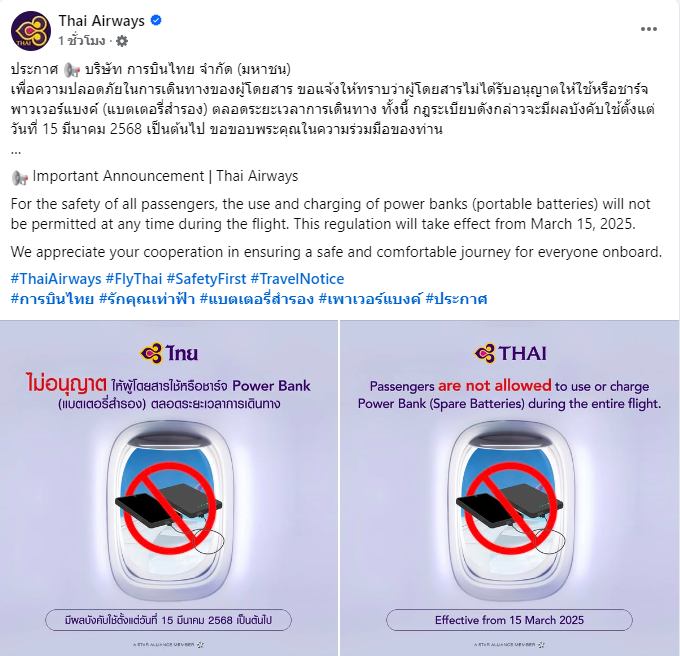
In a statement posted on its official Facebook page, Thai Airways stated, "Thai Airways Implements Power Bank Regulations for Passenger Safety. Following incidents of in-flight fires on international airlines, suspected to be linked to power bank usage, Thai Airways International Public Company Limited has introduced new safety measures.
Effective March 15, 2025, the use of power banks will be prohibited while onboard the aircraft.
These measures are implemented to ensure the highest level of safety for passengers and crew. We kindly ask for your cooperation in adhering to these regulations and apologize for any inconvenience caused."
The airline urged passengers to comply with the new rule and thanked them for their cooperation.
Thailand is considering creating designated zones for alcohol consumption to cater to certain tourists, a move highlighted by the Public Health Minister. With an expected 35 million visitors this year, the government aims to enhance the tourist experience without conflicting with religious principles.
At a recent meeting of the National Alcohol Beverage Policy Committee, members discussed balancing tourism growth with health guidelines. The year has already shown success in tourism revenue, but some visitors are calling for more relaxed alcohol rules.
The minister emphasized creating drinking areas that respect cultural values while supporting tourism. The committee decided to maintain the five key Buddhist holy days as alcohol-free, focusing instead on popular tourist spots for these adjustments.
The Health Minister assured that health concerns are being considered, aligning with ministry guidelines. However, identifying specific locations for alcohol sales will be handled by other departments, reported The Thaiger.
Tourism operators are concerned about foreigners working and renting condos on a daily basis.
Online debate over granting 60-day visa exemptions for tourists has intensified, fuelled by a string of incidents involving condos in Bangkok being illegally rented out on a daily basis, specifically targeting tourists.
Tourism operators suggested adjusting the visa period to match the average length of stay to help allay these concerns.
These operators believe travellers who intend to extend their stay would not be affected, as the country offers several long-stay visa options specifically targeted at "high-quality" visitors.
Q: HOW MANY LONG-STAY VISAS ARE BEING PROMOTED?
There are three types of visas for foreigners seeking long stays in Thailand, each with different requirements and privileges: the Long-Term Resident Visa (LTV), Destination Thailand Visa (DTV) and the Thailand Privilege Card Visa.
In 2022, as the government sought to salve the bruised economy post-pandemic, the Board of Investment (BoI) was assigned to oversee a new 10-year LTV to specifically attract four groups: wealthy visitors, wealthy pensioners, professionals looking to work from Thailand, and highly skilled professionals.
The privileges also extend to an applicant's spouse and children.
According to the BoI, 6,000 people applied for the LTV, led by residents of Europe (2,500), the US (1,080), Japan (610), China (340) and India (280), as of January 2025.
After the initial two years, the requirements were relaxed in January for minimum annual income, work experience and the number of legal dependents, such as family members.
Wealthy citizens still must have at least US$1 million in assets under the applicant's name, but the requirement of minimum annual personal income of $80,000 was removed.
The government said the new priority is how visitors spend within the country given the remaining criteria, requiring a combined investment in government bonds, or direct investment in companies registered in Thailand, or Thai property worth at least $500,000.
For skilled professionals, work experience is no longer necessary, while the targeted jobs now include lecturers at higher education and vocational institutions who have the ability to improve the capabilities of Thai workers.
Likewise, the requirement for five years of work experience for work-from-Thailand professionals is eliminated, and the benchmark for their companies' revenue was lowered from $150 million to $50 million in the last three years, with wholly-owned subsidiaries included.
The quota for family members, which was previously limited to four, is also removed as applicants can bring all legal dependents with them.
Visitors using the LTV can enter Thailand an unlimited amount of times and are permitted to work here, with the personal income tax rate for those with specialised skills reduced to 17%.
Furthermore, the reporting period to the Immigration Bureau was relaxed from every 90 days to once a year.
Q: HOW DOES THE DTV DIFFER?
Amid stagnant domestic consumption, last year the government intensified its efforts to lure foreign revenue by issuing the DTV, meant to draw remote workers, freelancers and digital nomads in particular. This visa type provides more relaxed requirements than the LTV.
While the LTV is regarded as a lucrative tool to attract substantial investments from affluent travellers, the DTV targets those wanting to work while travelling or engaging in cultural activities in Thailand, such as Muay Thai courses or Thai cooking classes, as well as receiving medical treatment.
The duration of stay for the DTV is much shorter than the LTV, with a maximum of 180 days per entry. After spending six months in the kingdom, applicants have the option of extending their stay for another 180 days.
An extension payment of 10,000 baht means the visa is valid for five years and offers multiple entries within that period.
Foreigners applying for this visa must provide evidence of financial resources or a guarantee amounting to at least 500,000 baht, as well as provide evidence of an employment contract or employment certificate outside Thailand.
The Foreign Affairs Ministry is responsible for promoting the DTV and said the country should be able to draw global talent, stimulating income for local people.
However, some operators view this visa as competing with the government-backed Thailand Privilege Card.
The cheapest membership level of the Thailand Privilege Card is dubbed the bronze card and offers a five-year visa, but it requires a fee of 650,000 baht compared with 10,000 baht for the DTV.
The Thailand Privilege Card offers five membership categories, providing long-stay visas valid for 5-15 years. The top tier of membership is available by invitation only and is valid for up to 20 years.
Additional services available to card members include a personal assistant, fast-track and VIP services at airports, concierge services, personal liaisons and points that can be redeemed for lifestyle products such as golf, spa treatments, hotels and travel.
Thailand Privilege Card has nearly 38,000 members, half of them Chinese. The programme is operated by Thailand Privilege Card Co, with the Tourism Authority of Thailand as a major shareholder.
Thailand Privilege Card admitted the DTV would have some impact on its business. The company is in the process of creating new privileges to help maximise the value of membership and differentiate it from other long-stay visas.
Q: WHAT ARE THE ARGUMENTS REGARDING VISA EXEMPTIONS?
Last year the government expanded its visa exemption policy, granting citizens from 93 countries a stay of 60 days, up from 57 nations previously.
International students who have completed a bachelor's degree or higher in Thailand are also eligible for a Non-Immigrant Visa ED (Education), allowing them to extend their stay for up to one year to seek jobs, travel or engage in other activities.
While the tourism sector is expected to benefit from the policy, operators in the sector raised concerns regarding the two-month visa exemption period.
Many industry stakeholders, including the Association of Thai Travel Agents and the Thai Hotels Association (THA), said most tourists typically stay no longer than 30 days.
For Asian visitors, the average stay is usually around one week, while long-haul travellers tend to stay two weeks.
The extension to 60 days could create a loophole, potentially attracting individuals who may attempt to work illegally in Thailand without undergoing proper screening, said the associations.
The THA raised concerns these visitors might bypass hotels -- where guest details are reported to the Immigration Bureau -- and instead opt to rent condos or apartments.
The extension of the visa exemption policy could also lead to unease among local residents, particularly those living in the same properties as tourists, as highlighted in news reports and online debates over the past few weeks.
In response to these concerns, Tourism and Sports Minister Sorawong Thienthong said the ministry plans to hold discussions with tourism operators who raised these issues.
He said if security concerns persist, the period for visa exemptions may be reduced to 30 days.
Fremover vil en forsinkelse skulle vare flere timer længere, end tilfældet er i dag, hvis flyrejsende skal kunne få kompensation. Det mener EU, regeringen, et flertal i Folketinget samt SAS.
I øjeblikket kan passagerer, hvis fly bliver mere end tre timer forsinket, søge om kompensation, hvorefter årsagerne til forsinkelsen skal vurderes, ligesom man kigger på, hvorvidt flyselskabet har taget de nødvendige skridt for at undgå den.
Disse rettigheder er sikret i EU's passagerforordning 261/2004, men i fremtiden skal grænsen for, hvornår flyrejsende kan anmode om kompensation, være to timer længere end i dag. Det skriver nyhedsbureauet Ritzau.
Et såkaldt samlenotat afslører, at EU-Kommissionen, regeringen samt et flertal i Folketinget arbejder for, at forordningen skal justeres således, at der fremover skal gå fem timer i stedet for tre, inden passagererne kan komme i betragtning til kompensation.
Ikke alle er for Den ønskede justering blev i første omgang fremlagt af EU-Kommissionen i 2013, men den er blevet aktualiseret af, at Polen, der i øjeblikket varetager formandsposten for EU, har sat sagen på dagsordenen.
Fredag den 21. februar var transportminister Thomas Danielsen (V) derfor til stede på Europaudvalgets møde med henblik på at indhente et forhandlingsmandat således, at man kan komme videre med ønsket om at justere i passagerrettighederne i EU-regi.
I en optagelse fra mødet fremgår det, at ministeren mener, at det kan være dyrt for flyselskaberne at leve op til reglerne i deres nuværende form.
"Formålet med ændringen af forordningen er at styrke flypassagerens rettigheder. Men samtidig at reglerne skal tage hensyn til omkostningerne for luftfartsselskaberne. Forordningen skal også sikre, at luftfartsselskaberne opererer på ens vilkår på tværs af EU."
Ministeren fik mandatet, da der ikke var et flertal, der stilles sig imod forslaget. Fem partier satte dog hælene i. Det drejer sig om Radikale Venstre, Danmarksdemokraterne, Socialistisk Folkeparti, Enhedslisten samt Dansk Folkeparti.
Får opbakning fra SAS SAS har fremsendt et høringssvar, hvori det skandinaviske flyselskab erklærer sig enige med regeringen, ligesom man også mener, at det beløb, som udbetales i kompensation, bør sænkes fra de nuværende mellem 1.865 og 4.475 kroner, er alle dog ikke enige.
Forbrugerrådet Tænk vurderer nemlig, at de fem timer vil være en forringelse af rettighederne. Ministeren anerkender i en udtalelse til Ritzau, at det godt kan se sådan ud.
"Der er dele af det, som kan ses som en forringelse. Men du kan også som passager se det sådan, at det vigtigste er, at du kommer frem," lyder det fra transportminister Thomas Danielsen over for nyhedsbureauet.
Derudover ønsker Forbrugerrådet Tænk også, at der indføres automatisk kompensation, når den fastsatte tidsgrænse er overskredet, men det blev afvist, hvilket var baggrunden for, at Radikale Venstre var imod tildelingen af en forhandlingsmandat.
Squirting water at Songkran can be viewed as soft power by some devotees.
The Thai premier's latest push to promote the country by stressing its appealing and attractive features may not be enough to outweigh negative news. According to a report in the South China Morning Post, the scandal of scam call centers requires urgent attention before Thailand's reputation can be rescued.
Since Covid, Thai authorities in international marketing have stressed soft power initiatives which have included cultural activities and festivities across the board. Even visa initiatives, such as the Destination Thailand Visa, have been promoted as soft power by permitting cookery or Thai boxing training as reasons for long stay.
According to the Chinese report soft power initiatives in Thai marketing are commendable, but the timing now clashes with widespread perceptions that authorities here have not done enough to tackle the growing problem of scam centers in the region. The Bangkok government has tried many measures including cutting off electricity supplies to Myanmar and Cambodian border regions, but the scam controllers have simply moved base to other localities.
Thai authorities emphasize soft power through cultural initiatives, from festivals to long-stay visa programs like the Destination Thailand Visa, which supports activities such as Thai cookery and Muay Thai training.
There have also been news stories of thousands of kidnapped foreigners forced to work in scam call centers specializing in fake romance projects, drugs trafficking and financial fraud. Such tales may not have dented enthusiasm for Thailand in European countries, but has had a detrimental effect on the Chinese who are now turning to other destinations, especially Japan.
Thai authorities claim they are working hard to eradicate call centers whilst pointing out that soft power promotes the good name of the country whilst creating jobs and expanding economic influence. According to the 2025 Global Soft Power Index, Thailand is now 39th in the ranking order, a huge leap as more and more government marketing initiatives are clothed in soft power clothing.
Tourism tax to be introduced during upcoming high season
The tourism tax of 300 baht a person will come into force for foreign tourists by the end of this year, Tourism and Sports Minister Sorawong Thienthong said on Thursday.
Ved udgangen af det kommende sommertrafikprogram vil Norse Atlantic Airways nedlægge Miami-ruten fra London for i stedet at åbne en ny direkte forbindelse til Bangkok.
Norse Atlantic Airways har foretaget justering af rutekortet med virkning fra slutningen af oktober 2025.
Således har det norske langdistanceflyselskab valgt at tilføje en ny destination fra London-Gatwick. Der er tale om en ny direkte rute til Bangkok med første flyvning søndag 26. oktober. Der vil være op til fire ugentlige afgange.
Herudover vil Norse øge til Bangkok på andre ruter. Flyselskabet vil således skrue op fra to til fire ugentlige flyvninger fra Stockholm-Arlanda til Bangkok fra 5. december, mens der fra 3. december øges fra tre til fire ugentlige afgange fra Oslo til samme asiatiske destination.
Bangkok højt på listen hos passagerer Rejsende med Norse Atlantic Airways får dermed endnu flere muligheder for at flyve til Bangkok, der er en yndet feriedestination for blandt andet skandinaver og briter.
"Vi er glade for at lancere direkte flyvninger mellem London-Gatwick og Bangkok – et topvalg blandt vores rejsende. Denne tilføjelse styrker ikke kun vores eksisterende netværk til Asien, men bygger også på vores ruter fra London-Gatwick til destinationer over Atlanten og Sydafrika," siger Bjørn Tore Larsen, stifter og koncernchef hos Norse Atlantic Airways.
"For os handler det om at tilbyde flere rejsemuligheder til gode priser uden at gå på kompromis med komfort og service for dem, der ønsker at nyde en smuk og varm vintersolskinsdestination."
Lukker Miami-rute fra London Mens der åbnes fra London-Gatwick til Bangkok, lukker Norse Atlantic Airways dog til gengæld ruten fra Gatwick til Miami. Af selskabets bookingsystem fremgår det, at sidste flyvning på ruten bliver 25. oktober 2025 – dagen før Bangkok-åbningen.
I det nuværende vintertrafikprogram flyver Norse fra den britiske hovedstad til Miami, ligesom tilfældet altså vil være hen over sommeren, hvorefter ruten tilsyneladende indstilles.
Foruden Miami tæller antallet af Norse-destinationer fra London-Gatwick i øjeblikket Cape Town, New York, Las Vegas og Orlando.
Norse, der i 2024 fløj med i alt 1.460.245 passagerer, flyver samlet set fra syv europæiske storbyer til destinationer i USA, Sydafrika og Thailand.
Tourists can travel in most countries of south east Asia without compulsory medical cover.
The unfortunate British tourist Pamela Gatehouse is facing medical and repatriation costs of around 80,000 pounds (3 million baht) and much more if a private plane evacuation proves necessary. Her husband says their travel insurance proved worthless because they visited India before Thailand, a technicality which invalidated all claims.
Inevitably, the British embassy was contacted but there is no slush fund to cover non-insured tourists or expats. Indeed, the Foreign, Commonwealth and Development Office in London has in the past pointed out that British taxpayers cannot, and should not, subsidize overseas tragedies no matter how pitiful. Any other policy, of course, would open the floodgates as Brits abroad would queue up in huge numbers to benefit from the unexpected generosity.
Gofundme might help a bit – it has provided over 7,000 pounds (30,000 baht) to date in the Gatehouse case. Traditionally, most of the cash in medical emergencies is volunteered in the first few days, soon drying up. The only other routes to try are compassionate friends and relatives back in the UK or negotiations with the private hospital to arrange a discount. There have been examples where hospital administrators have knocked off 10 percent as the case nears outpatient status. Worth a try.
It is a common myth that travel insurance, which the Gatehouses paid for, covers any and all medical issues abroad. Allianz Travel Insurance points out that "if a situation is not specified in the terms, it's not covered". Claims are regularly rejected because of ambiguous terms such as pre-existing conditions, foreseeable events and risky behaviour. Travel insurance is a competitive, even cut-throat industry, with companies trying to look as cheap as possible whilst maximizing their own escape clauses.
In the past 12 months, Brits in Thai hospitals for serious operations (assuming they had any insurance) have been rejected by their cover companies for not wearing a crash helmet, failing breath or drugs tests, negligence in personal conduct, inadequate vehicle insurance, self-incrimination (overstaying a visa), failure to return regularly to UK, refusal to accept outpatient treatment when offered and a host of other phrases which disguise the horror of individuals' misfortunes.
As regards compulsory medical insurance, Thai authorities are diffident. Cheap package deals for the millions from India, China and Russia would rise in cost if mandatory cover was introduced. A few expat visas such as the 10-year Long Term Residence and work authorizations require it, but well over 90 percent of foreigners can visit without any insurance requirement. Meanwhile, the Thai health authorities regularly grumble about foreigners' unpaid bills.
In early 2024, the Thai government launched a medical support scheme for foreign tourists which was centrally funded with 50 million baht (11 million UK). It was discretionary, complicated and not well publicized after the initial press conferences. There were the usual warnings about carelessness, intention to take part in an illegal activity or risky conduct. Much of the fund was spent on compensation for the relatives of foreigners who died in traffic accidents. The scheme ran until December 2024 but has not been renewed so far as is known.
A recurrent promise of the government has been to introduced a travel tax of 300 baht (7 pounds) on all foreigners arriving in Thailand. The revenue would be used to repair or renovate public monuments visited by tourists with a smaller percentage perhaps paying the costs of foreigners' accidents. Maybe anyway. But there has been no travel surcharge to date and no recent announcements. When it comes to significant medical treatment in any south east Asian country, you are essentially on your own. On the other hand, 99 percent of travellers won't have a problem.
Thailand has long been the key promoter of the "six countries one destination plan" which would allow international tourists entry to all after they entered just one. Often known as Asia's Schengen arrangement, the idea has been kicking around since the 1990s. The idea has been pushed hard by Thailand, especially by the two prime ministers in office since the end of the military-backed rule of general Prayut two years ago.
The current premier, Paetongtarn Shinawatra, stresses that the notion copies the Schengen formula from the European Union. Tourists, including those that need a visa, can enter one country and travel freely throughout the other member nations. In this way, argues the Thai lobby, everyone benefits from free association and income regionally rises steadily as everyone sees the merits of abolishing unwanted immigration bureaucracies at one stroke.
The concealed problem, of course, is that Thailand stands to gain more than the other ASEAN members. She already admits most tourists on a 60 days visa-exempt basis, whereas Cambodia (for example) relies on near-universal visa charges for a substantial part of her income. Vietnam has a complex visa structure which is still evolving. Myanmar doesn't have any tourists at all because of the insurgency and has been replaced by Brunei in recent proposals. A broader problem is that each of the proposed Schengen countries has its own immigration structures which are incompatible and at different stages of digitalization.
The reality is that Thailand is no longer the gateway to south east Asia. Gone or going are the days when Bangkok's airports were the hub to regional tourism because airlines now increasingly offer direct flights to other countries. Emirates fly to Phom Penh (shortly to open the ninth biggest airport in the world) and Laos Aviation offers direct services to South Korea. Malaysia is improving Kuala Lumpur international airport to be amongst the biggest and best in the region. Tourism these days is highly competitive and regional nations are fighting their own corners rather than assuming that neo-Schengen is a win-win for everybody.
Thailand hasn't given up. The Thai prime minister has claimed that both Cambodia and Malaysia have shown positive interest in recent meetings, but spokespersons have walked back these sentiments. In diplomatic-speak phrases like "we welcome further discussions" actually mean "forget it brother". ASEAN has a long history of not intervening in the domestic affairs of member nations, preferring to restrict its policies to free-trade issues. Thai hopes that everyone will hold hands in a broken diplomatic circle is pie in the sky. Better think it out again.
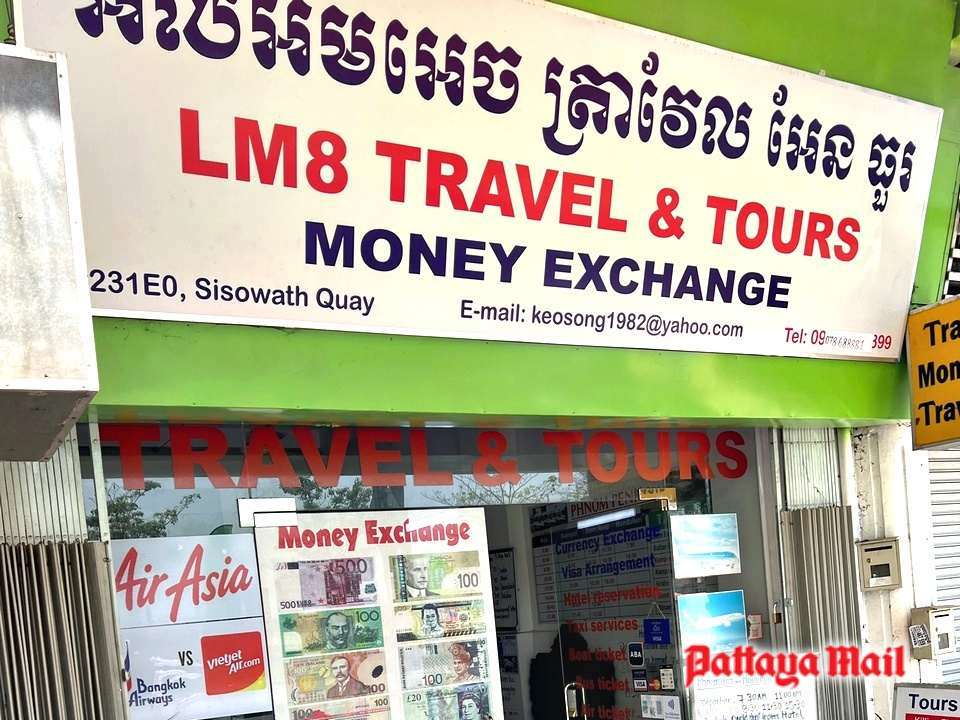
Visa agencies are common in south east Asia, including this long-established one in Phnom Penh.
It's not only Thailand. Visa agents have held a prominent place throughout south east Asia for at least 30 years. Even today it is rare for foreigners in Cambodia seeking extensions of stay, retirement visas or work authorizations to appear in person at the immigration bureau. In cities such as Phnom Penh and Siem Reap there are agencies who handle the entire process and take the paperwork to the immigration bureau for rubber stamping. Indeed, many reports suggest it is actually more expensive for foreigners to deal directly with the official bureau. That's absolutely not true in Thailand.
Please accept cookies to access this content
Here, the first agencies started in earnest during the 1980s and often doubled as foreign exchange bureaux and travel ticket buyers, traces of which remain to this day. Foreign tourists were restricted to 30 days or less with a final seven days at extension. Retirement visas were unknown and work permit regulations largely unenforced. Virtually all longterm expats had to make several visa runs every year, usually to Penang in Malaysia, where the Thai consulate general often had wearisome queues. Cambodia and Laos were closed to travellers in the aftermath of the American regional wars.
During the 1990s Thai immigration procedures became more complex and the golden age for visa agencies took root to assist with the expanding paperwork. Retirement visas and annual extensions began in 1994 and the number of 90 days non-immigrant visas catering for specialist groups grew quickly. The number of immigration officers rose rapidly in Thai cities and tourist areas as international tourism began to boom. Foreigners could (and still can) avoid long queues at immigration by paying third parties to obtain address notification reports, certificates of residence for driving licences and the rest
From the turn of the century many more visa packages have been introduced in quick succession: Elite, O/X 10 year retirement and 3 million baht-in-the-bank visas, followed recently by Long Term Residence, Smart permits and the establishment of the Board of Investment. On the other hand, the regulations have become stricter and more discretionary as is obvious with the recently-introduced Destination Thailand Visa, obtainable at various embassies with their own rules and extensions (if you are lucky) at local immigration. Visa agencies obviously vary in competence according to their ability to deal with the mushrooming of visa options, leading to constant social debate on social media whether to use an agent in the first place or go it alone instead.
The golden era for visa agents in Thailand has now passed. Most tourists currently receive 60 days on arrival, reducing the need for border hops which are almost always arranged by agencies and minibuses. Immigration checks have become much heavier thanks partly to the technology and biometric information available at entry points and offices nationwide. Some visas, including those based on volunteer work or education, are out of favour because of abuse during the covid pandemic and the false documentation then provided by some so-called charities and schools. Working visas are now complex bureaucratic matters and beyond the competence of some, usually small, agencies which have already closed. All in all, there is a reduced client base as more and more foreigners work online to solve their own immigration issues.
Please accept cookies to access this content
So the future of visa agencies will become more specialized as they will need to be both knowledgeable and skillful about complex visa rules. That suggests they will have to hire more expertise with specialist training. As Thailand moves towards a fully online and streamlined visa system, agencies which survive will also need to diversify into travel insurance brokerage, airport pickup, transfer services and home delivery of passports. In other words, agencies will need to cater for those wanting a luxury service in both expertise and convenience.
In February 2025, visa agents were hit by the news that opening bank accounts or servicing existing ones were banned because of the government crackdown on largely unrelated scams and illegal call centers. Perhaps this restriction will prove to be temporary, but others are waiting in line. How will visa agents be affected by the increasing use of airport electronic gates in travel which mean that neither exit nor entry stamps appear in a passport? What happens to them when, in 10 years time, even traditional passports are being phased out altogether in favour of digital monitoring using contactless smart card technology. Visa agents will surely join the dinosaurs if they can't access a traveller's vital information.